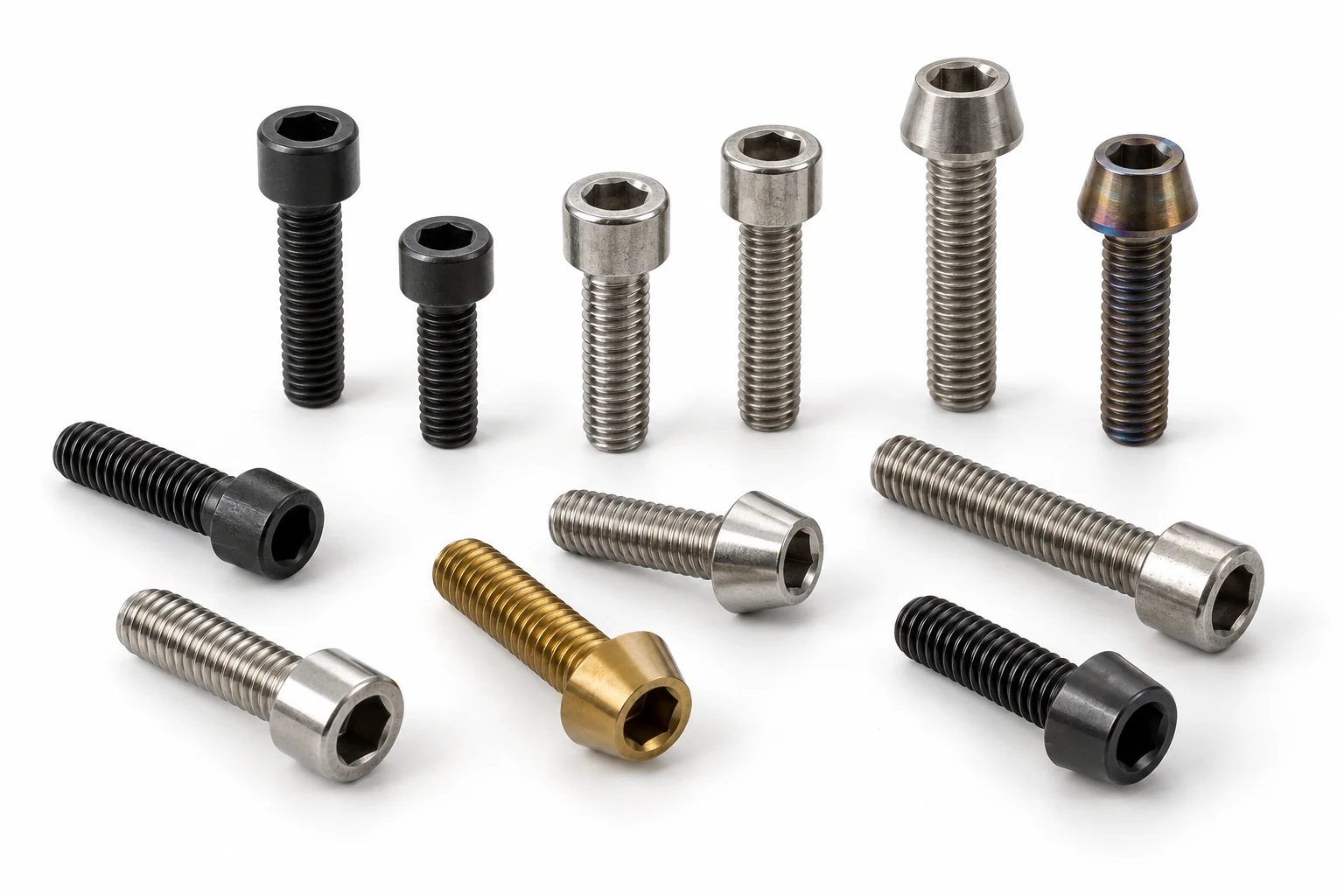
Bicycle Stem and Headset Bolts (Trade series (bicycle stem bolts)) are specified where the joint requires clamping a stem faceplate or steerer with the specified thread engagement and torque. The sections below cover the typical end-uses by industry, the size and material decisions for each, assembly practice, and the applications this fastener type is not suited to. Stocked across roughly M5 to M6, they cover light-duty and instrument-scale work.
Typical Applications for Bicycle Stem and Headset Bolts
The most common settings where these are specified:
- Bicycle assembly: M5 stem bolts clamp the faceplate and steerer hardware.
- Bike fitting: Length and head style are selected with the stem design.
- Mountain-bike service: M6 options cover larger clamp and preload hardware.
- Repair shops: Torque is taken from the stem or headset maker, not a generic bolt chart.
How to Specify Bicycle Stem and Headset Bolts for Your Application
- Size: Match the nominal size to the mating thread or hole. This product spans M5–M6; check the full table below for the exact dimensions of each size.
- Strength class: Choose the property class (e.g. 8.8, 10.9, 12.9 or A2/A4 stainless) for the load and environment, and tighten to the matching torque so the joint relies on preload, not friction.
- Environment: For damp, coastal or chemical exposure prefer A4/316 stainless or a suitable coating; indoors, plated steel or A2 is usually sufficient.
- Standard: This product is supplied to Trade series (bicycle stem bolts). Quoting the standard on your order guarantees interchangeable dimensions between suppliers.
Installation & Assembly Practice
- Tighten to the torque for the size and property class with a calibrated wrench — the joint is held by preload, not by the thread friction alone.
- Ensure at least one full thread projects beyond the nut after tightening, and never re-use a bolt that has been tightened into yield.
- Under slotted or oversized holes, fit a hardened washer so the preload does not relax into the hole edge.
Common Selection Mistakes with Bicycle Stem and Headset Bolts
- Specifying class 12.9 "to be safe" in a corrosive environment — high classes are more sensitive to hydrogen embrittlement and stress corrosion; 8.8 hot-dip galvanized often outlasts them outdoors.
- Choosing a length that puts the shear plane through the threaded portion when a plain shank (partially threaded bolt) was available.
- Mixing stainless bolts with plated-steel nuts: the joint loses its corrosion logic and can gall or seize.
Where Bicycle Stem and Headset Bolts Are Not the Right Choice
Not for permanent joints that will never be opened (a rivet or weld is cheaper), and not where the head must sit flush — use a countersunk screw instead.