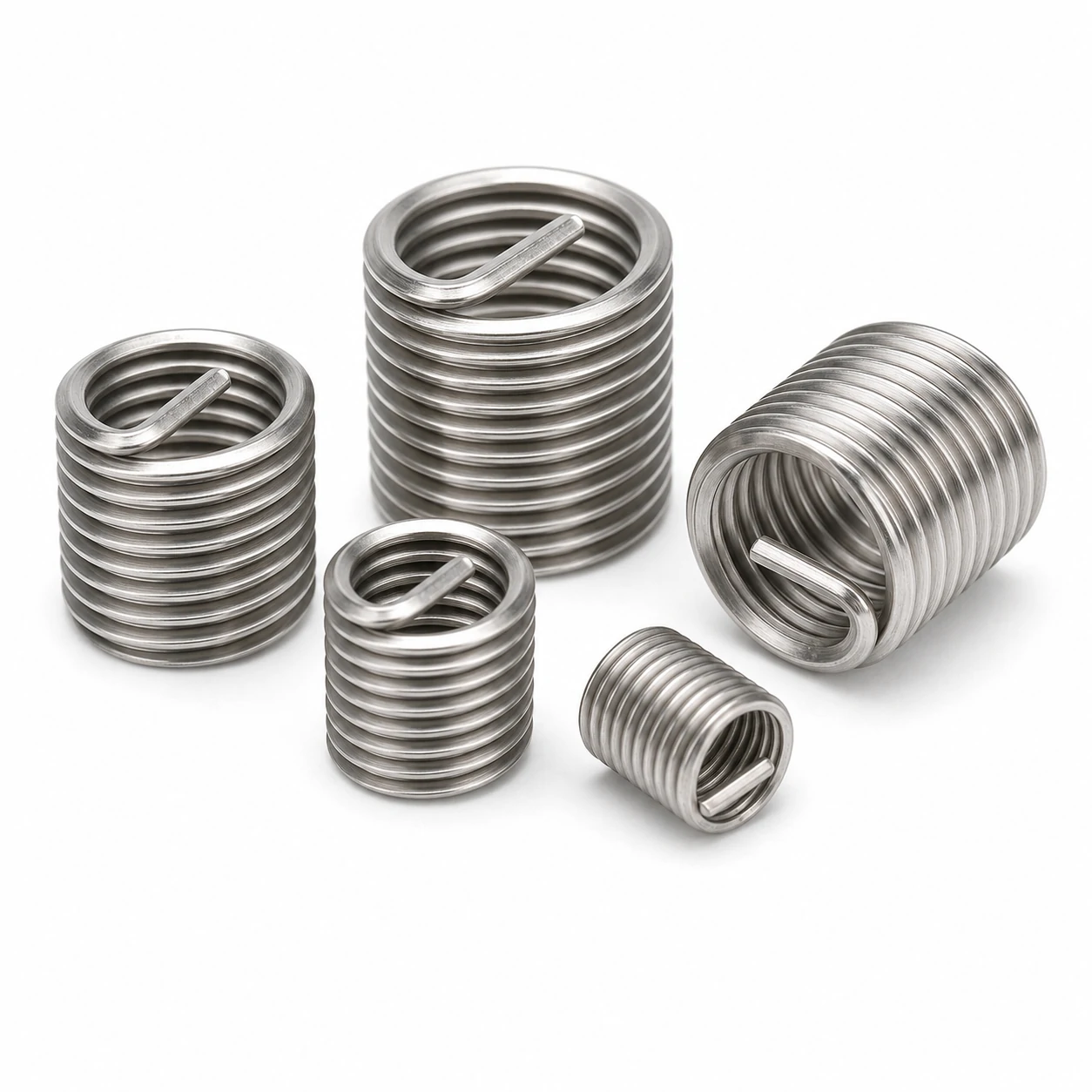
Helical Thread Inserts (DIN 8140) are specified where the joint requires reinforcing or repairing threads in aluminum, magnesium and plastics. The sections below cover the typical end-uses by industry, the size and material decisions for each, assembly practice, and the applications this fastener type is not suited to. Stocked across roughly M3 to M20, they cover general to heavy-duty work.
Typical Applications for Helical Thread Inserts
The most common settings where these are specified:
- Aerospace & motorsport: lightweight alloy parts needing full-strength steel threads.
- Field repair: recovering a stripped thread without scrapping the part.
- General machine building: fastening covers, brackets, motors and sub-assemblies on production equipment.
- Maintenance & repair (MRO): a stocked size for servicing existing plant where the original fastener spec must be matched.
- Fabrication & metalwork: bench and on-site assembly of steel frames, enclosures and weldments.
How to Specify Helical Thread Inserts for Your Application
- Size: Match the nominal size to the mating thread or hole. This product spans M3–M20; check the full table below for the exact dimensions of each size.
- Tap & length: Drill and tap to the specified STI size, and pick insert length (commonly 1.5×D or 2×D) for the load and parent material strength.
- Environment: For damp, coastal or chemical exposure prefer A4/316 stainless or a suitable coating; indoors, plated steel or A2 is usually sufficient.
- Standard: This product is supplied to DIN 8140. Quoting the standard on your order guarantees interchangeable dimensions between suppliers.
Installation & Assembly Practice
- Drill and tap with the specified STI tap — a standard tap will not produce the correct thread for the insert.
- Install to the specified depth (typically 0.25–0.5 mm below the surface) and remove the tang where the design requires it.
Common Selection Mistakes with Helical Thread Inserts
- Fitting an insert into strong steel that already holds a thread — added cost for no gain.
- Skipping the tang removal, which then blocks the mating screw.
Where Helical Thread Inserts Are Not the Right Choice
Not a fix for a hole that is already oversized beyond the STI tap range, and not needed in steel that already holds a thread well.