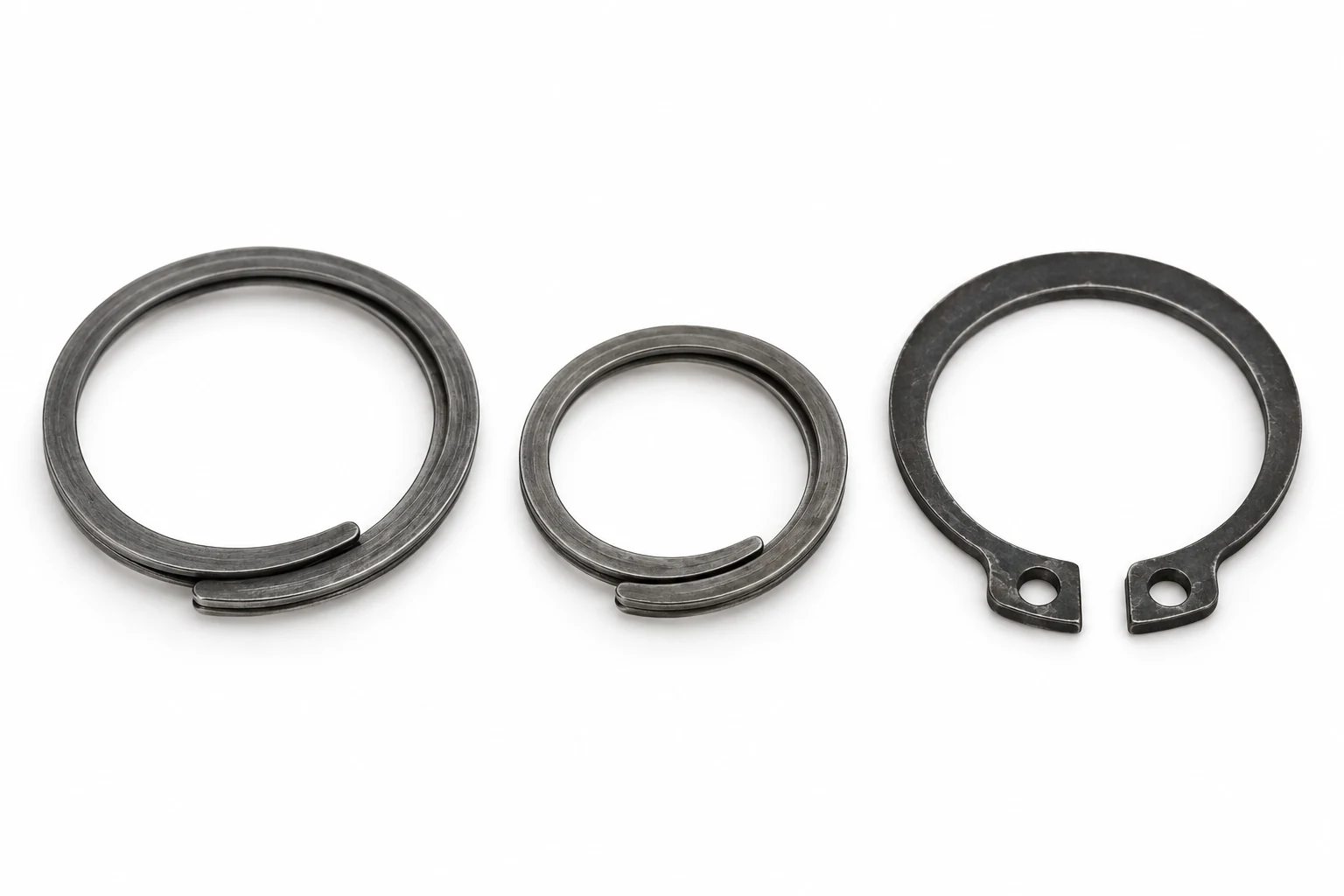
Spiral Retaining Rings are used primarily for axial retention on a shaft or in a bore where the ring must bear on the full circumference and nothing may protrude above the groove. This page lists the industries and assemblies where they are specified, the selection criteria that matter for each application, installation practice, and the cases where a different fastener type is the correct choice. Parts are supplied to Trade series (spiral wound retaining ring). Stocked across roughly 10 mm to 50 mm, they cover general to heavy-duty work.
Typical Applications for Spiral Retaining Rings
The most common settings where these are specified:
- Fabrication & metalwork: bench and on-site assembly of steel frames, enclosures and weldments.
- Shafts & gearboxes: retaining bearings, gears and pulleys against axial movement.
- Hydraulic & pneumatic: holding pistons and seals in bores.
- Automotive driveline: axial location on rotating shafts.
- General machine building: fastening covers, brackets, motors and sub-assemblies on production equipment.
How to Specify Spiral Retaining Rings for Your Application
- Size: Select on nominal diameter, then on the hole tolerance and fit class — the fit, not the diameter alone, determines whether the part locates or slips. This product spans 10 mm–50 mm; check the full table below for the exact dimensions of each size.
- Groove fit: Specify to the shaft or bore groove diameter; the ring must seat fully in the groove to carry the thrust load.
- Environment: For damp, coastal or chemical exposure prefer A4/316 stainless or a suitable coating; indoors, plated steel or A2 is usually sufficient.
- Standard: This product is supplied to Trade series (spiral wound retaining ring). Quoting the standard on your order guarantees interchangeable dimensions between suppliers.
Installation & Assembly Practice
- Use the correct circlip pliers for the ring size; over-spreading a ring permanently reduces its retention.
- Check the ring is fully seated in the groove around its whole circumference before loading the assembly.
Common Selection Mistakes with Spiral Retaining Rings
- Machining the groove to the shaft tolerance instead of the groove dimensions in the ring standard.
- Loading a standard ring axially beyond the groove rating instead of moving to a heavy-duty section ring.
Where Spiral Retaining Rings Are Not the Right Choice
Not for heavy axial thrust beyond the groove rating, and not where the groove cannot be machined to spec.