
Key Takeaways
- Concrete fasteners must match the load type—tension, shear, or combined—and the base material's compressive strength.
- Proper installation, including drilling the correct hole diameter and depth and thoroughly cleaning the hole, is critical to achieving published load values.
- Expansion anchors, concrete screws, and adhesive anchors each have distinct installation methods and load characteristics that influence selection.
- Always refer to manufacturer load tables and apply appropriate safety factors; on-site pull testing is recommended for critical applications.
- Consistent fastener specification across a project reduces installation errors and ensures compliance with engineering requirements.
Concrete Fasteners: Overview for Industrial Procurement
How do you ensure reliable load transfer into concrete when specifying fasteners for a structural or heavy-duty application? Concrete fasteners—including mechanical expansion anchors, screw anchors, and adhesive systems—provide engineered solutions for attaching steel, timber, and equipment to concrete, brick, or block. Designed for tensile and shear loads, these fasteners are critical in commercial construction, infrastructure maintenance, and industrial fabrication. A well-specified anchor can mean the difference between a permanent, vibration-resistant connection and a costly field failure. B2B buyers typically seek anchors that comply with international design codes (e.g., ACI 318, ETAG), offer consistent load capacity, and integrate smoothly into supply chains with reliable lot traceability.
Specification Overview
The following attributes define a concrete fastener’s performance and compatibility. Specifications vary by anchor type and manufacturing standard, but a typical product line includes these key parameters:
- Anchor Diameters: Nominal body diameters from 1/4″ to 1″ (M6 to M24) in imperial or metric series. Thread sizes for stud-type anchors follow UNC, UNF, or metric coarse/fine standards.
- Embedment Depth: Minimum and maximum depths specified per anchor model to achieve rated loads in cracked or uncracked concrete.
- Lengths: Overall lengths ranging from 1-3/4″ to 12″ (45 mm to 300 mm), with custom lengths available for high-volume orders.
- Head/Drive Types: Hex heads, flat countersunk, hex socket, or acorn heads. Some female-type anchors accept standard hex bolts or threaded rod.
- Material Grades: Carbon steel (grade 4.6, 4.8, 5.8, 8.8), stainless steel (A2 / 304, A4 / 316), and zinc alloy bodies. Property classes for bolts used with anchors follow ISO 898-1 or SAE J429.
- Surface Finish: Zinc electroplating, hot-dip galvanizing, mechanical galvanizing, or stainless steel passivation to combat corrosion in exposed environments.
- Approvals: Manufacturers often offer anchors tested to ACI 355.2, ETAG 001, or equivalent, with published load data for distinct concrete strengths.
Product Variants and Differentiation
Choosing the correct concrete fastener means matching the anchor’s working principle to the base material, load type, and installation conditions. Common variants within a product line include:
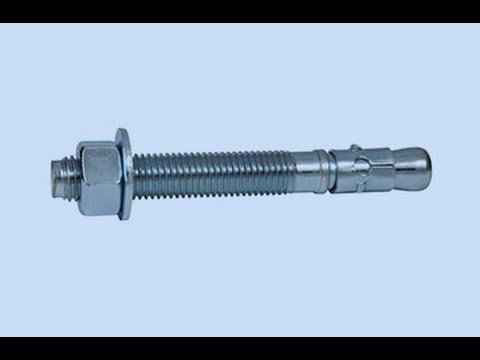
- Wedge Anchors: A pre-assembled expansion clip that wedges into the hole as the nut is torqued. Ideal for heavy static loads, including column bases and machinery. Available in carbon and stainless steel.
- Sleeve Anchors: A slotted sleeve expands along the entire embedment length, providing strong radial grip. They suit medium loads in concrete, brick, or block, and allow some adjustability during installation.
- Drop-In Anchors: A female-threaded shell set into a drilled hole with a setting tool. Accept a threaded rod or bolt. Common for overhead applications or where the fixture must be removed periodically.
- Concrete Screws (Screw Anchors): Hardened threads cut directly into concrete, requiring no expansion. They offer high shear capacity and immediate load handling. Non-expansion nature suits close edge distances.
- Adhesive Anchors: A two-component epoxy or polyester resin injected into a cleaned hole, securing a threaded rod. These anchors provide maximum bond strength in cracked or uncracked concrete and accommodate extreme embedment depths.
- Hammer-Set Anchors / Drive Pins: A pre-assembled pin and barrel driven into a pre-drilled hole. Used for light to medium loads in attaching wood or metal to concrete. Quick installation with a hammer.
Differing features include full-thread vs. partial-thread studs, coarse vs. fine thread, and coatings like zinc-nickel or PTFE for high-corrosion environments. Some anchors are removable; others are permanent once set.
Typical Applications and Buyer Scenarios
B2B buyers source concrete fasteners for a wide range of load cases and environments:
- Structural Steel Connections: Wedge anchors or adhesive anchors for column base plates, moment-resisting frames. Seismic qualification (e.g., ICC-ES AC193) may apply.
- Heavy Equipment Mounting: Generators, compressors, and CNC machines demand vibration-resistant anchors with high pull-out strength, often stainless steel grade A4 for washdown areas.
- MRO and Facility Management: Through-bolts and sleeve anchors for pipe supports, ductwork, and cable trays, typically in overhead or vertical orientations.
- Infrastructure and Civil Works: Bridge bearing pads, barrier rails, and sign structures frequently use adhesive anchors or cast-in-place alternatives, working with rebar-intensive concrete.
- Racking and Shelving: Concrete screw anchors are popular for rapid installation and high shear performance in warehouse rack footplates.
Load types include static tension and shear, combined loads, and dynamic or shock loading. Edge distance and spacing coefficients influence anchor selection, especially in thin slabs or near corners.
Customization and Branding Options
For supply chain partners and OEMs, a range of customization options ensures anchors align with specific project needs and brand standards:
- Special Dimensions: Non-standard lengths, larger diameters, or extended thread lengths for fixture clearance. Custom headed studs or bent anchors can be manufactured to drawing.
- Protective Coatings: Beyond standard zinc finishes, hot-dip galvanized, zinc-aluminum flake, Xylan, or PTFE coatings increase corrosion resistance or reduce friction during torqueing.
- Head Marking and Identification: Laser engraving or stamping of lot numbers, strength grades, or company logos on anchor heads or washers for traceability.
- Packaging and Labeling: Private label packaging, pallet consolidation, mixed-size boxes, and customized barcodes for distribution. Peel-and-stick tags with installation torque values can be included.
- Testing and Certificates: Optional mill test reports, ISO 9001 lot traceability, or job-site pull-test reports (third-party) for critical installations.
Ordering Parameters
When preparing a purchase order or RFQ, consider the following parameters which influence MOQ, lead time, and packaging format:
- Minimum Order Quantity (MOQ): Varies by anchor type, diameter, and finish; standard stock anchors may have low per-size MOQs, while custom finishes or sizes typically require full production batches. Project volumes are negotiated case by case.
- Lead Time: Stock products: 1–3 weeks from factory. Custom manufacturing: 4–8 weeks, depending on complexity and coating. Air freight options can reduce transit time for urgent needs.
- Packaging: Bulk cartons, kegs, or pails for high-volume use; smaller job packs or pre-assembled kits (anchor + bolt + washer) for ease of distribution. Export palletizing with weight certificates available.
- Shipping: Standard sea freight FOB or CIF terms; consolidated containers possible across product families to optimize logistics.
Request a Tailored Quote
To receive a quote that matches your load conditions, installation environment, and volume requirements, provide as much detail as possible: base material (concrete compressive strength, cracking status), fixture thickness, anchor diameter preference, finish requirements, and estimated annual usage. Send your specifications, parts list, or construction drawings, and our engineering support team will recommend anchor solutions and return a competitive proposal.
Load Considerations for Concrete Fasteners
The safe use of concrete fasteners depends on matching anchor type and size to the applied load — whether static, dynamic, or seismic — and the condition of the base material. Procurement teams should evaluate tension (pull-out) and shear loads individually, as allowable capacities differ for each. Published load tables assume normal-weight concrete with a minimum compressive strength (e.g., 2,000–3,000 psi for many expansion anchors) and correct embedment depth; weaker or cracked concrete significantly reduces capacity. For critical connections, a safety factor of at least 4:1 is typical, though project-specific codes such as ACI 318 may govern. Edge distance and anchor spacing also affect performance: spacing closer than 10 diameters can reduce group capacity, while edges less than 5 diameters risk concrete breakout.
Key Load Factors
- Tension vs. shear: some anchors, like wedge types, excel in tension, while sleeve anchors and through-bolts handle moderate shear.
- Embedment depth: deeper embedment increases load capacity, but must respect base material thickness and reinforcement.
- Base material: solid concrete allows highest loads; hollow block or brick requires specialty anchors or screen tubes.
- Cyclic and shock loads: adhesive anchors and undercut systems provide more predictable behavior than expansion anchors under dynamic loading.
Installation Methods for Concrete Fasteners
Installation precision directly impacts performance. All concrete fasteners require pre-drilling with a hammer drill and carbide-tipped masonry bit sized to the manufacturer’s specified hole diameter — typically 1/16″ to 1/8″ larger than the anchor diameter. Hole depth must be controlled with a depth stop; too shallow prevents full embedment, too deep may compromise holding power. After drilling, thoroughly clean the hole of dust and debris using a blow-out bulb, wire brush, or compressed air, as contaminants can reduce pull-out strength by more than 50%. For wedge anchors, insert the anchor, assemble the nut and washer, then tighten to the recommended torque using a calibrated torque wrench. Concrete screws are driven with an impact driver until the head is flush; overtightening can strip threads. Drop-in anchors require a setting tool and hammer to expand the internal sleeve before inserting the threaded rod or bolt. Adhesive anchors demand thorough hole cleaning and careful injection of epoxy or polyester resin, followed by insertion of the threaded stud and a specified cure time. Always verify that the fixture aligns with the anchor hole to avoid side loading. After installation, a torque check and, for critical applications, on-site pull testing, confirm anchor performance.
Consolidated Overview of Concrete Fasteners
| Fastener Type | Load Type | Installation Method | Key Considerations |
|---|---|---|---|
| Wedge Anchor | High tension, moderate shear | Drill, clean, drive anchor, tighten nut to torque | Tension-only; requires solid concrete; not for brick/block |
| Sleeve Anchor | Moderate tension and shear | Drill, clean, insert anchor, tighten nut | Versatile for concrete, brick, block; medium loads |
| Concrete Screw | Light to medium tension and shear | Drill, clean, drive screw with impact driver | Removable; correct hole diameter critical; limited depth |
| Drop‑in Anchor | Flush‑mount, high tension | Drill, clean, insert anchor, set with tool and hammer | For flush applications; requires setting tool; permanent |
| Adhesive Anchor | Highest tension and shear, dynamic loads | Drill, thoroughly clean, inject adhesive, insert rod, cure | Requires cure time; temperature‑sensitive; load tables by resin type |
When specifying concrete fasteners, consider the assembly as a system including the anchor, nut, and washer. For heavy hex nuts and flat washers that distribute load, or to reference correct tightening torque values, consult our technical resources. For applications requiring threaded rods or studs, our studs & threaded rods page provides additional specifications.
Request a Tailored Quote: For project‑specific load data, embedment depth requirements, or installation advice, send your structural drawings and load cases. Our technical support team will recommend anchor systems and return a competitive proposal for your volume requirements.
Frequently Asked Questions
What are the different types of concrete fasteners?
The main types are mechanical expansion anchors (wedge, sleeve, drop-in), concrete screws (such as Tapcon), and adhesive anchors (epoxy or polyester resin systems). Each type transfers load to the base material differently: expansion anchors via friction, screws via thread cutting, and adhesives via bonding.
How much weight can a concrete screw anchor hold?
The load capacity depends on the screw diameter, embedment depth, and concrete strength. Manufacturers provide load tables showing allowable tension and shear values for specific conditions; always apply a safety factor as required by local codes.
Do you hammer in concrete anchors?
Some anchors, like drop-in anchors, require a setting tool and hammer to expand the anchor inside the hole. Wedge anchors are typically tightened with a wrench, not hammered. Concrete screws are driven with a screw gun. The installation method varies by anchor type.
Are tapcon or wedge anchors better?
Wedge anchors generally provide higher load capacity and are preferred for heavy structural applications in solid concrete. Concrete screws (like Tapcons) offer easier installation and removability, making them suitable for lighter loads and non-structural fixtures. The choice depends on the specific load, base material, and project requirements.
What is the minimum embedment depth for concrete anchors?
Minimum embedment depth varies by anchor type and diameter, and is specified by the manufacturer. It typically ranges from about 1.5 to 2.5 times the anchor diameter. Using the correct embedment is crucial for achieving the rated capacity and preventing premature failure.