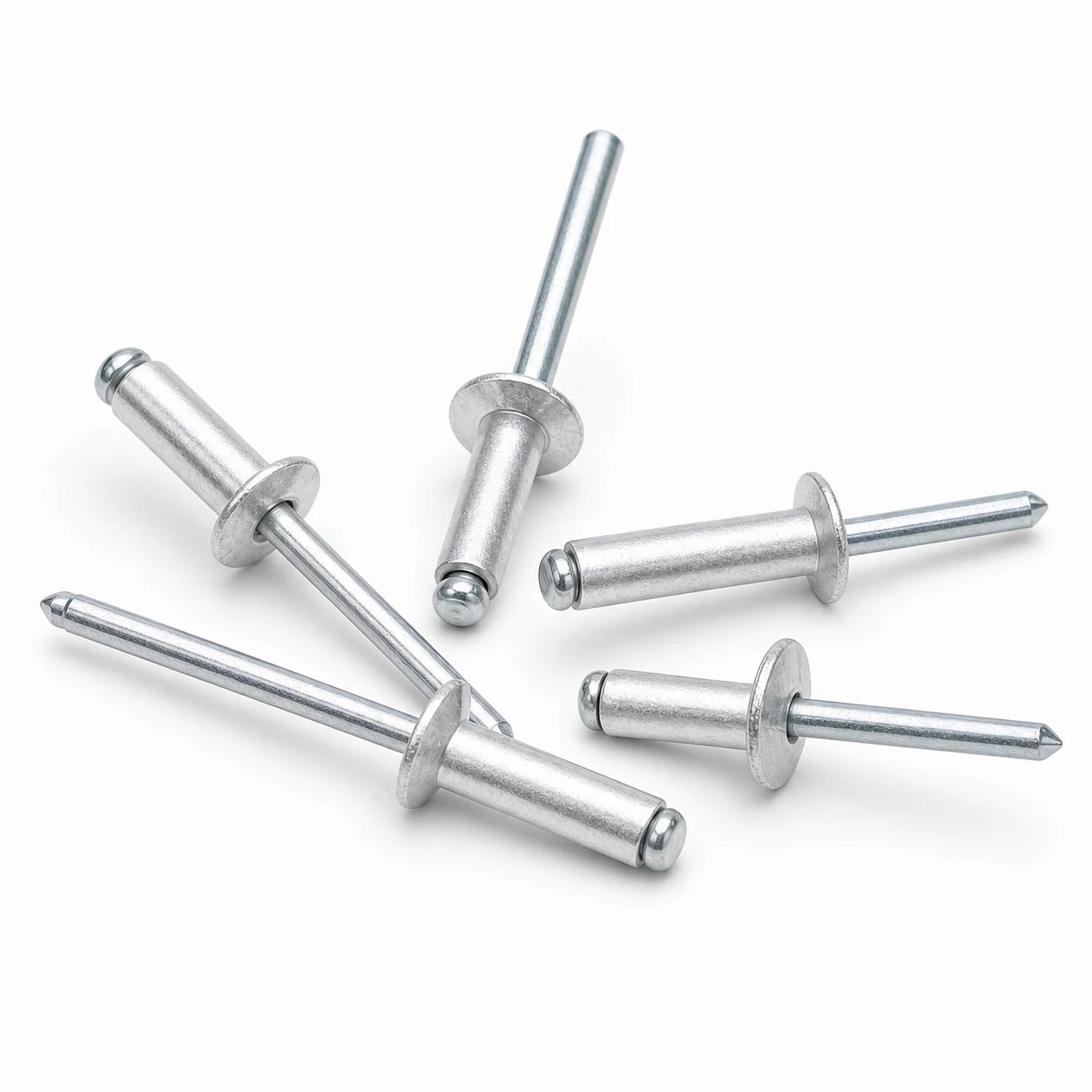
Blind (Pop) Rivets manufactured in A2 Stainless Steel (ISO 3506 group A2 (304 / 1.4301), commonly supplied A2-70) are dimensioned to ISO 15977 / DIN 7337. The sections below give the mechanical and physical properties of the grade, its behavior in corrosive and elevated-temperature service, and the full size table.
Why Choose A2 Stainless Steel for Blind (Pop) Rivets
The most common stainless group for indoor and general outdoor fasteners. For blind (pop) rivets, this matters when good general corrosion resistance is the primary requirement.
Mechanical & Physical Properties
| Grade designation | ISO 3506 group A2 (304 / 1.4301), commonly supplied A2-70 |
|---|---|
| Magnetic response | Largely non-magnetic |
| Service temperature | approx. -200 °C to +400 °C, subject to the property class and the joint |
| Corrosion characteristic | Good general corrosion resistance |
Corrosion Behavior in Service
A2 (304) gives excellent atmospheric and most-water corrosion resistance and is the most common stainless for Blind (Pop) Rivets in indoor and general outdoor service. In chloride-bearing environments (marine air, road salt, swimming pools) consider stepping up to A4 (316).
Comparable Grades
For Blind (Pop) Rivets, the alternative stainless grade is A4 (316). A2 (304) suits general indoor and outdoor service; A4 (316) adds molybdenum for marine and chloride environments. Where higher strength matters more than corrosion, switch to plated alloy-steel class 8.8 or 10.9.
Using Stainless Fasteners in Aluminum
Stainless steel is more noble than aluminum, so in the presence of an electrolyte — rain, condensation, salt spray — the aluminum becomes the anode and corrodes at the joint. The effect is driven by the area ratio: a small stainless fastener in a large aluminum section is normally acceptable, while a large stainless fastener in thin aluminum is not. Where the joint is wet, isolate the two metals with a coated or nylon washer and a sealant, or specify an aluminum or coated fastener instead.
Sizes of Blind (Pop) Rivets Available in A2 Stainless Steel
| Nominal diameter (mm) | Grip range (mm) | Cap diameter dk (mm) | Free length (mm) | Body / mandrel material | Reference standard | Notes |
|---|---|---|---|---|---|---|
| 2.4 | 0.5~3.0 | 5.0 | 7.0 | Aluminum / aluminum | ISO 15977/15978 | Use drill of diameter +0.1 to 0.2 mm |
| 2.4 | 0.5~3.0 | 5.0 | 7.0 | Aluminum / steel | ISO 15977/15978 | Use drill of diameter +0.1 to 0.2 mm |
| 3.0 | 0.5~4.0 | 6.0 | 8.0 | Aluminum / aluminum | ISO 15977/15978 | Use drill of diameter +0.1 to 0.2 mm |
| 3.0 | 0.5~4.0 | 6.0 | 8.0 | Aluminum / steel | ISO 15977/15978 | Use drill of diameter +0.1 to 0.2 mm |
| 3.2 | 0.5~6.0 | 6.4 | 10.0 | Aluminum / aluminum | ISO 15977/15978 | Use drill of diameter +0.1 to 0.2 mm |
| 3.2 | 0.5~6.0 | 6.4 | 10.0 | Stainless / stainless | ISO 15977/15978 | Use drill of diameter +0.1 to 0.2 mm |
| 4.0 | 0.5~6.0 | 8.0 | 12.0 | Aluminum / aluminum | ISO 15977/15978 | Use drill of diameter +0.1 to 0.2 mm |
| 4.0 | 0.5~6.0 | 8.0 | 12.0 | Aluminum / steel | ISO 15977/15978 | Use drill of diameter +0.1 to 0.2 mm |
| 4.0 | 0.5~6.0 | 8.0 | 12.0 | Stainless / stainless | ISO 15977/15978 | Use drill of diameter +0.1 to 0.2 mm |
| 4.8 | 0.5~8.0 | 9.5 | 14.0 | Aluminum / aluminum | ISO 15977/15978 | Use drill of diameter +0.1 to 0.2 mm |
| 4.8 | 0.5~8.0 | 9.5 | 14.0 | Aluminum / steel | ISO 15977/15978 | Use drill of diameter +0.1 to 0.2 mm |
| 4.8 | 0.5~8.0 | 9.5 | 14.0 | Stainless / stainless | ISO 15977/15978 | Use drill of diameter +0.1 to 0.2 mm |
| 5.0 | 1.0~10.0 | 10.0 | 16.0 | Aluminum / aluminum | ISO 15977/15978 | Use drill of diameter +0.1 to 0.2 mm |
| 6.0 | 1.5~12.0 | 12.0 | 18.0 | Aluminum / aluminum | ISO 15977/15978 | Use drill of diameter +0.1 to 0.2 mm |
| 6.0 | 1.5~12.0 | 12.0 | 18.0 | Aluminum / steel | ISO 15977/15978 | Use drill of diameter +0.1 to 0.2 mm |