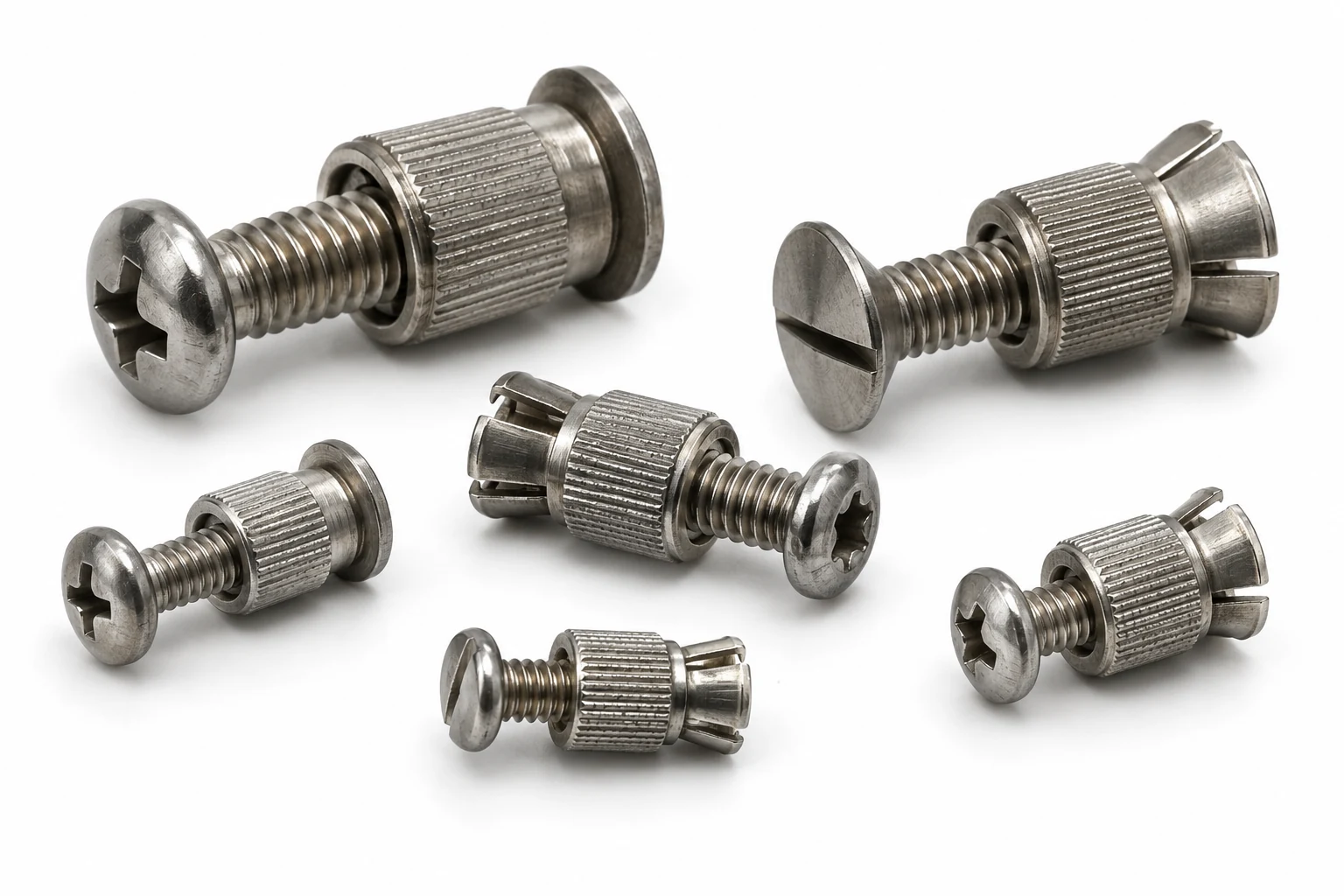
A4 Stainless Steel Press-In and Flare-In Captive Screws combine the dimensional form of Trade series (panel captive screws) with the material properties of grade ISO 3506 group A4 (316 / 1.4401), commonly supplied A4-80: superior, including marine and chloride environments, largely non-magnetic, service range approx. -200 °C to +400 °C, subject to the property class and the joint. This page summarizes the grade data, its corrosion behavior in service, the comparable grades, and the sizes supplied.
Why Choose A4 Stainless Steel for Press-In and Flare-In Captive Screws
Specified for marine, coastal and chemical applications. For press-in and flare-in captive screws, this matters when superior, including marine and chloride environments is the primary requirement.
Mechanical & Physical Properties
| Grade designation | ISO 3506 group A4 (316 / 1.4401), commonly supplied A4-80 |
|---|---|
| Magnetic response | Largely non-magnetic |
| Service temperature | approx. -200 °C to +400 °C, subject to the property class and the joint |
| Corrosion characteristic | Superior, including marine and chloride environments |
Galvanic & Galling Considerations
Two important notes for stainless press-in and flare-in captive screws: (1) stainless can gall on stainless threads under load — use a thread lubricant or anti-galling compound, especially for M6 and below; (2) when joined to aluminum or galvanized steel, stainless can drive galvanic corrosion of the less-noble metal in wet service — isolate with a coating or sleeve where appropriate.
Comparable Grades
For Press-In and Flare-In Captive Screws, the alternative stainless grade is A2 (304). The practical dividing line is chlorides: A2 (304) is fine until salt is involved, and A4 (316) exists for the cases where it is — coastal, marine and road-salt service. Neither reaches the strength of a plated class 8.8 or 10.9 fastener.
Using Stainless Fasteners in Aluminum
The galvanic couple here runs the wrong way: aluminum is the less noble metal, so it corrodes and the fastener does not. What governs the rate is the ratio of areas — a large anode and a small cathode is a tolerable combination, the reverse concentrates the attack into thin material around the hole. An isolating washer plus sealant breaks the circuit; where that is impractical, match the fastener to the substrate.
Sizes of Press-In and Flare-In Captive Screws Available in A4 Stainless Steel
| Thread options | Press-in panel hole (mm) | Press-in ferrule (mm) | Flare-in ferrule (mm) | Drive options | Material options |
|---|---|---|---|---|---|
| M3 or 4-40 | 3.2 | 5.6 | 4.8 | Phillips/slot or Torx/slot | steel / stainless / aluminum |
| M3.5 or 6-32 | 3.7 | 6.4 | 5.4 | Phillips/slot or Torx/slot | steel / stainless / aluminum |
| M4 or 8-32 | 4.4 | 8.0 | 6.8 | Phillips/slot or Torx/slot | steel / stainless / aluminum |
| M5 or 10-32 | 5.2 | 8.0 | 6.8 | Phillips/slot or Torx/slot | steel / stainless / aluminum |
| M6 or 1/4-20 | 6.2 | 9.5 | 8.2 | Phillips/slot or Torx/slot | steel / stainless / aluminum |