
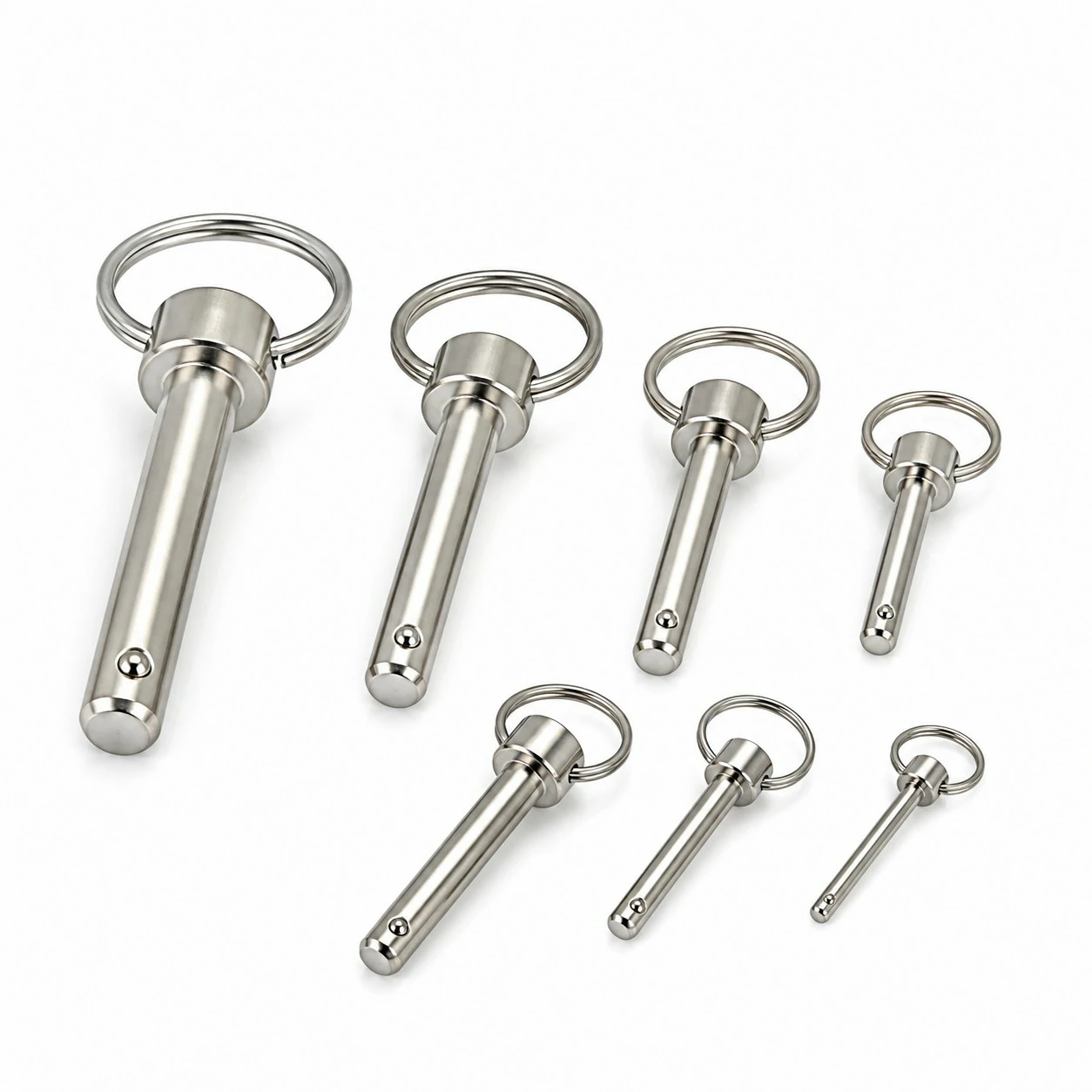
A4 Stainless Steel Quick-Release Pins, Push-Button combine the dimensional form of Trade series (push-button quick-release pin) with the material properties of grade ISO 3506 group A4 (316 / 1.4401), commonly supplied A4-80: superior, including marine and chloride environments, largely non-magnetic, service range approx. -200 °C to +400 °C, subject to the property class and the joint. This page summarizes the grade data, its corrosion behavior in service, the comparable grades, and the sizes supplied.
Why Choose A4 Stainless Steel for Quick-Release Pins, Push-Button
Specified for marine, coastal and chemical applications. For quick-release pins, push-button, this matters when superior, including marine and chloride environments is the primary requirement.
Mechanical & Physical Properties
| Grade designation | ISO 3506 group A4 (316 / 1.4401), commonly supplied A4-80 |
|---|---|
| Magnetic response | Largely non-magnetic |
| Service temperature | approx. -200 °C to +400 °C, subject to the property class and the joint |
| Corrosion characteristic | Superior, including marine and chloride environments |
Galvanic & Galling Considerations
For stainless quick-release pins, push-button the compatibility question is galvanic rather than galling: joined to aluminum or galvanized steel in wet service, stainless drives corrosion of the less-noble metal. Isolate with a coating, sleeve or non-conductive washer where the joint sees moisture. Note also that stainless is softer than hardened carbon steel, so where the part carries a wear or shear duty, check the load against the grade before substituting.
Comparable Grades
For Quick-Release Pins, Push-Button, the alternative stainless grade is A2 (304). A2 (304) covers general indoor and outdoor service. A4 (316) adds molybdenum, which is what buys the chloride resistance for marine and de-icing-salt exposure. Where strength matters more than corrosion, plated alloy steel in class 8.8 or 10.9 is the swap to make.
Using Stainless Fasteners in Aluminum
Stainless steel is more noble than aluminum, so with an electrolyte present — rain, condensation, salt spray — the aluminum becomes the anode and corrodes at the joint. Area ratio decides how bad it gets: a small stainless fastener in a large aluminum section is normally acceptable, a large stainless fastener in thin aluminum is not. Where the joint gets wet, isolate the metals with a coated or nylon washer and a sealant, or specify an aluminum or coated fastener instead.
Sizes of Quick-Release Pins, Push-Button Available in A4 Stainless Steel
| Shank diameter d (mm) | Usable length (mm) | Head diameter (mm) | Double shear load (kN) | Operation | Material | Finish | Head profile |
|---|---|---|---|---|---|---|---|
| 4 | 15 | 11 | 3.5 | Push button | Stainless 1.4305 | Passivated | Low button |
| 5 | 20 | 13 | 5.5 | Push button | Stainless 1.4305 | Passivated | Low button |
| 6 | 25 | 16 | 8.0 | Push button | Stainless 1.4305 | Passivated | Low button |
| 8 | 35 | 20 | 14.5 | Push button | Stainless 1.4305 | Passivated | Low button |
| 10 | 45 | 24 | 23.0 | Push button | Stainless 1.4305 | Passivated | Low button |



