
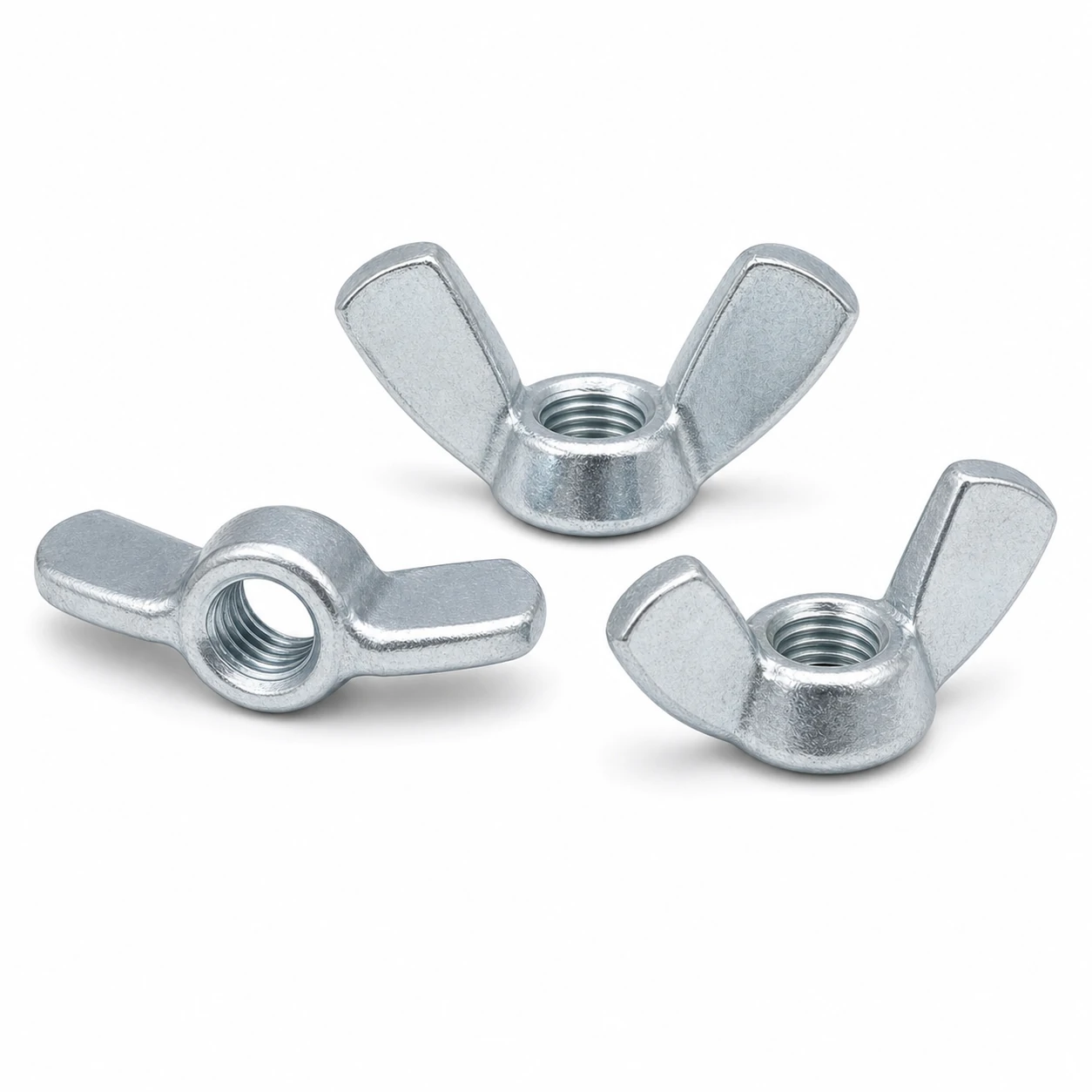
Specification summary of DIN 315 as applied to wing nuts: the dimensions the standard controls, the tolerance and product grades it defines, the full specified size range, and the equivalent DIN/ISO/ASME designations.
DIN 315 — Scope
DIN 315 specifies the dimensions and tolerances of wing nuts. Material, property class, surface finish and packaging are governed by separate documents in the same standards family (for example ISO 898-1 for the mechanical property classes of bolts and screws).
Tolerance & Product Grades
DIN 315, alongside the related DIN 315 entries on this site, specifies product grades (typically A or B for fine work and C for general engineering) and tolerance classes for the controlling dimensions. Choose the grade against the precision your application requires.
Dimensions Specified by DIN 315
| Size | Pitch (mm) | Wing span (mm) | Wing height (mm) | Body height (mm) | Reference standard | Notes |
|---|---|---|---|---|---|---|
| M4 | 0.7 | 28 | 17 | 9 | DIN 315 | Hand-tightened wing nut |
| M5 | 0.8 | 32 | 19 | 10 | DIN 315 | Hand-tightened wing nut |
| M6 | 1.0 | 37 | 22 | 12 | DIN 315 | Hand-tightened wing nut |
| M8 | 1.25 | 45 | 27 | 15 | DIN 315 | Hand-tightened wing nut |
| M10 | 1.5 | 55 | 33 | 18 | DIN 315 | Hand-tightened wing nut |
| M12 | 1.75 | 64 | 38 | 22 | DIN 315 | Hand-tightened wing nut |
Companion Standards
DIN 315 controls only the geometry of wing nuts. The mechanical strength is set by ISO 898-1 (bolts and screws) or ISO 898-2 (nuts); the surface finish is governed by separate finish standards (e.g. ISO 4042 for electroplating). For corrosion testing, the relevant document is ISO 9227 (neutral salt spray).
When to Specify DIN 315
DIN 315 is still widely used in European mechanical engineering and as a cross-reference on legacy drawings; its ISO equivalent is preferred for new designs.