
By the Engineering Hardware sourcing & engineering team · Reviewed November 2026
Quick answer: Choose a rivet nut by four things in this order: the thread you need, the total thickness you are clamping (grip range), the hole you can drill, and how much spin-out resistance the joint needs. Round smooth bodies suit most sheet metal; knurled or hex bodies resist spinning in soft or slotted holes; closed-end versions keep water and dust out.
- Grip range is the material thickness a rivet nut can clamp — buy for your actual stack, not the nominal sheet.
- Standard round-body hole sizes: M4 ≈ 6.0 mm, M5 ≈ 7.0 mm, M6 ≈ 9.0 mm, M8 ≈ 11.0 mm, M10 ≈ 13.0 mm.
- Hex and knurled bodies resist spin-out; closed-end bodies seal.
- Steel rivet nuts in aluminum need a barrier or a matching alloy to avoid galvanic corrosion.
A rivet nut (also sold as rivnut, nutsert or blind rivet nut) gives you a strong internal thread in sheet metal, tube or composite panel when you can only reach one side. The setting tool pulls the threaded end toward the head, collapsing the body into a bulge that clamps the panel. Getting the part number right means matching thread, head, body, material and grip range to the job.
Anatomy of a rivet nut
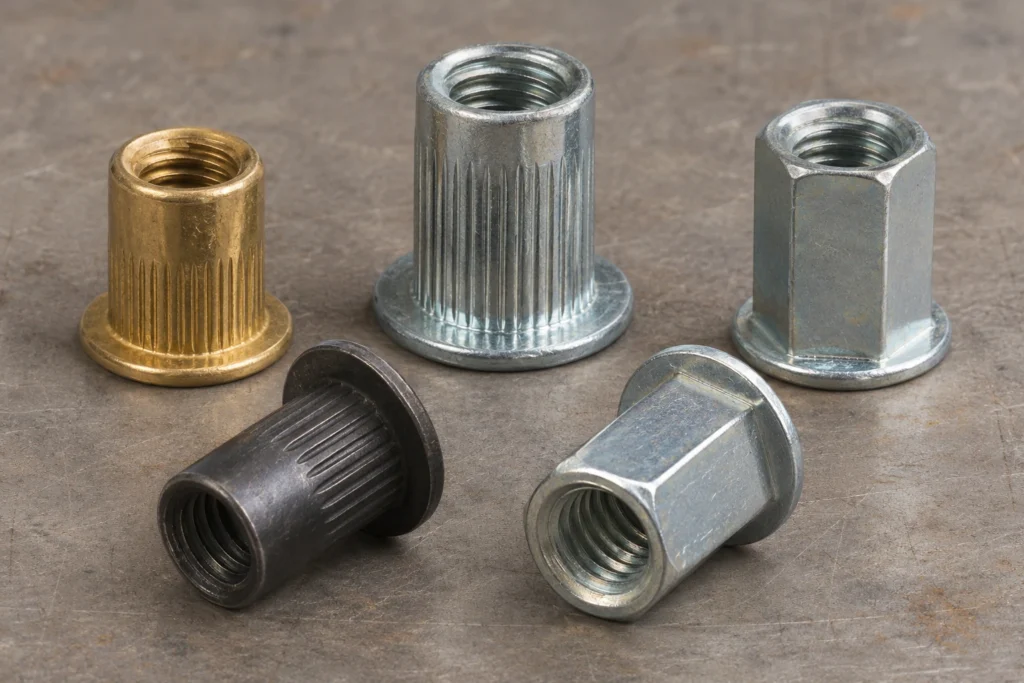
- Head — sits on the accessible side. Flat (large flange) spreads load; countersunk or reduced (thin) heads sit flush or nearly flush.
- Body — round smooth, round knurled, half-hex or full-hex. The body shape decides spin-out resistance.
- Collapse zone — the unthreaded part that bulges behind the panel. Its length determines grip range.
- Thread — for example the #10-32 knurled flat-head rivet nut or a UNF fine-thread rivnut range — metric (M3–M12 typical) or inch (#6-32 to 1/2-13); open-end or closed-end.
Hole size and grip range chart
Typical values for standard flat-head, round-body steel rivet nuts. Always confirm against the supplier’s drawing — knurled, hex and thin-wall versions use different holes.
| Thread | Typical hole (mm) | Typical body OD (mm) | Common grip ranges (mm) |
|---|---|---|---|
| M4 | 6.0 | 6.0 | 0.5–2.0 / 2.0–3.5 |
| M5 | 7.0 | 7.0 | 0.5–3.0 / 3.0–4.5 |
| M6 | 9.0 | 9.0 | 0.5–3.0 / 3.0–4.5 |
| M8 | 11.0 | 11.0 | 0.5–3.0 / 3.0–5.5 |
| M10 | 13.0 | 13.0 | 1.0–3.5 / 3.5–6.0 |
Hole tolerance is tight: a hole only a few tenths of a millimetre oversize lets the body spin, and an undersize hole damages the knurl. Drill, then deburr — burrs prevent the head from seating. If you are unsure of your sheet thickness, see How to measure diameter, length and thread pitch.
Body styles compared
| Body | Spin-out resistance | Hole | Use it when |
|---|---|---|---|
| Round, smooth | Low | Round | General sheet metal, light torque on the screw |
| Round, knurled | Medium | Round | Soft alloys, plastics, higher assembly torque |
| Half-hex | High | Hex (punched) | Repeated assembly, thin sheet |
| Full-hex | Highest | Hex | Heavy torque, tube and profile, automotive brackets |
| Slotted / plusnut style | High | Round | Plastics, fibreglass and brittle panels — wide bearing area |
Materials and finishes
- Steel, zinc-plated — strongest and cheapest; standard for steel enclosures and racks.
- Aluminum — e.g. #8-32 aluminum knurled rivet nuts — easiest to set, light, matches aluminum panels; lower thread strength.
- Stainless 304/316 — corrosion resistance; needs a stronger tool and correct stroke.
- Brass — conductive, good in electrical enclosures.
Mixing metals matters. A zinc-plated steel rivet nut in a bare aluminum panel outdoors is a galvanic couple; use aluminum or stainless with an isolating coating. Our article on Stainless fasteners in aluminum: preventing galvanic corrosion explains why.
Setting tools and stroke
Hand tools — see our rivet nut setting tools — suit maintenance and prototypes; pneumatic-hydraulic spin-pull tools suit production. Set by stroke (distance) for consistent results across a batch, or by pull force for mixed grips. Signs of a bad set: the rivet nut spins when you tighten the screw (under-set or oversize hole), or the thread is distorted (over-set). For one-sided joints more broadly, see How to choose blind fasteners for one-sided access.
What to put on your RFQ
- Thread size and pitch (e.g. M6×1.0 or 1/4-20)
- Head style and body style
- Grip range or panel thickness
- Material and finish
- Open or closed end
- Quantity, packing and whether you need a matching tool or mandrels
Products from our catalog
Hand-picked from the Rivet Nuts & Threaded Rivet Inserts category. Every listing shows price tiers, MOQ and the full specification table; one inquiry gets you a confirmed quote, lead time and shipping.
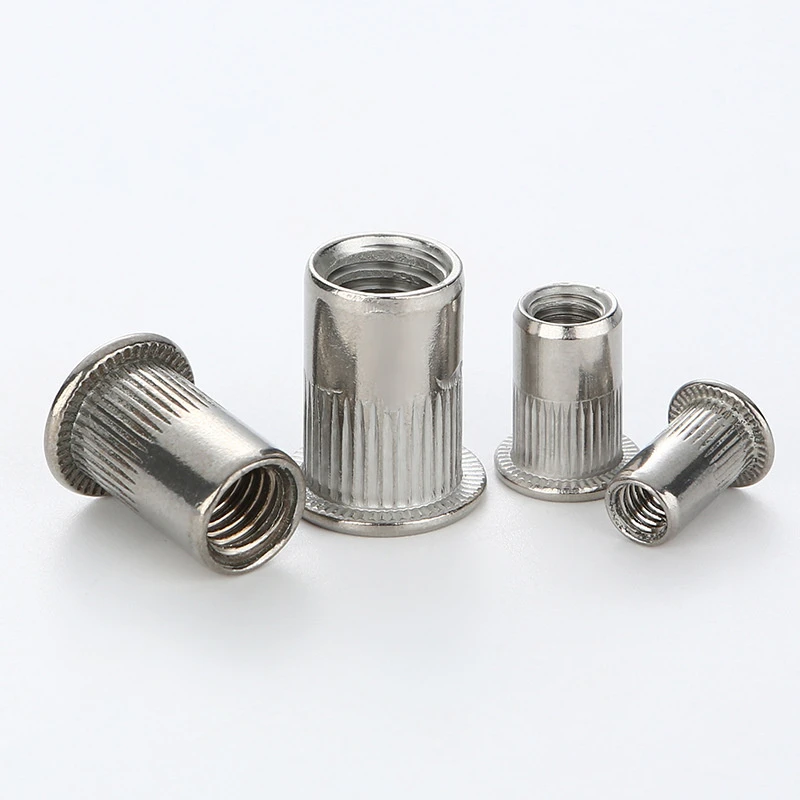 #10-32 Rivet Nuts Knurled Flat Head Threaded Insert Nut
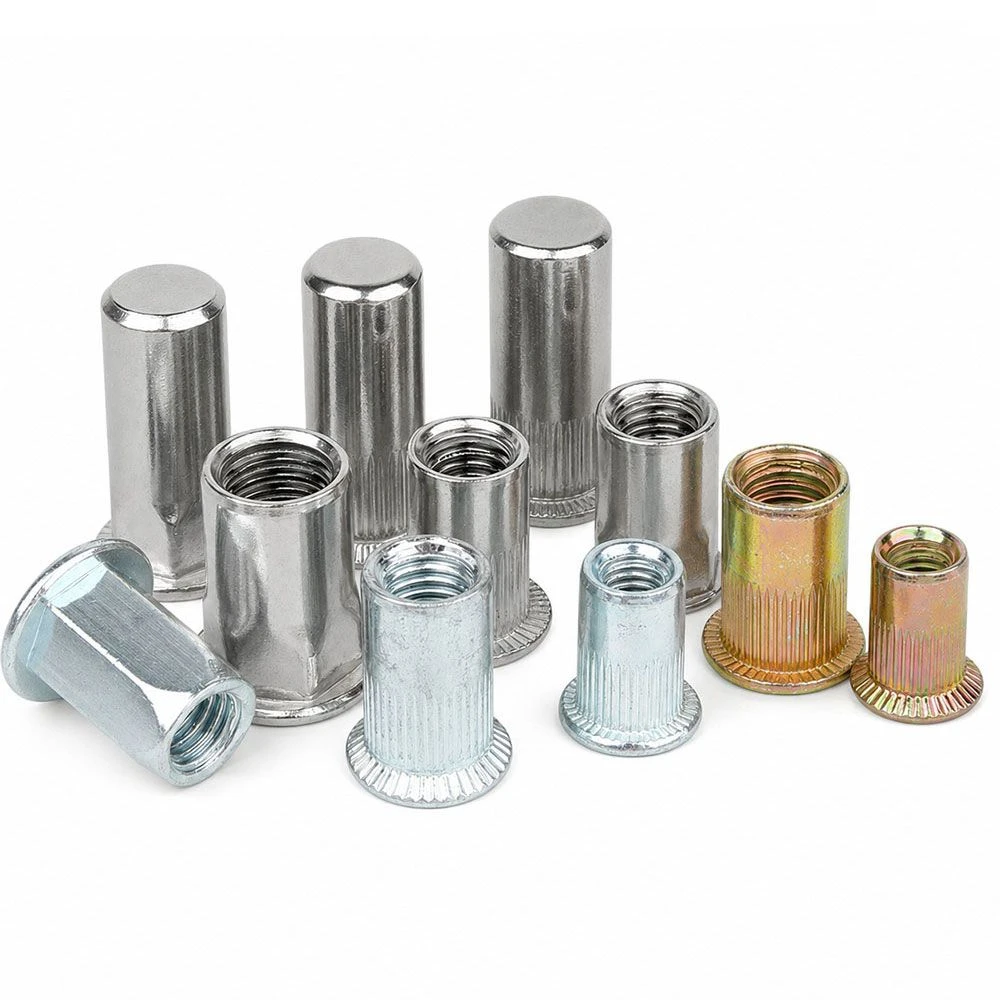 #10-32 1/4-28 1/2-20 Unf Fine Thread Rivnut Nutsert Blind Rivet Nut
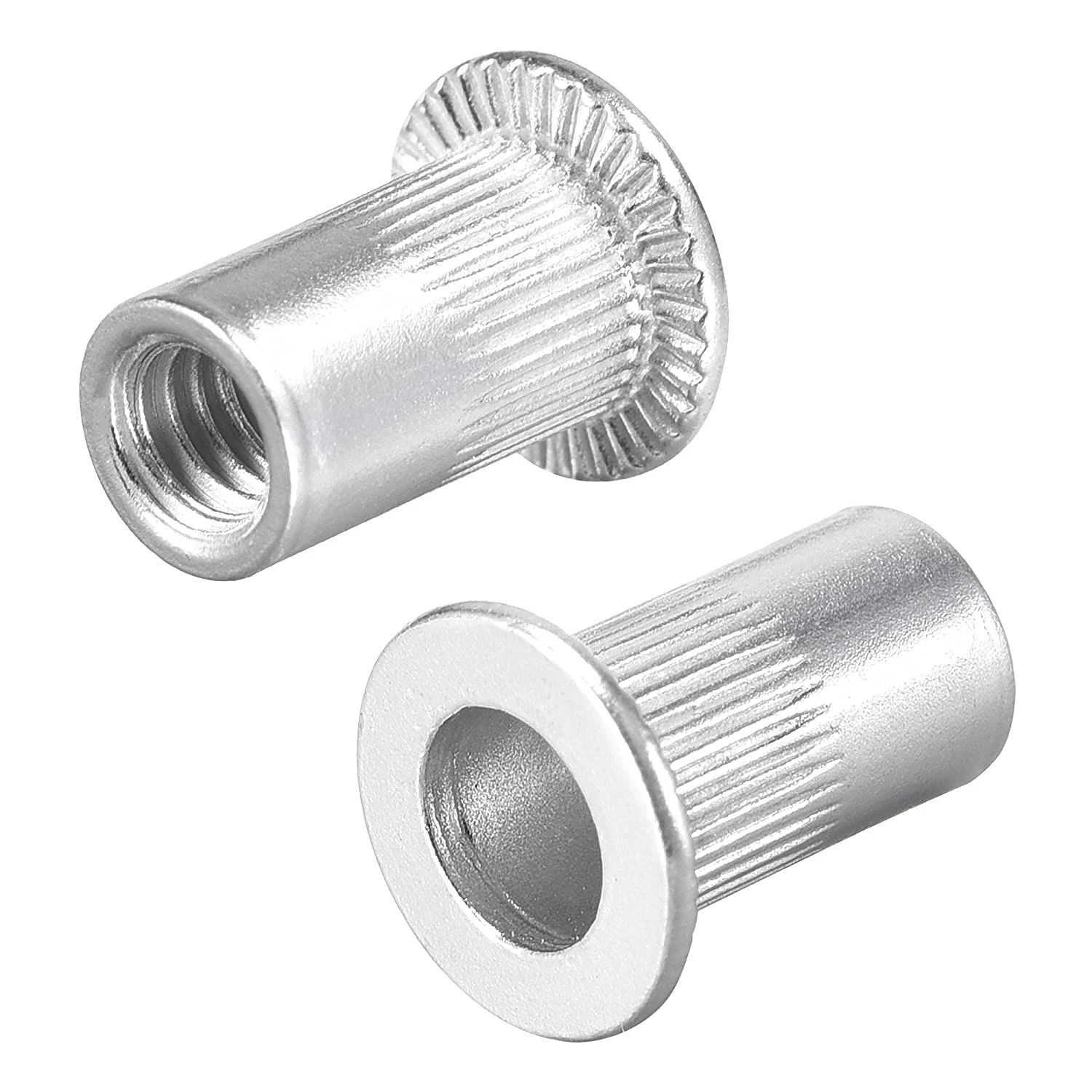 #8-32 Aluminum Alloy Knurled Flat Head Threaded Insert Nut Silver Rivet Nuts
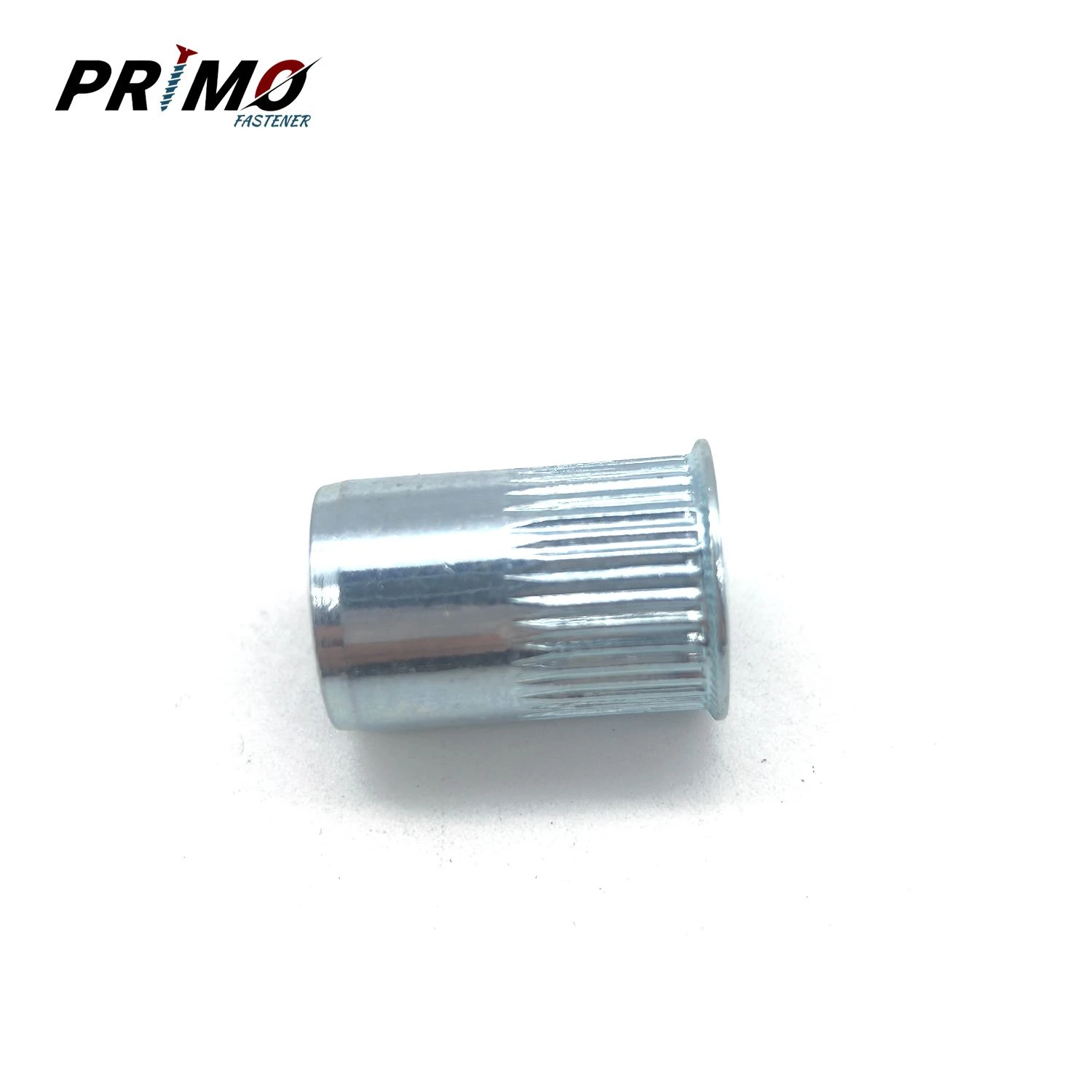 #10-24 0.585″ 0.685″Length Knurled Body Thin Wall Open End Rivet Nut
Browse all Rivet Nuts & Threaded Rivet Inserts → Request a quote
Frequently asked questions
What size hole do I drill for an M6 rivet nut?
For a standard flat-head, round-body M6 rivet nut the hole is typically 9.0 mm. Knurled, hex and thin-wall versions differ, so confirm on the product drawing.
What is grip range on a rivet nut?
Grip range is the minimum to maximum total material thickness the rivet nut can clamp. Choose a part whose range covers your actual stack, including paint and any gasket.
Why does my rivet nut spin when I tighten the bolt?
Usually the hole is oversize, the part was under-set, or the body is smooth in a soft material. Use the correct hole, set to full stroke, or switch to a knurled or hex body.
Rivet nut or self-clinching nut — which is better?
Self-clinching nuts are pressed into ductile sheet from one side during production and give very consistent results; rivet nuts install blind with a hand or air tool and also work in tube, aluminum extrusions and plastics.
Related reading
Sources & further reading
Figures in this article are typical values for orientation. Always confirm against the governing standard and the manufacturer’s data for your part, and have safety-critical connections designed by a qualified engineer.