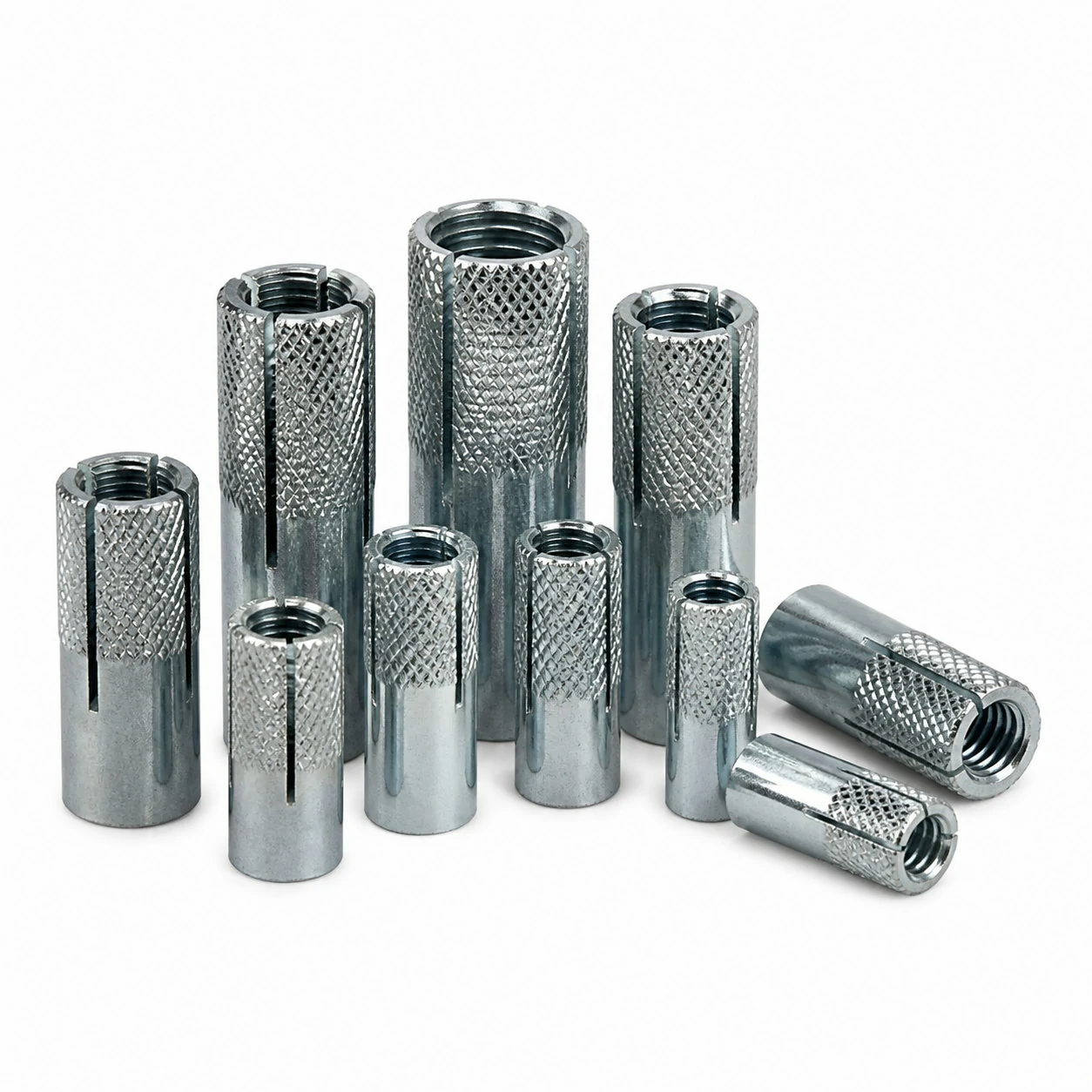
Drop-In Anchors (Internally Threaded) are used primarily for providing a flush, internally threaded fixing point in concrete so the bolt — and the fixture with it — can be removed and replaced without disturbing the anchor. This page lists the industries and assemblies where they are specified, the selection criteria that matter for each application, installation practice, and the cases where a different fastener type is the correct choice. Parts are supplied to Trade series (displacement-controlled anchor). Stocked across roughly M6 to M16, they cover general to heavy-duty work.
Typical Applications for Drop-In Anchors (Internally Threaded)
The most common settings where these are specified:
- Fit-out & drylining: fixing to plasterboard, block and hollow wall where there is no solid backing.
- General machine building: fastening covers, brackets, motors and sub-assemblies on production equipment.
- Maintenance & repair (MRO): a stocked size for servicing existing plant where the original fastener spec must be matched.
- Fabrication & metalwork: bench and on-site assembly of steel frames, enclosures and weldments.
- Structural fixing to concrete: base plates, brackets, rails and steelwork bolted to a concrete slab or wall.
How to Specify Drop-In Anchors (Internally Threaded) for Your Application
- Size: Match the nominal size to the mating thread or hole. This product spans M6–M16; check the full table below for the exact dimensions of each size.
- Material: Choose the material and finish for the service environment — plated steel for general use, stainless for corrosion resistance.
- Environment: For damp, coastal or chemical exposure prefer A4/316 stainless or a suitable coating; indoors, plated steel or A2 is usually sufficient.
- Standard: This product is supplied to Trade series (displacement-controlled anchor). Quoting the standard on your order guarantees interchangeable dimensions between suppliers.
Where Drop-In Anchors (Internally Threaded) Are Not the Right Choice
Match the fastener to the load, environment and whether the joint must be reopened; the wrong class or style is the usual cause of joint failure.