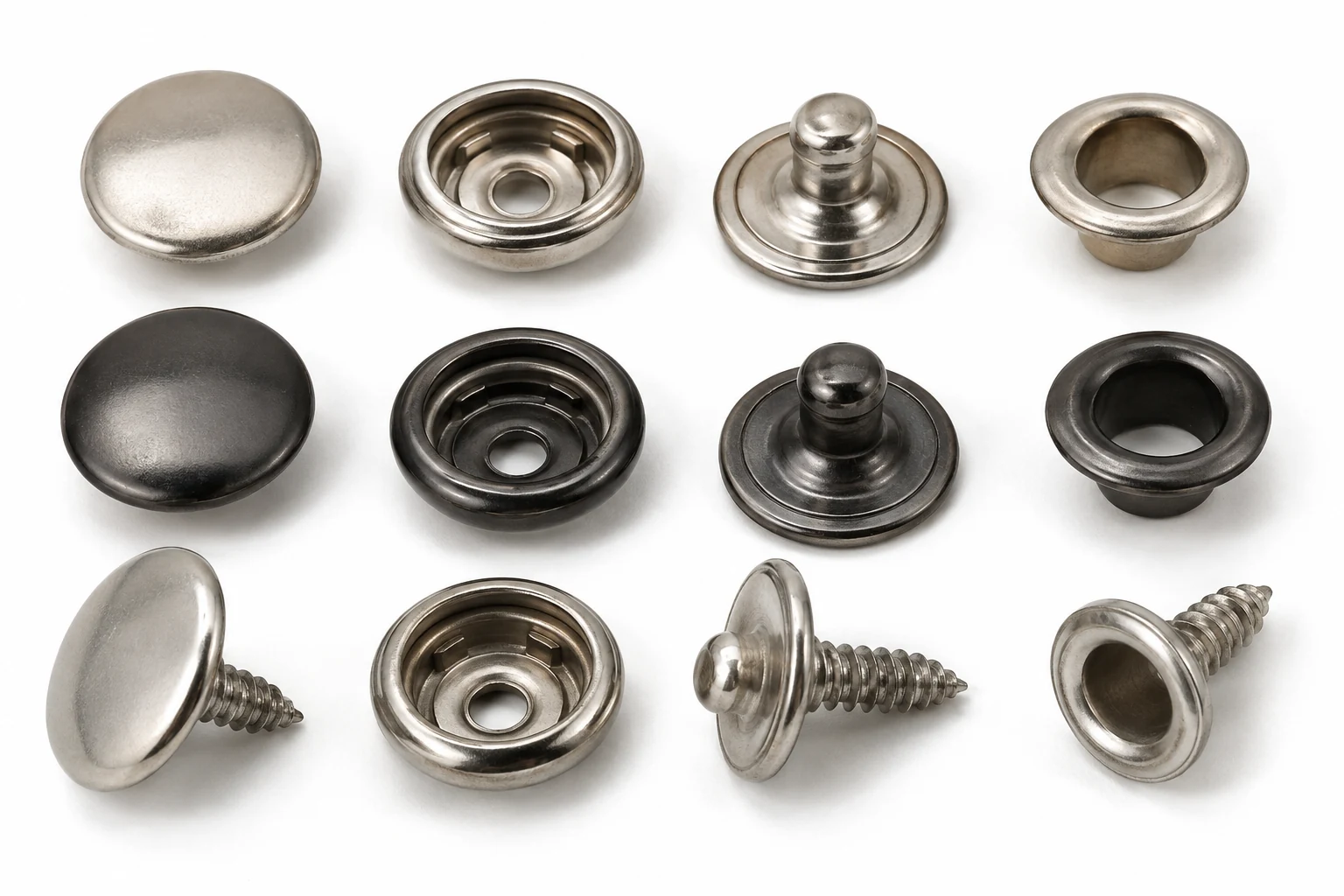
Application guide for Fabric Snap Fasteners to Trade series (fabric snap fasteners). The core duty of the type is joining fabric to a mating stud so a cover can be installed and removed without a loose nut. The typical industries, the how-to-specify checklist, assembly practice and the exclusion cases are set out below. Stocked across roughly 1 to 9, they cover general to heavy-duty work.
Typical Applications for Fabric Snap Fasteners
The most common settings where these are specified:
- Marine canvas: Snap sets attach fabric panels to solid surfaces with removable hardware.
- Vehicle interiors: Threaded or blind-rivet studs secure trim and covers.
- Outdoor covers: Stainless and plated options follow moisture exposure.
- Upholstery: Snap diameter and stud form match the material stack.
How to Specify Fabric Snap Fasteners for Your Application
- Size: Select on screw size, and confirm it against the mating feature in the assembly. This product spans 1–9; check the full table below for the exact dimensions of each size.
- Material: Choose the material and finish for the service environment — plated steel for general use, stainless for corrosion resistance.
- Environment: For damp, coastal or chemical exposure prefer A4/316 stainless or a suitable coating; indoors, plated steel or A2 is usually sufficient.
- Standard: This product is supplied to Trade series (fabric snap fasteners). Quoting the standard on your order guarantees interchangeable dimensions between suppliers.
Installation & Assembly Practice
- Drill the hole 0.1 mm over the nominal rivet diameter and deburr both sides before setting.
- Grip range must match the total joint thickness — a rivet set outside its grip range clamps poorly and works loose.
Common Selection Mistakes with Fabric Snap Fasteners
- Setting a rivet outside its grip range, which leaves the joint loose from day one.
- Using aluminum rivets on steel sheet outdoors — galvanic corrosion eats the rivet.
Where Fabric Snap Fasteners Are Not the Right Choice
Not where the joint must later be disassembled, and not for high-tension structural connections.