
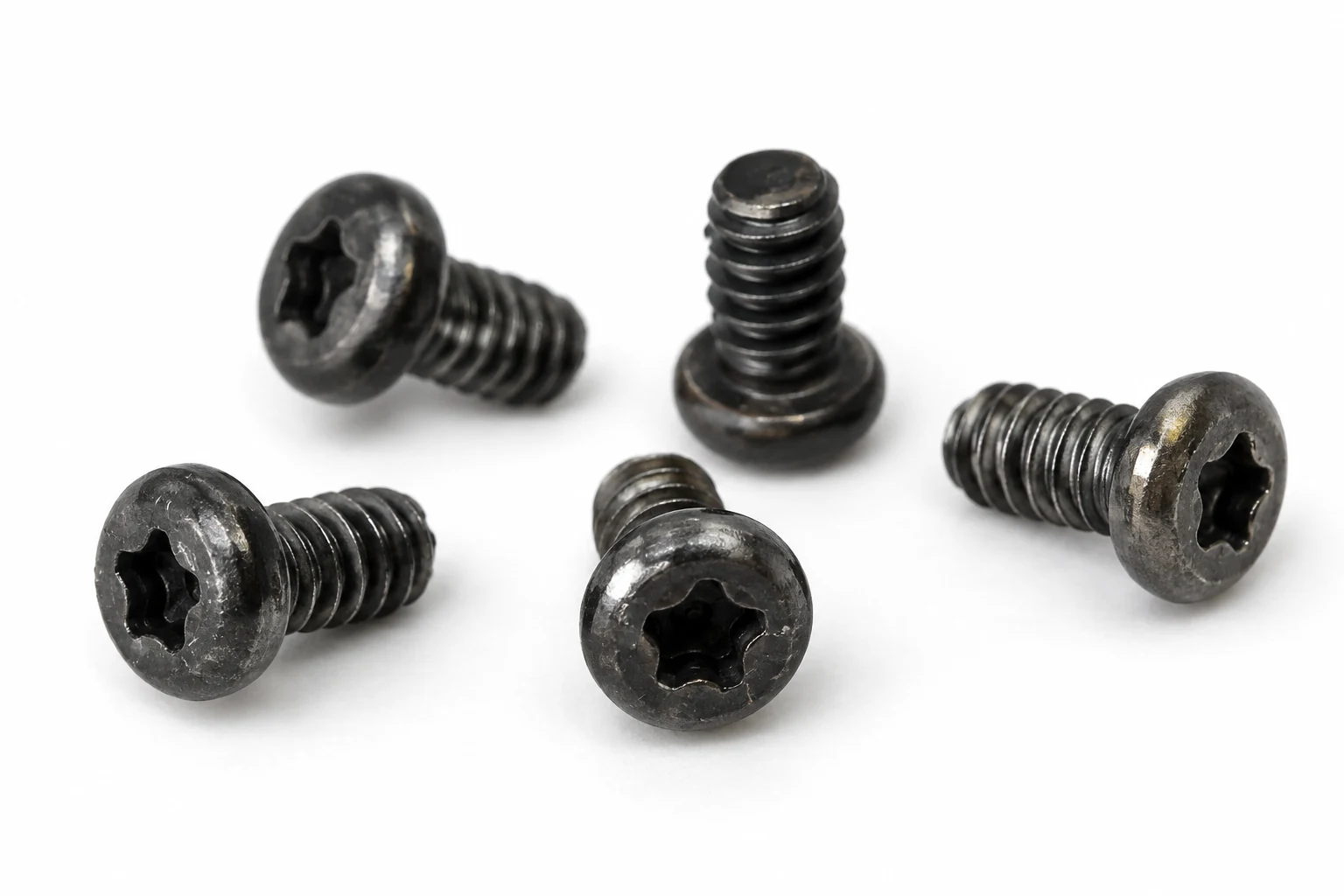
Application guide for Five-Lobe Bottom Service Screws for Mobile Devices to Trade series (five-point service screws). The core duty of the type is replacing a model-specific internal or exterior service screw with the correct drive and under-head length. The typical industries, the how-to-specify checklist, assembly practice and the exclusion cases are set out below.
Typical Applications for Five-Lobe Bottom Service Screws for Mobile Devices
The most common settings where these are specified:
- Smartphone service: Five-lobe screws retain the bottom edge where a five-lobe driver is specified.
- Consumer electronics repair: Short under-head lengths suit thin exterior panels.
- Device refurbishment: Model-matched replacement sets restore the original service interface.
- Mobile equipment labs: The small head and P2 drive fit a confined case edge.
How to Specify Five-Lobe Bottom Service Screws for Mobile Devices for Your Application
- Size: Match the size to the mating part — see the dimension table below for each option.
- Drive & head: Pick the drive (socket, cross, slot) and head style for the tool access and seating surface; a recessed drive resists cam-out under power tools.
- Environment: For damp, coastal or chemical exposure prefer A4/316 stainless or a suitable coating; indoors, plated steel or A2 is usually sufficient.
- Standard: This is a trade-series article rather than one covered by a published dimensional standard, so dimensions can differ between manufacturers. Quote the dimensions you need — or the part you are replacing — rather than a standard number.
Installation & Assembly Practice
- Match the driver exactly to the recess (PH ≠ PZ; hex key sizes per ISO 2936) and keep the tool axial — side load is the main cause of stripped drives.
- In tapped holes, engage a thread length of at least 1× the nominal diameter in steel, 2× in aluminum.
- Set power tools to a torque that seats the head without embedding it into the mating surface.
Common Selection Mistakes with Five-Lobe Bottom Service Screws for Mobile Devices
- Under-sizing the drive for the installation torque — a small recess at high torque strips before the screw is seated.
- Using a countersunk head in thin sheet where the countersink removes most of the load-bearing material.
- Specifying stainless in high-strength duty: A2-70 is roughly class 7 steel, not a 10.9 substitute.
Where Five-Lobe Bottom Service Screws for Mobile Devices Are Not the Right Choice
Not for high-preload structural joints (use a property-class bolt and nut), and not in thin sheet where a self-drilling or self-tapping type suits better.
Custom manufacturing · Made to drawing
Need a five-lobe bottom service screws for mobile devices outside the standard range?
Thread size and pitch, length, property class, drive form, head geometry and head marking are all specifiable — the standard part is where it starts, not where it stops. Made by cold heading or warm forging.
Minimum order from 2,000 pieces; samples within 7 days of drawing approval.



