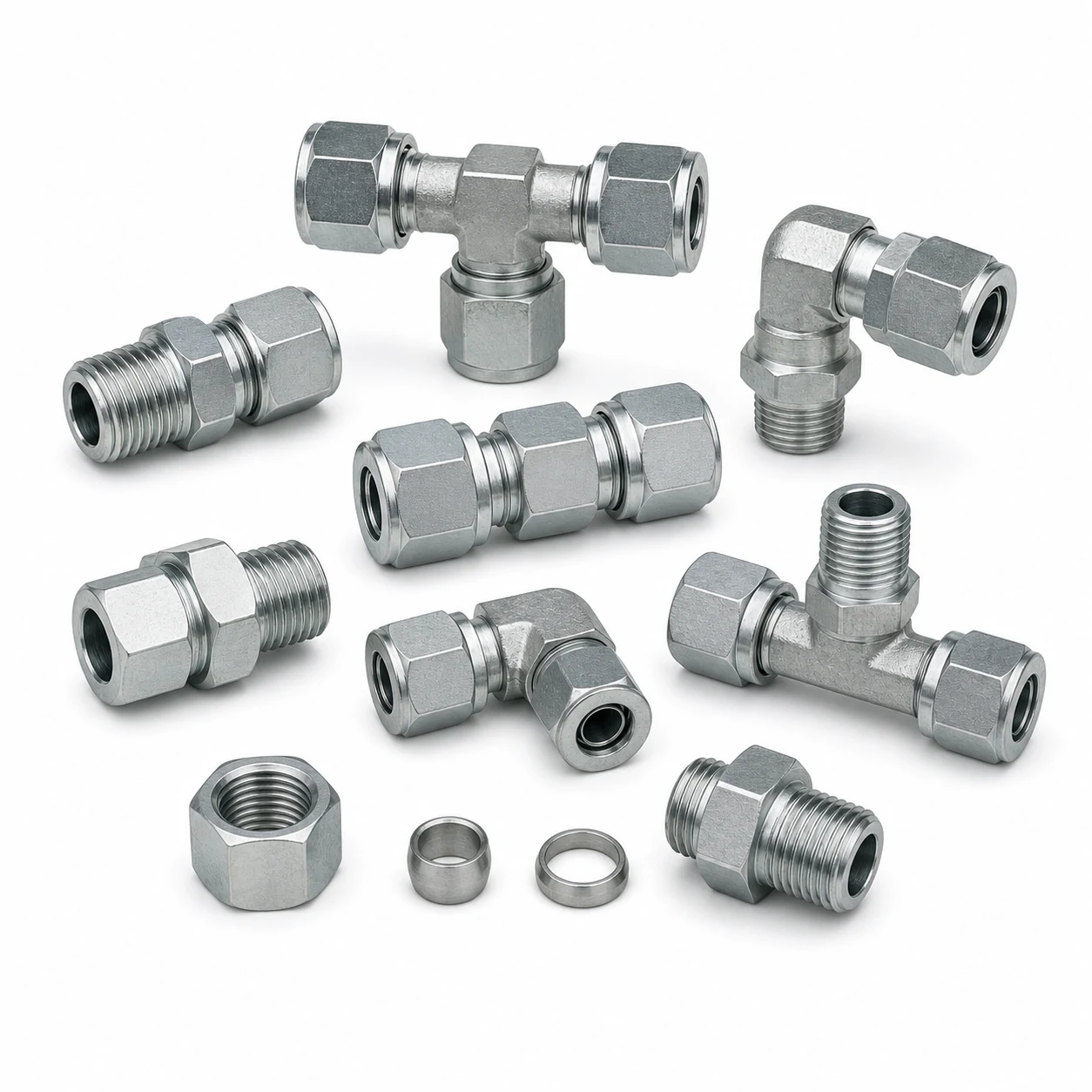
Hydraulic Compression Fittings are used primarily for joining and sealing fluid or pneumatic lines. This page lists the industries and assemblies where they are specified, the selection criteria that matter for each application, installation practice, and the cases where a different fastener type is the correct choice. Parts are supplied to DIN 2353. Stocked across roughly 4 to 42, they cover general to heavy-duty work.
Typical Applications for Hydraulic Compression Fittings
The most common settings where these are specified:
- General machine building: fastening covers, brackets, motors and sub-assemblies on production equipment.
- Maintenance & repair (MRO): a stocked size for servicing existing plant where the original fastener spec must be matched.
- Fabrication & metalwork: bench and on-site assembly of steel frames, enclosures and weldments.
- Pneumatic systems: connecting air lines, cylinders and valves on automation rigs.
- Hydraulic & fluid power: sealed, pressure-rated joints in fluid lines.
How to Specify Hydraulic Compression Fittings for Your Application
- Size: Match the nominal size to the mating thread or hole. This product spans 4–42; check the full table below for the exact dimensions of each size.
- Thread & pressure: Match the thread form (BSP/NPT/metric) and pressure rating to the line, and seal appropriately (tape, sealant or O-ring).
- Environment: For damp, coastal or chemical exposure prefer A4/316 stainless or a suitable coating; indoors, plated steel or A2 is usually sufficient.
- Standard: This product is supplied to DIN 2353. Quoting the standard on your order guarantees interchangeable dimensions between suppliers.
Installation & Assembly Practice
- Seal tapered threads with PTFE tape or anaerobic sealant applied clear of the first thread; parallel threads seal on a washer or O-ring, not on the thread.
- Tighten to the fitting manufacturer's torque — over-tightening tapered threads splits female ports.
Common Selection Mistakes with Hydraulic Compression Fittings
- Mating BSP and NPT threads directly — the 55°/60° forms do not seal against each other.
- Exceeding the pressure rating of the lowest-rated component in the line.
Where Hydraulic Compression Fittings Are Not the Right Choice
Do not mix thread forms (BSP into NPT) without an adapter, and do not exceed the pressure rating of the lowest-rated component.
Custom manufacturing · Made to drawing
Need a hydraulic compression fittings outside the standard range?
Dimensions, material, finish and form are specified from the drawing — a pipe & pneumatic fitting outside the standard range is a variation on existing tooling rather than a new design.
Minimum order from 2,000 pieces; samples within 7 days of drawing approval.