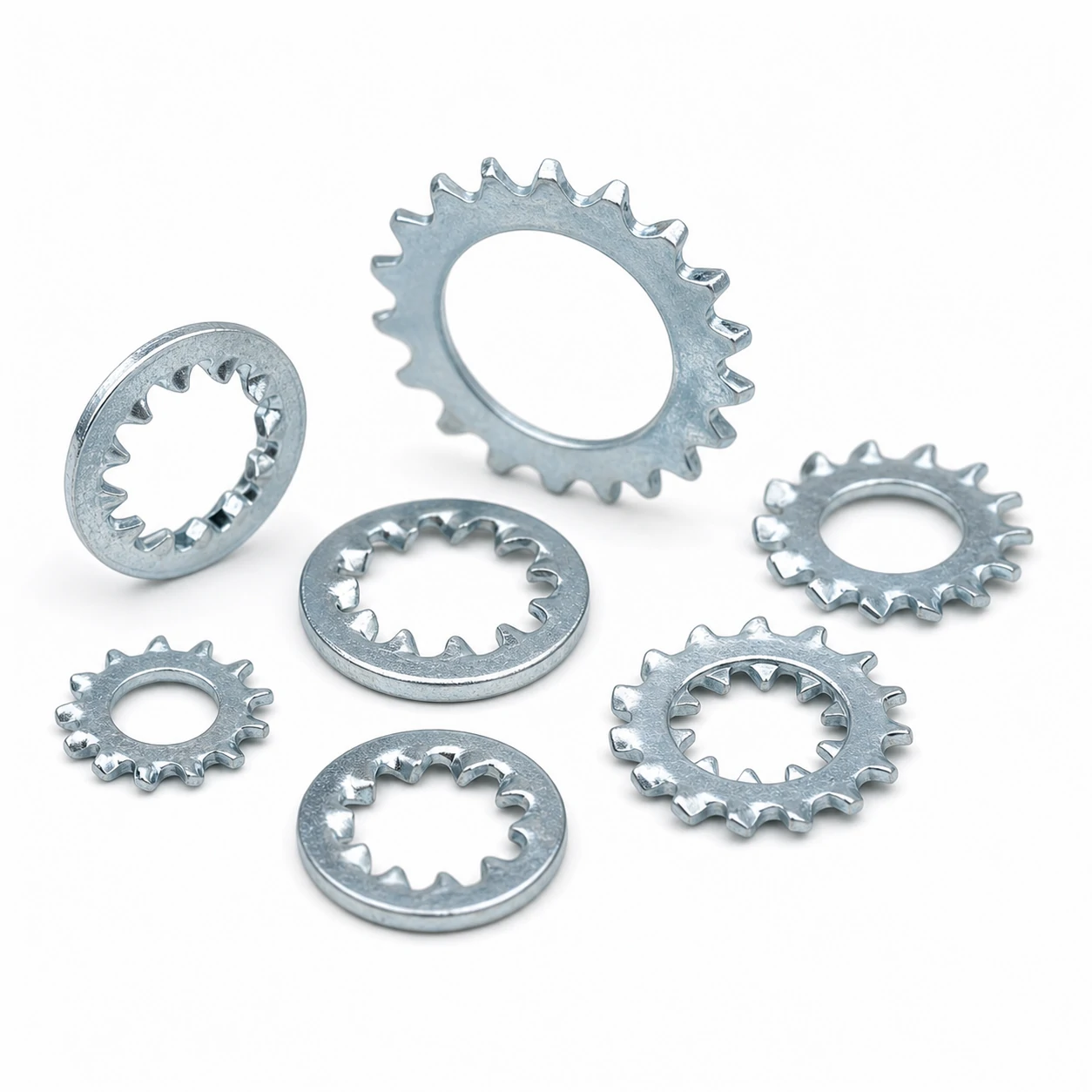
The primary duty of Serrated Lock Washers is load distribution and anti-loosening under a bolt or nut. Below: the sectors that specify them in volume, the checklist used to select the right size and material for the application, installation notes, and the known limits of the type. Stocked across roughly M3 to M20, they cover general to heavy-duty work.
Typical Applications for Serrated Lock Washers
The most common settings where these are specified:
- Timber & soft materials: large-OD types that prevent pull-through.
- General machine building: fastening covers, brackets, motors and sub-assemblies on production equipment.
- Maintenance & repair (MRO): a stocked size for servicing existing plant where the original fastener spec must be matched.
- Fabrication & metalwork: bench and on-site assembly of steel frames, enclosures and weldments.
- Bolted structural joints: spreading load over soft or oversized holes and protecting the surface.
How to Specify Serrated Lock Washers for Your Application
- Size: Match the nominal size to the mating thread or hole. This product spans M3–M20; check the full table below for the exact dimensions of each size.
- Type & OD: Select flat for load spreading, spring/serrated for anti-loosening, or fender/large-OD for soft or oversized holes.
- Environment: For damp, coastal or chemical exposure prefer A4/316 stainless or a suitable coating; indoors, plated steel or A2 is usually sufficient.
- Standard: This product is supplied to DIN 6798. Quoting the standard on your order guarantees interchangeable dimensions between suppliers.
Installation & Assembly Practice
- Place the washer under the rotating element (usually the nut) so tightening does not score the surface.
- Chamfered-hole side of a hardened washer faces the bolt head fillet.
- On serrated-flange hardware, do not add a plain washer — it defeats the serrations.
Common Selection Mistakes with Serrated Lock Washers
- Relying on a spring washer for locking on class 8.8+ joints — at high preload it flattens and adds nothing.
- Choosing an OD too small for soft material, so the head pulls through or embeds.
Where Serrated Lock Washers Are Not the Right Choice
A washer does not replace a locking feature on its own in severe vibration, and a spring washer adds little clamp on high-strength joints.
Custom manufacturing · Made to drawing
Need a serrated lock washers outside the standard range?
Bearing area is usually the reason for a special washer: a larger outside diameter to spread load into a softer material, or a thicker section to resist dishing. Made by stamping or punching.
Minimum order from 2,000 pieces; samples within 7 days of drawing approval.