

By the Engineering Hardware sourcing & engineering team · Reviewed November 2026
Quick answer: For heavy static loads in solid, uncracked concrete, a wedge anchor is the strongest of the four common mechanical anchors. Sleeve anchors are the most forgiving in brick, block and mixed masonry; drop-in anchors give a flush internal thread for threaded rod; and concrete screw anchors are the fastest to install and the only ones you can remove cleanly.
- Rank by your base material first — an anchor that is excellent in concrete can fail in hollow block.
- Wedge and sleeve anchors use a bit the same diameter as the anchor; drop-ins use a larger bit; screw anchors use a smaller one.
- Edge distance and spacing matter as much as anchor size: crowded or edge-close anchors break out the concrete.
- For life-safety or seismic work, use only anchors with a current evaluation report and follow its embedment and torque tables.
Mechanical concrete anchors look interchangeable in a catalog photo, but each one transfers load to the base material differently. A wedge anchor expands a clip at the bottom of the hole; a sleeve anchor expands a full-length sleeve; a drop-in anchor is set with a punch and accepts a bolt or threaded rod; a screw anchor cuts its own thread into the concrete. That mechanism decides where each one is strong, and where it is a liability. This guide ranks the four most common types and shows how to choose between them for a real job.
How we ranked them
Each anchor type is scored 1–5 on five criteria that matter to contractors and maintenance buyers. Scores describe typical, correctly installed products of the same diameter; actual capacities always come from the manufacturer’s published data.
| Criterion | What it means |
|---|---|
| Holding power | Tension and shear capacity in solid concrete at the same diameter and embedment |
| Base-material range | How well it works beyond solid concrete — brick, block, stone |
| Installation speed | Drilling, cleaning and setting time per anchor |
| Removability | Whether it can be taken out and leave a usable surface |
| Fixture flexibility | Through-fixing, flush mounting, threaded-rod hanging |
The ranking at a glance
| Rank | Anchor | Holding | Base range | Speed | Removable | Best for |
|---|---|---|---|---|---|---|
| 1 | Wedge anchor | 5 | 2 | 4 | 1 | Machinery, racking, structural steel in solid concrete |
| 2 | Concrete screw anchor | 4 | 4 | 5 | 5 | Fast fixing, temporary work, close-to-edge installs |
| 3 | Sleeve anchor | 3 | 5 | 4 | 2 | Brick, block, mixed masonry, light–medium loads |
| 4 | Drop-in anchor | 3 | 2 | 3 | 1 | Overhead threaded rod, flush mounting points |
The ranking is a starting point, not a verdict. A drop-in anchor ranks last overall, but it is the right answer when you hang pipe or cable tray from a slab with threaded rod — nothing else on this list gives you a flush female thread.
1. Wedge anchors — the strongest in solid concrete
A wedge anchor is a threaded stud with a tapered end and an expansion clip. Tightening the nut pulls the cone into the clip, which bites into the side of the hole. Because the expansion happens over a short length deep in the hole, the anchor relies on sound concrete around it.
- Drill: bit diameter equals anchor diameter (a 1/2″ anchor goes in a 1/2″ hole).
- Strength: the highest tension values of the four types at the same size, which is why they dominate machinery and pallet-racking work.
- Limits: not for hollow block, brick or weak concrete; cannot be removed without cutting; needs adequate edge distance.
- Examples: a 1/2″ 18-8 stainless wedge anchor with nut and washer or the SS304/SS316 wedge anchor range from 1/4″ to 3/4″.
- Material: zinc-plated carbon steel indoors, hot-dip galvanized outdoors, 304 or 316 stainless in wet, coastal or chemical environments.
2. Concrete screw anchors — fastest and removable
Screw anchors cut a thread into the hole wall with hardened threads, so there is no expansion stress. That makes them friendlier near edges and in closely spaced patterns, and you can back them out.
- Drill: smaller than the screw — common sizes are a 5/32″ bit for a 3/16″ screw and a 3/16″ bit for a 1/4″ screw. Heavy-duty screw anchors list their own bit size; follow it exactly.
- Do not over-drive: once the head seats, stop. Extra turns strip the thread you just cut.
- Reuse: light-duty blue screws can often be reused in a new hole for temporary work, but structural screw anchors are generally rated for single use.
3. Sleeve anchors — most versatile in masonry
A sleeve anchor expands a slotted sleeve along much of its length, spreading the load over a larger area of the hole. That makes it tolerant of brick, block and stone where a wedge anchor would crush the material.
- Example: 3/8″ × 1-7/8″ hex flange-nut sleeve anchor.
- Head styles: hex nut, flat (countersunk), round, acorn and hook/eye versions for different fixtures.
- Trade-off: lower ultimate loads than a wedge anchor of the same diameter in solid concrete.
- Tip: choose a sleeve length so the expansion zone sits in solid material, not in a mortar joint or a block void.
4. Drop-in anchors — flush internal thread
A drop-in anchor is an internally threaded shell with an expander plug. You set it with a matching setting tool until the tool’s shoulder meets the anchor, then thread in a bolt or rod.
- Drill: larger than the thread — for example a 3/8″ drop-in usually needs a 1/2″ bit. Check the setting depth; too shallow and the anchor protrudes, too deep and it sets loose.
- Example: 1/2″ zinc-plated knurled drop-in anchor; pair it with fully threaded rod.
- Best use: overhead threaded-rod hangers for pipe, duct and cable tray, and removable fixtures that must leave a flush surface.
- Watch for: under-set anchors — always use the correct setting tool and check that the plug has travelled fully.
Installation rules that apply to every type
- Check the base material. Cracked concrete, low-strength concrete, hollow block and brick each need anchors rated for them.
- Drill to the right diameter and depth with a carbide bit in good condition. Worn bits drill undersize holes; new oversize bits drill loose ones.
- Clean the hole — blow, brush, blow. Dust left in the hole is one of the most common reasons anchors fail to reach rated load.
- Respect edge distance and spacing. A widely used rule of thumb for expansion anchors is at least 5 anchor diameters to an edge and 10 diameters between anchors; the product’s evaluation data overrides any rule of thumb.
- Torque to the published value with a calibrated wrench, not an impact driver.
For base-material behavior and load paths in more depth, see our earlier guide to Concrete fasteners: types, loads and installation and the step-by-step on Masonry fasteners for brick, block and concrete.
Buying tips for bulk orders
- Specify diameter, overall length, thread length, material and finish — and the nut and washer if you want them assembled.
- For stainless anchors, say 304 or 316 explicitly; “stainless” alone is not a specification.
- Ask for packing per box and per carton: contractors prefer boxes of 25–100, distributors want inner boxes with labels.
- Request a sample lot and check that the clip or sleeve is crimped securely — loose clips fall off on site.
Products from our catalog
Hand-picked from the Anchors & Construction Fixings category. Every listing shows price tiers, MOQ and the full specification table; one inquiry gets you a confirmed quote, lead time and shipping.
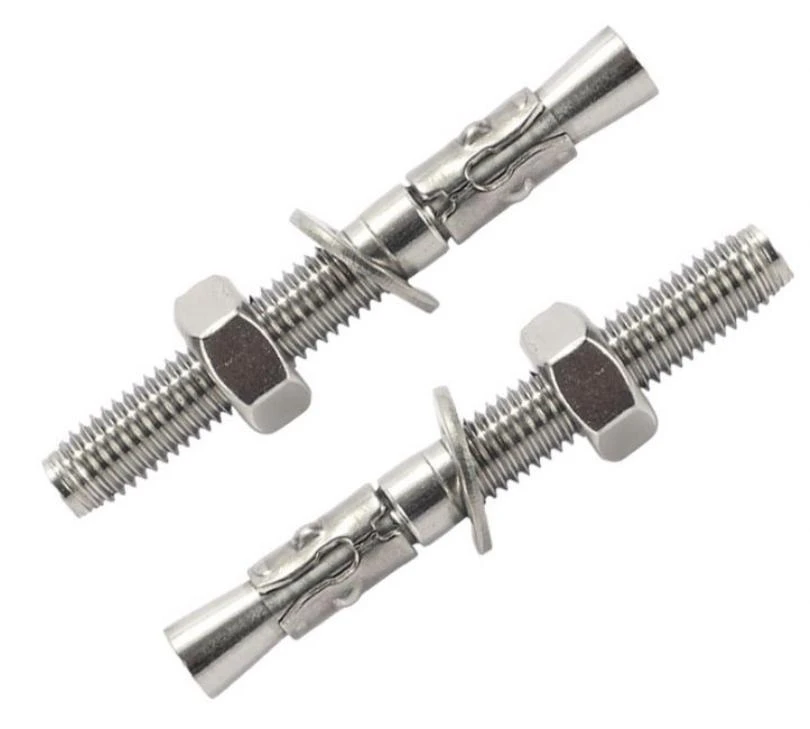 1/2 Wedge Anchor 18-8ss with Nut and Washer 304 Wedge Anchor Bolt and Nut and Washer
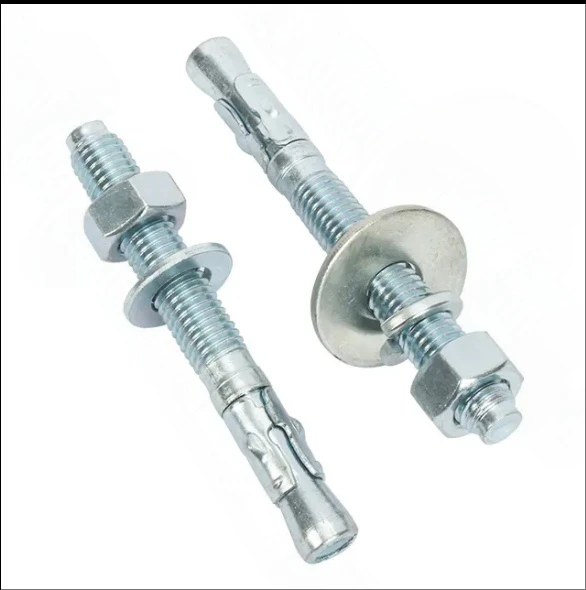 1/4 3/8 1/2 5/8 3/4 Concrete Bolts SS304 SS316 Wedge Anchor
 3/8 X 1-7/8-Inch Concrete Metal Anchor Hex Head Flange Nut Sleeve Anchors Bolt
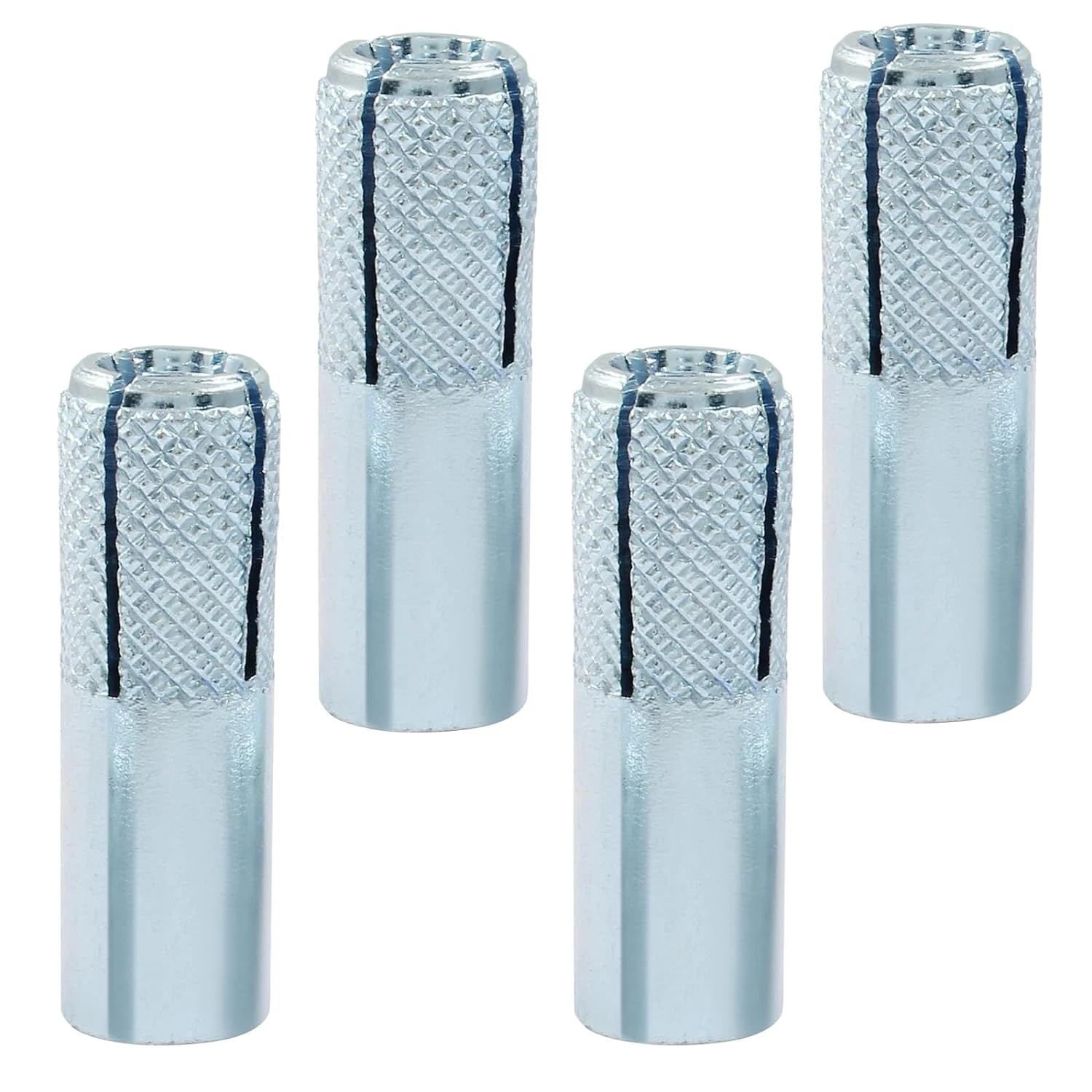 1/2 Inch Drop in Anchors Zinc Plated Carbon Steel Concrete Knurled Internal Forced Expansion Screw Bolts for Home and Construction
Frequently asked questions
Which concrete anchor holds the most weight?
In solid, uncracked concrete a wedge anchor generally has the highest tension capacity of the common mechanical anchors at the same diameter. For the heaviest or cracked-concrete loads, engineers often specify adhesive (chemical) anchors or heavy-duty screw anchors with an evaluation report.
Can I use a wedge anchor in brick or block?
It is not recommended. Wedge anchors expand over a short length and can crack brick or pull out of hollow block. Use a sleeve anchor, a screw anchor rated for masonry, or an adhesive anchor with a screen tube.
What size drill bit do I need for a concrete anchor?
Wedge and sleeve anchors use a bit equal to the anchor diameter. Drop-in anchors use a larger bit (often 1/2″ for a 3/8″ drop-in). Screw anchors use a smaller bit (5/32″ for 3/16″, 3/16″ for 1/4″). Always confirm on the product data sheet.
Are concrete screw anchors reusable?
Light-duty screw anchors can often be removed and reused for temporary work. Structural screw anchors are normally rated for one installation; reusing them can reduce capacity.
How far from the edge of a slab should an anchor be?
A common rule of thumb is at least 5 anchor diameters from a free edge and 10 diameters between anchors, but the manufacturer’s evaluation data governs for any rated application.
Related reading
Sources & further reading
Figures in this article are typical values for orientation. Always confirm against the governing standard and the manufacturer’s data for your part, and have safety-critical connections designed by a qualified engineer.