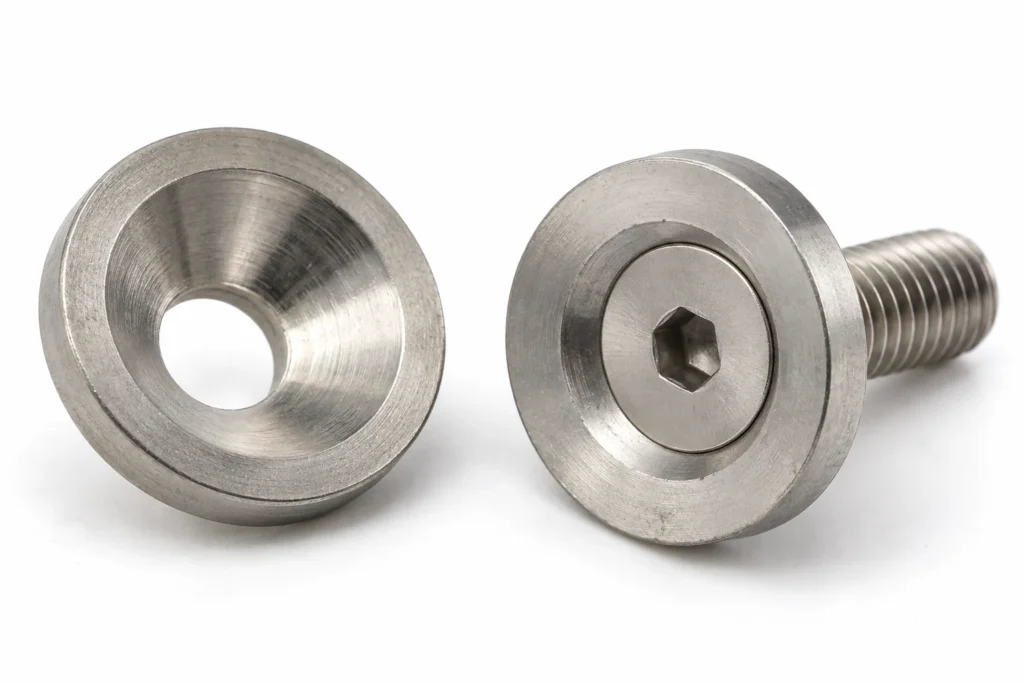
Stamping is used at Engineering Hardware to make custom washers, retaining rings, panel latches & catches to a customer drawing. Cutting and forming sheet metal between a punch and a die, usually in one press stroke per part. The minimum order is 2,000–5,000 pieces and samples follow within 7 days of the drawing being approved.
Cutting and forming sheet metal between a punch and a die, usually in one press stroke per part.
Everything flat and thin in a fastener catalog comes from here: washers, retaining rings, spring clips, tab washers, panel clips, shims. A progressive die carries the strip through several stations so that blanking, forming and piercing all happen in one pass, which is why stamped parts are measured in fractions of a cent at volume. The die is the whole investment, and it is why stamping has a real minimum quantity.
What Stamping is the right choice for
- Flat and formed sheet parts at volume
- Washers, clips, retaining rings, spring steel parts
- Consistent parts at very low unit cost
Where it is the wrong choice
- Die cost has to be amortised — the wrong process for small runs
- Thickness is limited by press capacity
- Cut edges carry a burr that may need removing
Parts produced this way
- Custom Washer — 56 standard parts in the catalog
- Custom Retaining Ring — 9 standard parts in the catalog
- Custom Panel Latch — 7 standard parts in the catalog
- Custom Support & Bracket — 14 standard parts in the catalog
Usually combined with
Stamping is rarely the only operation on a part. On most jobs it sits in a sequence with:
Order terms
- Minimum order
- 2,000–5,000 pieces. The exact figure depends on the part: it is set by the tooling the drawing calls for, and is confirmed when the drawing has been reviewed.
- Samples
- Within 7 days of drawing approval.
- Drawing
- Preferred, but not required — a sample, photographs or a sketch is enough to start.
What a quotation needs
Nine things, and a drawing settles most of them at once. Where a field is unknown, say so — an assumption stated is better than a blank, and several of these can be recommended rather than specified.
- Drawing
- A 2D drawing (PDF or DWG) or a 3D model settles almost every other question on this list at once.
- Dimensions
- Diameter, length, head size and any features — enough to know what is being made.
- Tolerance
- Tolerance is the single biggest cost driver. Tell us which dimensions are critical and which are not — holding everything tight costs money on features nobody measures.
- Material
- Carbon steel, alloy steel, stainless, brass, aluminium, titanium — or the application, and we will suggest one.
- Strength grade
- Property class to ISO 898-1 (8.8, 10.9, 12.9) or stainless class to ISO 3506 (A2-70, A4-80). This decides the material and the heat treatment together.
- Thread standard
- Metric coarse, metric fine, UNC, UNF, BSW or a pipe thread — and the tolerance class if it is specified.
- Surface finish
- Zinc, hot-dip galvanised, black oxide, Dacromet, Geomet, nickel, passivation, or plain. Salt-spray hours if you have a requirement.
- Quantity
- Annual volume and first-order quantity. Volume changes which process is the right one, so it changes the price more than most buyers expect.
- Application & environment
- What the part holds together, and what it has to survive — temperature, vibration, chemicals, salt. This is what lets us catch a specification that will not work before it is made.
Draw it here
No CAD, no account, nothing to install. Draw the part in your browser, generate a real ISO metric thread from M1 to M100 with the end treatment it needs, dimension it, and export a PDF or a DXF to attach below. Sheets run to two metres for long studs and threaded rod.
Questions
What is the minimum order quantity for a custom part?
Between 2,000 and 5,000 pieces for most parts. The exact figure depends on the part: it is set by the tooling the drawing calls for, and is confirmed when the drawing has been reviewed.
How long does a sample take?
Within 7 days once the drawing has been approved. The drawing stage comes first, and for a part being reverse-engineered from a sample it is where most of the time goes.
Can you make a part without a drawing?
Yes. A physical sample, photographs against a scale, or a dimensioned sketch are all workable starting points. A drawing is produced from whichever of those you have and sent back for approval before anything is made.
When is Stamping not the right process?
Die cost has to be amortised — the wrong process for small runs. Thickness is limited by press capacity. Cut edges carry a burr that may need removing.
Which fasteners are made by stamping?
In this catalog: washer, retaining ring, panel latch, support & bracket. Whether it is the right process for a particular part depends on the drawing and the quantity.