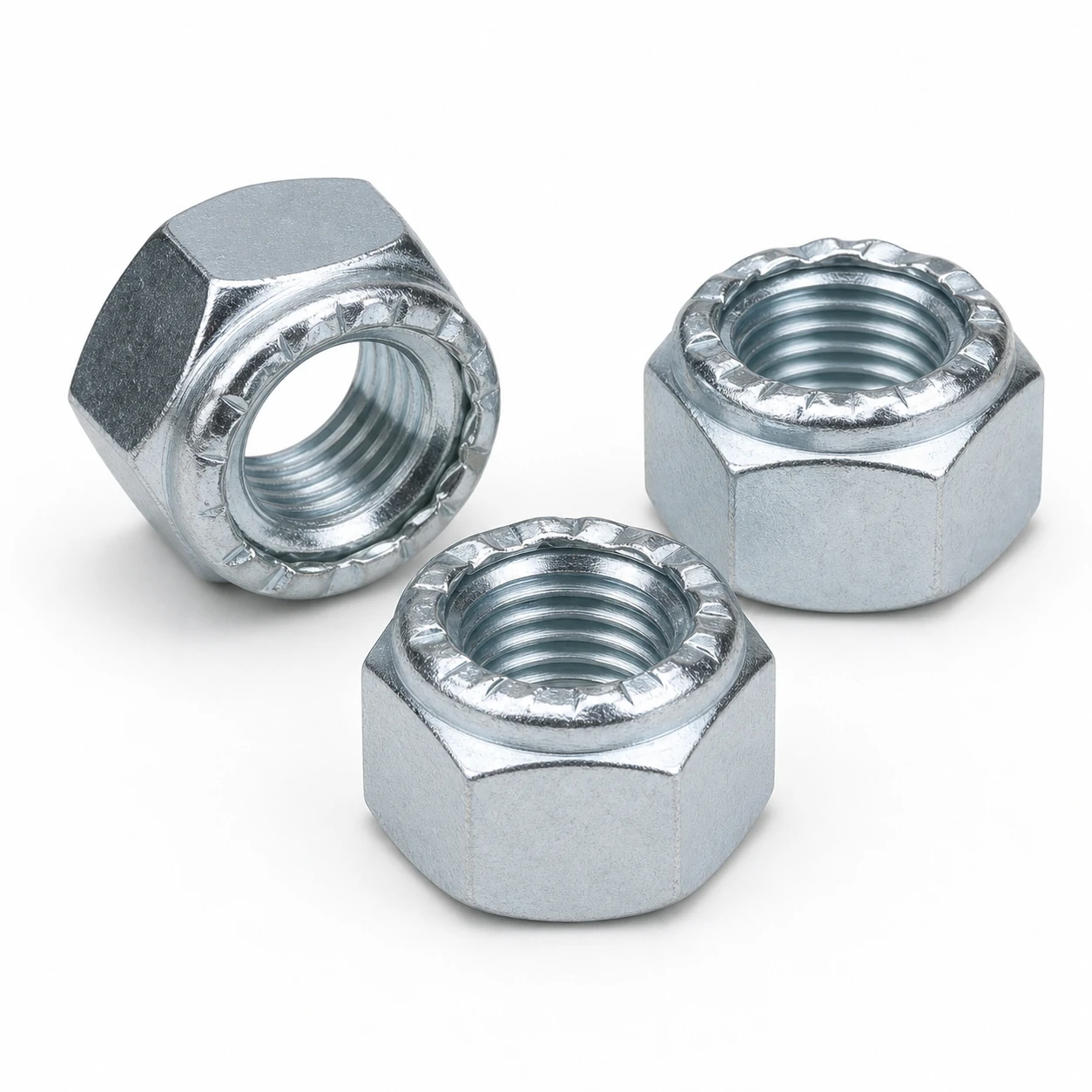
Material specification page for all-metal lock nuts in A2 Stainless Steel. Covers the grade designation (ISO 3506 group A2 (304 / 1.4301), commonly supplied A2-70), corrosion and magnetic behavior, comparable grades and their trade-offs, and the sizes available to ISO 7042 / DIN 980.
Why Choose A2 Stainless Steel for All-Metal Lock Nuts
The most common stainless group for indoor and general outdoor fasteners. For all-metal lock nuts, this matters when good general corrosion resistance is the primary requirement.
Mechanical & Physical Properties
| Grade designation | ISO 3506 group A2 (304 / 1.4301), commonly supplied A2-70 |
|---|---|
| Magnetic response | Largely non-magnetic |
| Service temperature | approx. -200 °C to +400 °C, subject to the property class and the joint |
| Corrosion characteristic | Good general corrosion resistance |
Corrosion Behavior in Service
A2 (304) gives excellent atmospheric and most-water corrosion resistance and is the most common stainless for All-Metal Lock Nuts in indoor and general outdoor service. In chloride-bearing environments (marine air, road salt, swimming pools) consider stepping up to A4 (316).
Comparable Grades
For All-Metal Lock Nuts, the alternative stainless grade is A4 (316). A2 (304) suits general indoor and outdoor service; A4 (316) adds molybdenum for marine and chloride environments. Where higher strength matters more than corrosion, switch to plated alloy-steel class 8.8 or 10.9.
Using Stainless Fasteners in Aluminum
Stainless steel is more noble than aluminum, so in the presence of an electrolyte — rain, condensation, salt spray — the aluminum becomes the anode and corrodes at the joint. The effect is driven by the area ratio: a small stainless fastener in a large aluminum section is normally acceptable, while a large stainless fastener in thin aluminum is not. Where the joint is wet, isolate the two metals with a coated or nylon washer and a sealant, or specify an aluminum or coated fastener instead.
Sizes of All-Metal Lock Nuts Available in A2 Stainless Steel
| Size | Pitch (mm) | Width across flats s (mm) | Nut height m (mm) | Reference standard | Notes |
|---|---|---|---|---|---|
| M5 | 0.8 | 8.0 | 6.0 | ISO 7042 / DIN 980 | Deformed-top locking, high-temperature capable |
| M6 | 1.0 | 10.0 | 7.0 | ISO 7042 / DIN 980 | Deformed-top locking, high-temperature capable |
| M8 | 1.25 | 13.0 | 9.0 | ISO 7042 / DIN 980 | Deformed-top locking, high-temperature capable |
| M10 | 1.5 | 16.0 | 11.0 | ISO 7042 / DIN 980 | Deformed-top locking, high-temperature capable |
| M12 | 1.75 | 18.0 | 13.0 | ISO 7042 / DIN 980 | Deformed-top locking, high-temperature capable |
| M14 | 2.0 | 21.0 | 15.0 | ISO 7042 / DIN 980 | Deformed-top locking, high-temperature capable |
| M16 | 2.0 | 24.0 | 17.0 | ISO 7042 / DIN 980 | Deformed-top locking, high-temperature capable |
| M18 | 2.5 | 27.0 | 19.0 | ISO 7042 / DIN 980 | Deformed-top locking, high-temperature capable |
| M20 | 2.5 | 30.0 | 21.0 | ISO 7042 / DIN 980 | Deformed-top locking, high-temperature capable |
| M24 | 3.0 | 36.0 | 24.0 | ISO 7042 / DIN 980 | Deformed-top locking, high-temperature capable |
| M30 | 3.5 | 46.0 | 30.0 | ISO 7042 / DIN 980 | Deformed-top locking, high-temperature capable |
| M36 | 4.0 | 55.0 | 36.0 | ISO 7042 / DIN 980 | Deformed-top locking, high-temperature capable |