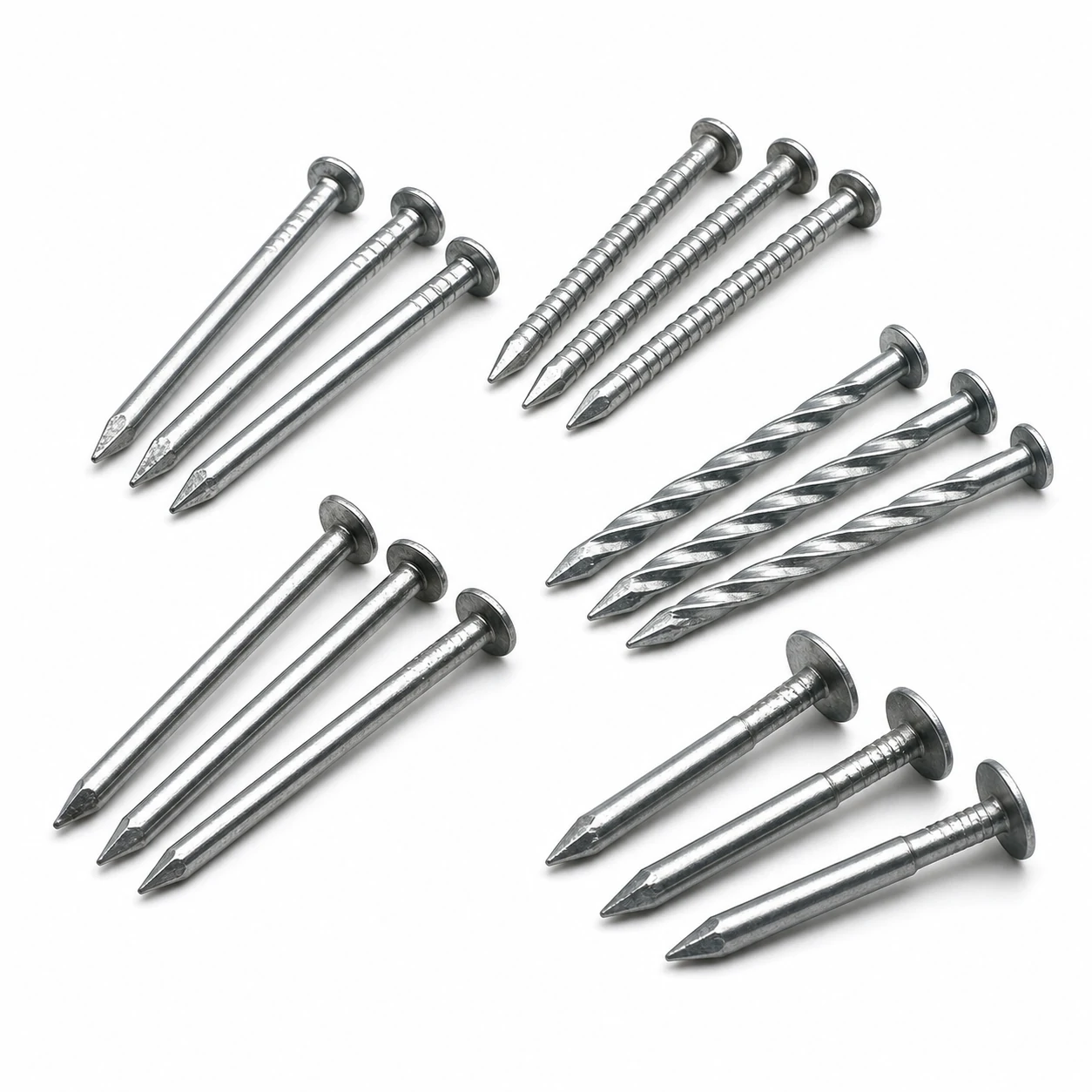
Mechanical properties, corrosion behaviour and the full dimensional range for this grade.
A2 Stainless Steel Specialty Nails are supplied to ISO 3506 group A2 (304 / 1.4301), commonly supplied A2-70. Corrosion behaviour is good general corrosion resistance, the material is largely non-magnetic, and the usable service range is approx. -200 °C to +400 °C, subject to the property class and the joint. In practice this grade is the most common stainless group for indoor and general outdoor fasteners.
Grade
ISO 3506 group A2 (304 / 1.4301), commonly supplied A2-70
Corrosion resistance
Good general corrosion resistance
Magnetic response
Largely non-magnetic
Service temperature
approx. -200 °C to +400 °C, subject to the property class and the joint
Property values are typical for the grade. Certified mechanical test data is available on request for production orders.
Hidden Deck Fasteners Sourcing: Manufacturing, Types & Material Compatibility
A2 Stainless Steel is not a material specialty nails are supplied in. Specialty Nails are specified by size designation, and this combination does not describe a part that exists.
A2 Stainless Steel is one of the grades the catalog describes. Dimensions, material, finish and form are specified from the drawing — a nail outside the standard range is a variation on existing tooling rather than a new design.
Minimum order from 2,000 pieces; samples within 7 days of drawing approval.
Customize the parameters below — every spec field is editable, and the drawing redraws to match the values you choose. Changing the size will snap the other fields to that size's standard values; you can then override any individual value.
Dimensioned line drawing of Round steel nail Specialty Nails to Industry standard. Side view and top view, drawn to the dimensions in the table below and redrawn for any size selected.
Diameter (mm)
1.8
Common length range (mm)
32~65
Head diameter (mm)
4.5
Point form
Pointed
Application
General woodworking
Sends the selected values to the quote form below.
Request a Quote
The form below follows the current technical drawing configuration. Change the drawing values above and the request details update automatically.
Dimensions & Specifications (Industry standard)
Nail type
Diameter (mm)
Common length range (mm)
Head diameter (mm)
Point form
Application
Reference standard
Round steel nail
1.8
32~65
4.5
Pointed
General woodworking
DIN 1151
Round steel nail
2.5
45~90
6.5
Pointed
General woodworking
DIN 1151
Round steel nail
3.1
60~120
7.5
Pointed
Structural woodworking
DIN 1151
Round steel nail
3.8
80~150
9.5
Pointed
Structural woodworking
DIN 1151
Spiral nail
2.5
45~90
5.5
Pointed
Pallet / crate
Industry standard
Spiral nail
3.1
60~120
7.5
Pointed
Pallet / crate
Industry standard
Ring-shank nail
2.5
45~75
6.5
Pointed
Pull-out resistant
DIN 1052
Ring-shank nail
3.1
60~100
7.5
Pointed
Pull-out resistant
DIN 1052
Concrete steel nail
2.5
20~50
5.5
Hardened taper
Concrete / masonry
Industry standard
Concrete steel nail
3.0
30~60
6.5
Hardened taper
Concrete / masonry
Industry standard
Pneumatic nail
1.6
15~50
3.0
D-head
For nail gun
Industry standard
Pneumatic nail
2.0
25~65
3.5
D-head
For nail gun
Industry standard
Staple
1.4
10~20
-
Double-pointed
Cable / hose fixing
Industry standard
Staple
1.8
14~25
-
Double-pointed
Cable / hose fixing
Industry standard
Staple
2.0
16~32
-
Double-pointed
Cable / hose fixing
Industry standard
Materials & Grades
Select a material class to see the grades we supply it in. Each designation is listed with its ISO/EN, AISI/SAE, JIS and GB equivalents.
Third-party video, selected automatically for this topic. It is not produced by Engineering Hardware and is not a specification source — use the tables on this page for dimensional data.
Inside the plant
Manufactured in our own plant
This part is cold-formed, threaded, heat-treated and finished in-house. The stages below are where its class and finish are actually decided.
01
Cold heading
Wire rod is drawn to size and cold-formed into blanks. Forming rather than cutting keeps the grain flow continuous around the head, which is where a bolt is most likely to fail.
Head dimensions and under-head radius checked at set-up and per shift.
02
Thread rolling
Threads are rolled between hardened dies rather than cut. Rolled threads are stronger in fatigue than cut threads and hold pitch and flank angle far more consistently across a batch.
Go / no-go ring gauges to ISO 965 tolerance class 6g.
03
Heat treatment
Quench-and-temper brings carbon and alloy steel to the property class ordered — 8.8, 10.9 or 12.9 — with the furnace charge tracked so a finished lot can be traced back to it.
Core hardness and tensile tested per lot to ISO 898-1.
04
Surface treatment
Zinc, zinc-nickel, hot-dip galvanizing, black oxide, phosphate and Dacromet, selected against the service environment rather than against the price list.
Coating thickness and neutral salt spray hours to ISO 9227.
Frequently Asked Questions
Can A2 Stainless Steel Specialty Nails be used with aluminum?
Yes, but stainless drives mild galvanic corrosion of aluminum in wet service — isolate with a coating, sleeve or paint, or accept the trade-off if the joint is dry and indoor.
What's the service temperature limit for A2 Stainless Steel?
The practical service range is approx. -200 °C to +400 °C, subject to the property class and the joint.
Can A2 Stainless Steel replace plated alloy steel structurally?
Only at the standard strength classes — A2-70 / A4-80 are roughly equivalent to class 7 steel; A4-100 reaches class 8.8. For class 10.9 or 12.9 strength, plated alloy steel is required.
Are A2 Stainless Steel Specialty Nails magnetic?
A2 Stainless Steel Specialty Nails are largely non-magnetic.
How do I request a quotation?
Use the technical drawing on this page to pick the exact configuration, then submit it with the quote form. We respond within one business day.
This website uses only necessary and functional cookies to operate, secure, and improve basic website performance.
We do not use advertising cookies, Google Analytics, or cross-site tracking technologies.
Privacy Policy