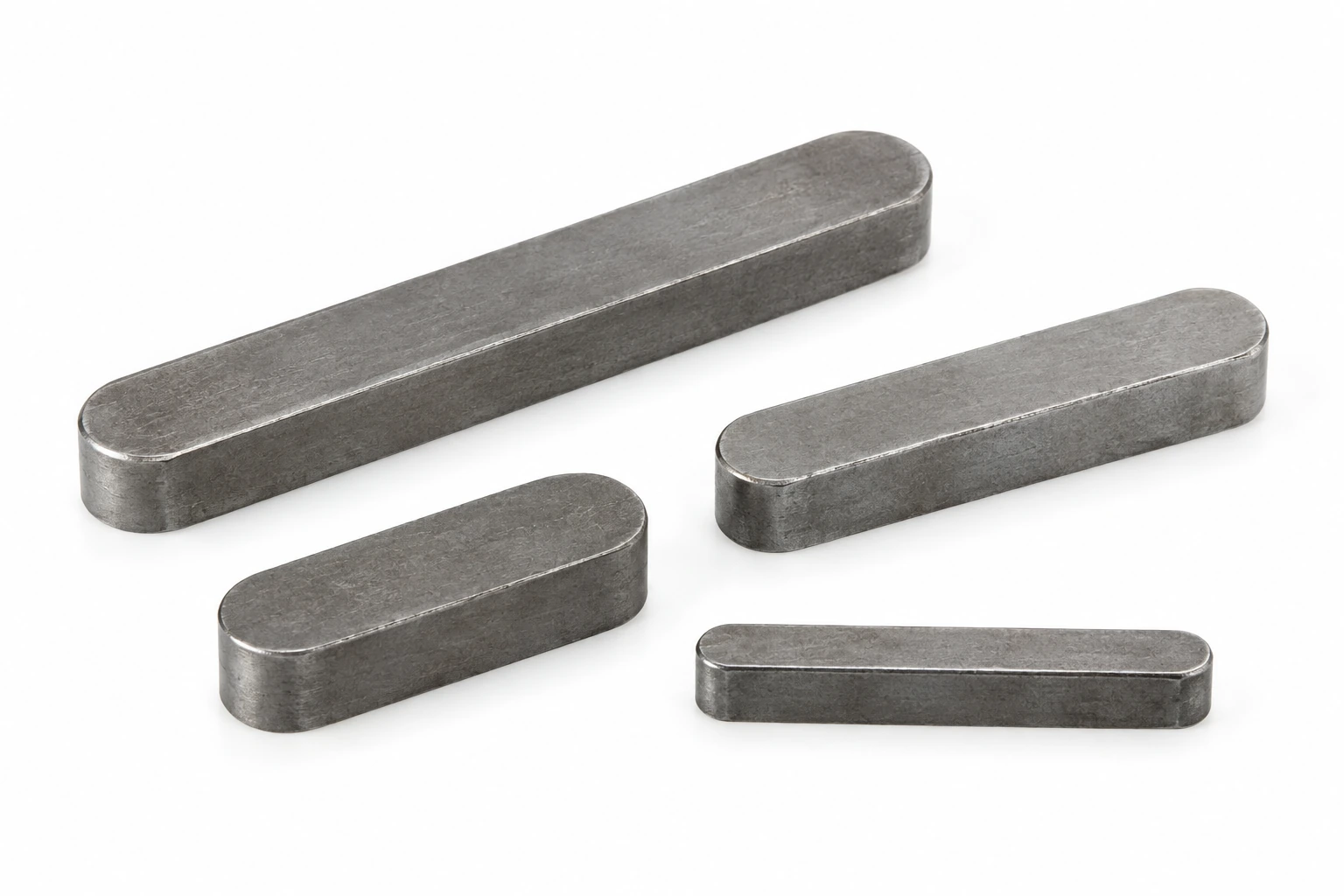
Material specification page for feather (sliding) keys in A4 Stainless Steel. Covers the grade designation (ISO 3506 group A4 (316 / 1.4401), commonly supplied A4-80), corrosion and magnetic behavior, comparable grades and their trade-offs, and the sizes available to DIN 6885 Form B / sliding key practice.
Why Choose A4 Stainless Steel for Feather (Sliding) Keys
Specified for marine, coastal and chemical applications. For feather (sliding) keys, this matters when superior, including marine and chloride environments is the primary requirement.
Mechanical & Physical Properties
| Grade designation | ISO 3506 group A4 (316 / 1.4401), commonly supplied A4-80 |
|---|---|
| Magnetic response | Largely non-magnetic |
| Service temperature | approx. -200 °C to +400 °C, subject to the property class and the joint |
| Corrosion characteristic | Superior, including marine and chloride environments |
Corrosion Behavior in Service
A4 (316) adds 2–3% molybdenum to the A2 (304) composition, which dramatically improves resistance to chloride-pitting corrosion. For Feather (Sliding) Keys in marine, coastal, swimming-pool or food-processing environments, A4 is the default selection.
Comparable Grades
For Feather (Sliding) Keys, the alternative stainless grade is A2 (304). A2 (304) covers general indoor and outdoor service. A4 (316) adds molybdenum, which is what buys the chloride resistance for marine and de-icing-salt exposure. Where strength matters more than corrosion, plated alloy steel in class 8.8 or 10.9 is the swap to make.
Using Stainless Fasteners in Aluminum
The galvanic couple here runs the wrong way: aluminum is the less noble metal, so it corrodes and the fastener does not. What governs the rate is the ratio of areas — a large anode and a small cathode is a tolerable combination, the reverse concentrates the attack into thin material around the hole. An isolating washer plus sealant breaks the circuit; where that is impractical, match the fastener to the substrate.
Sizes of Feather (Sliding) Keys Available in A4 Stainless Steel
| Key width b (mm) | Key height h (mm) | Shaft diameter range (mm) | Fixing |
|---|---|---|---|
| 5 | 5 | 12 u2013 17 | one countersunk screw |
| 6 | 6 | 17 u2013 22 | one countersunk screw |
| 8 | 7 | 22 u2013 30 | two countersunk screws |
| 10 | 8 | 30 u2013 38 | two countersunk screws |
| 12 | 8 | 38 u2013 44 | two countersunk screws |
| 14 | 9 | 44 u2013 50 | two countersunk screws |
| 16 | 10 | 50 u2013 58 | two countersunk screws |
| 18 | 11 | 58 u2013 65 | two countersunk screws |
| 20 | 12 | 65 u2013 75 | two countersunk screws |