
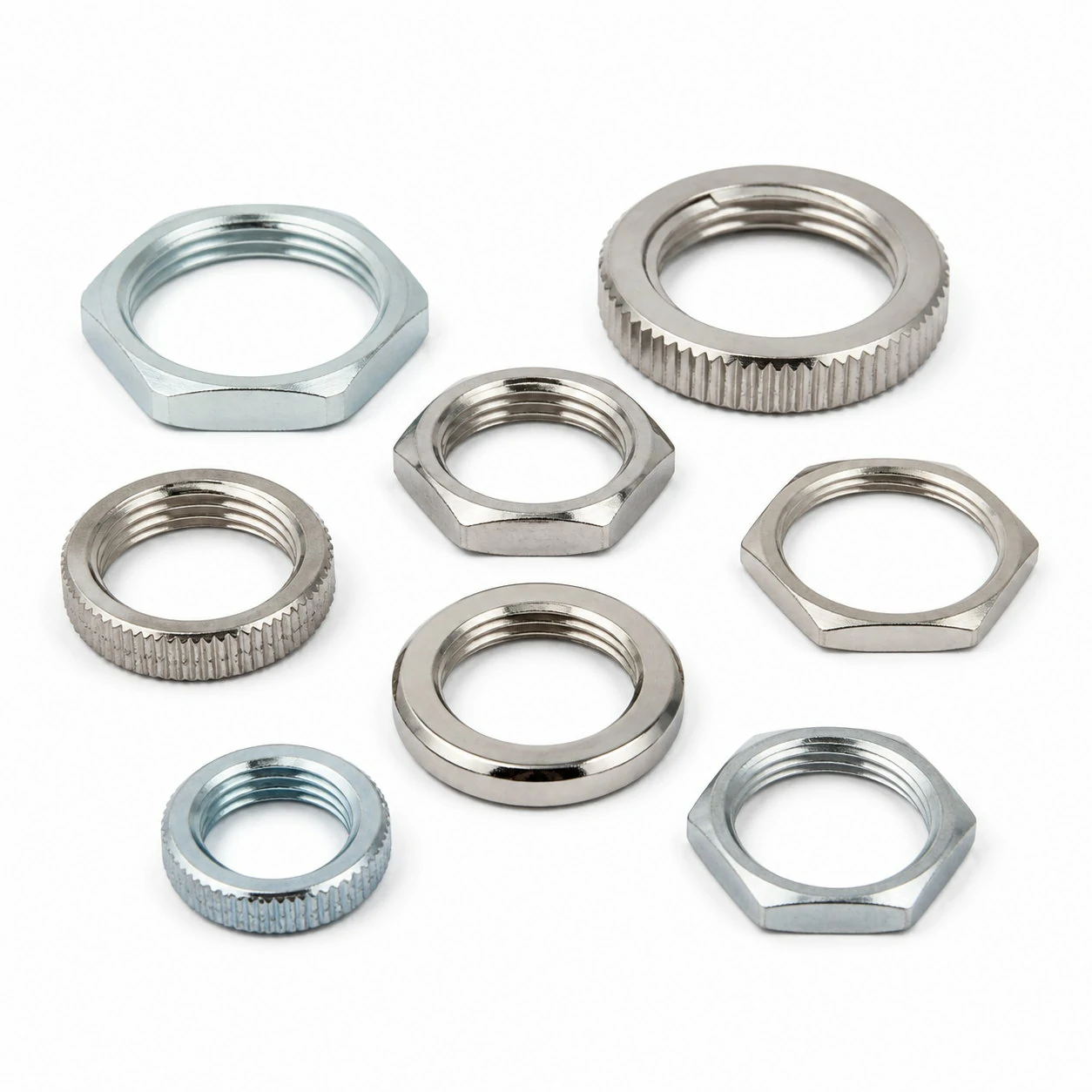
A4 Stainless Steel Panel Nuts (Thin, Fine Pitch) combine the dimensional form of DIN 439 with the material properties of grade ISO 3506 group A4 (316 / 1.4401), commonly supplied A4-80: superior, including marine and chloride environments, largely non-magnetic, service range approx. -200 °C to +400 °C, subject to the property class and the joint. This page summarizes the grade data, its corrosion behavior in service, the comparable grades, and the sizes supplied.
Why Choose A4 Stainless Steel for Panel Nuts (Thin, Fine Pitch)
Specified for marine, coastal and chemical applications. For panel nuts (thin, fine pitch), this matters when superior, including marine and chloride environments is the primary requirement.
Mechanical & Physical Properties
| Grade designation | ISO 3506 group A4 (316 / 1.4401), commonly supplied A4-80 |
|---|---|
| Magnetic response | Largely non-magnetic |
| Service temperature | approx. -200 °C to +400 °C, subject to the property class and the joint |
| Corrosion characteristic | Superior, including marine and chloride environments |
Galvanic & Galling Considerations
Two important notes for stainless panel nuts (thin, fine pitch): (1) stainless can gall on stainless threads under load — use a thread lubricant or anti-galling compound, especially for M6 and below; (2) when joined to aluminum or galvanized steel, stainless can drive galvanic corrosion of the less-noble metal in wet service — isolate with a coating or sleeve where appropriate.
Comparable Grades
For Panel Nuts (Thin, Fine Pitch), the alternative stainless grade is A2 (304). Choose A2 (304) for general use and A4 (316) wherever chlorides are present; the molybdenum in A4 is the whole difference. Remember that stainless is the corrosion answer, not the strength answer — for load, look at class 8.8 or 10.9 instead.
Using Stainless Fasteners in Aluminum
The galvanic couple here runs the wrong way: aluminum is the less noble metal, so it corrodes and the fastener does not. What governs the rate is the ratio of areas — a large anode and a small cathode is a tolerable combination, the reverse concentrates the attack into thin material around the hole. An isolating washer plus sealant breaks the circuit; where that is impractical, match the fastener to the substrate.
Sizes of Panel Nuts (Thin, Fine Pitch) Available in A4 Stainless Steel
| Thread size | Pitch (mm) | Across flats s (mm) | Across corners e (mm) | Nut height m (mm) | Typical application | Reference standard |
|---|---|---|---|---|---|---|
| M6x0.75 | 0.75 | 10 | 11.05 | 3.2 | Potentiometer bushing | DIN 439 B |
| M8x0.75 | 0.75 | 13 | 14.38 | 4.0 | Toggle switch bushing | DIN 439 B |
| M9x0.75 | 0.75 | 14 | 15.51 | 4.0 | Rotary switch bushing | DIN 439 B |
| M10x0.75 | 0.75 | 17 | 18.90 | 5.0 | Indicator lamp | DIN 439 B |
| M12x1 | 1.0 | 19 | 21.10 | 5.0 | Cable gland PG/M12 | DIN 439 B |
| M16x1.5 | 1.5 | 24 | 26.75 | 6.0 | Cable gland M16 | DIN 439 B |
| M20x1.5 | 1.5 | 30 | 33.53 | 8.0 | Cable gland M20 | DIN 439 B |
Dimensions are independent of the material: every size above is available in A4 Stainless Steel.
Custom manufacturing · Made to drawing
Need this nut in a grade that is not listed?
A4 Stainless Steel is one of the grades the catalog describes. Height and across-flats are the two most often changed — a thinner nut for clearance, a larger hex for a tool that is already on the line. Made by cold heading or tapping.
Minimum order from 2,000 pieces; samples within 7 days of drawing approval.



