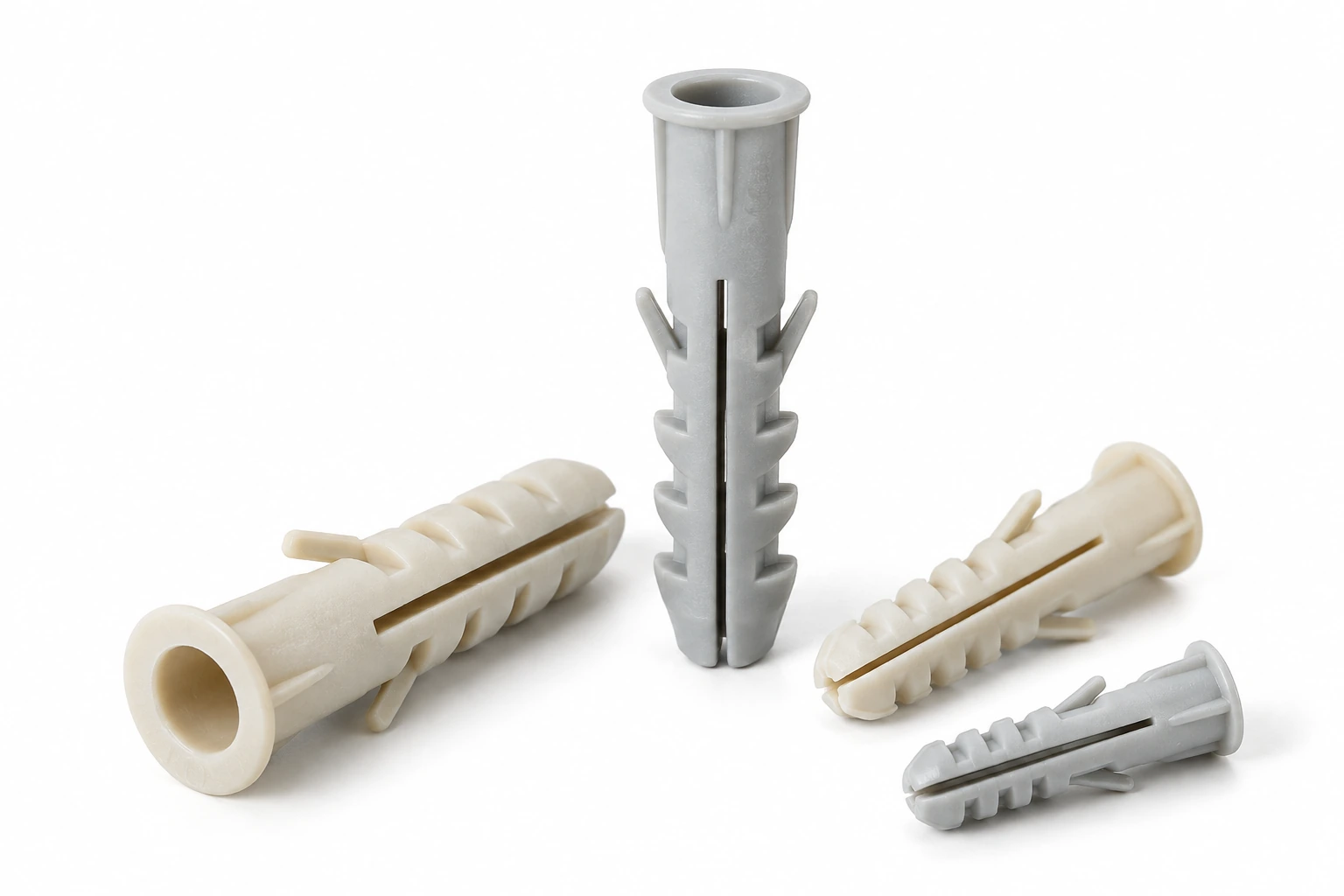
Mechanical properties, corrosion behaviour and the full dimensional range for this grade.
A4 Stainless Steel Plastic Expansion Wall Plugs are supplied to ISO 3506 group A4 (316 / 1.4401), commonly supplied A4-80. Corrosion behaviour is superior, including marine and chloride environments, the material is largely non-magnetic, and the usable service range is approx. -200 °C to +400 °C, subject to the property class and the joint. In practice this grade is specified for marine, coastal and chemical applications.
Grade
ISO 3506 group A4 (316 / 1.4401), commonly supplied A4-80
Corrosion resistance
Superior, including marine and chloride environments
Magnetic response
Largely non-magnetic
Service temperature
approx. -200 °C to +400 °C, subject to the property class and the joint
Property values are typical for the grade. Certified mechanical test data is available on request for production orders.
Hidden Deck Fasteners Sourcing: Manufacturing, Types & Material Compatibility
A4 Stainless Steel (ISO 3506 group A4 (316 / 1.4401), commonly supplied A4-80) is specified for marine, coastal and chemical applications. When plastic expansion wall plugs are specified in this grade, the dimensions remain per JG/T 139 / ETAG 020; the material determines corrosion behavior (superior, including marine and chloride environments) and the service temperature range (approx. -200 °C to +400 °C, subject to the property class and the joint). Both are covered below with the size table.
Why Choose A4 Stainless Steel for Plastic Expansion Wall Plugs
Specified for marine, coastal and chemical applications. For plastic expansion wall plugs, this matters when superior, including marine and chloride environments is the primary requirement.
Mechanical & Physical Properties
Grade designation
ISO 3506 group A4 (316 / 1.4401), commonly supplied A4-80
Magnetic response
Largely non-magnetic
Service temperature
approx. -200 °C to +400 °C, subject to the property class and the joint
Corrosion characteristic
Superior, including marine and chloride environments
Galvanic & Galling Considerations
Two important notes for stainless plastic expansion wall plugs: (1) stainless can gall on stainless threads under load — use a thread lubricant or anti-galling compound, especially for M6 and below; (2) when joined to aluminum or galvanized steel, stainless can drive galvanic corrosion of the less-noble metal in wet service — isolate with a coating or sleeve where appropriate.
Comparable Grades
For Plastic Expansion Wall Plugs, the alternative stainless grade is A2 (304). A2 (304) covers general indoor and outdoor service. A4 (316) adds molybdenum, which is what buys the chloride resistance for marine and de-icing-salt exposure. Where strength matters more than corrosion, plated alloy steel in class 8.8 or 10.9 is the swap to make.
Using Stainless Fasteners in Aluminum
The galvanic couple here runs the wrong way: aluminum is the less noble metal, so it corrodes and the fastener does not. What governs the rate is the ratio of areas — a large anode and a small cathode is a tolerable combination, the reverse concentrates the attack into thin material around the hole. An isolating washer plus sealant breaks the circuit; where that is impractical, match the fastener to the substrate.
Sizes of Plastic Expansion Wall Plugs Available in A4 Stainless Steel
Tube diameter (mm)
Body material
Mating screw
Substrate
Typical duty
5
PE or nylon
wood screw or self-tapping screw
brick / concrete / gypsum board
decorative trim and light fixtures
6
PE or nylon
wood screw or self-tapping screw
brick / concrete / gypsum board
light fixtures and cabinet rails
8
PE or nylon
wood screw or self-tapping screw
brick / concrete / gypsum board
cabinets and light wall-mounted units
10
PE or nylon
wood screw or self-tapping screw
brick / concrete
heavier cabinet and rail mounting
Technical Drawing
Customize the parameters below — every spec field is editable, and the drawing redraws to match the values you choose. Changing the size will snap the other fields to that size's standard values; you can then override any individual value.
Sends the selected values to the quote form below.
Request a Quote
The form below follows the current technical drawing configuration. Change the drawing values above and the request details update automatically.
Dimensions & Specifications (JG/T 139 / ETAG 020)
Tube diameter (mm)
Body material
Mating screw
Substrate
Typical duty
5
PE or nylon
wood screw or self-tapping screw
brick / concrete / gypsum board
decorative trim and light fixtures
6
PE or nylon
wood screw or self-tapping screw
brick / concrete / gypsum board
light fixtures and cabinet rails
8
PE or nylon
wood screw or self-tapping screw
brick / concrete / gypsum board
cabinets and light wall-mounted units
10
PE or nylon
wood screw or self-tapping screw
brick / concrete
heavier cabinet and rail mounting
Applications & Industries
Where Plastic Expansion Wall Plugs are used, and what decides the specification in each case. Stocked from 5 to 10 (nominal diameter).
Industries that specify Plastic Expansion Wall Plugs
Interior fit-outPlastic plugs carry trim, light fittings and cabinet rails.
Residential buildingNylon bodies suit brick, concrete and gypsum board.
Retail displayLight-load fixing without specialist tooling.
MaintenanceCommon sizes cover most small wall fixings.
Construction & structuralBase plates, brackets and steelwork fixed to concrete.
Building servicesSuspending tray, duct, pipe and sprinkler runs from a soffit.
Typical applications
matching the plug diameter to the drill and the screw shank
choosing a wood or self-tapping screw so the thread expands the body
selecting tube length for the substrate thickness
keeping the load light and static
making a load-bearing threaded fixing in concrete or masonry
fixing a steel fixture through to a solid substrate
Service conditions to specify against
Marine and coastal
Available in A4 (316) stainless for chloride exposure — coastal structures, pool halls, water treatment and deck hardware, where A2 will eventually pit.
Temperature ceiling
The polymer feature sets the limit, not the steel: nylon softens above roughly 120 °C, so an all-metal locking type is the correct choice on hot assemblies.
The concrete governs
Capacity is a property of the base material and the geometry — grade, edge distance, spacing and cracked or uncracked — not of the anchor alone. Work to the anchor manufacturer's ETA or ICC-ES report.
Hole preparation
Drilled diameter, depth and cleanliness are part of the specification; an uncleaned hole is the single most common cause of a failed anchor.
Where to use something else
Do not use a light-duty plastic plug for overhead or safety-critical loads; ETAG 020 assessment is per manufacturer and per substrate.
Not for a substrate the type is not qualified in — an expansion anchor near an edge or in hollow block will split it.
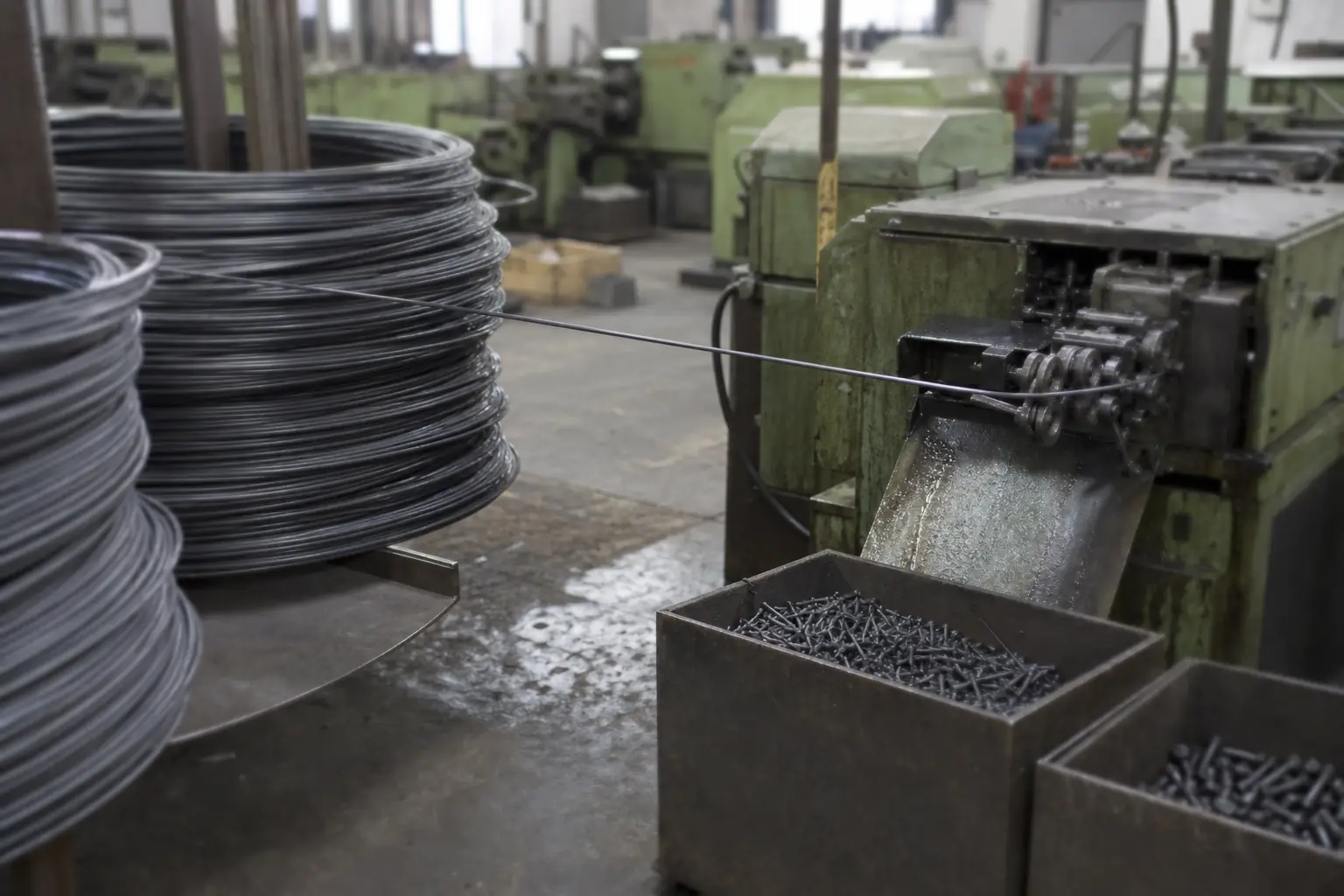
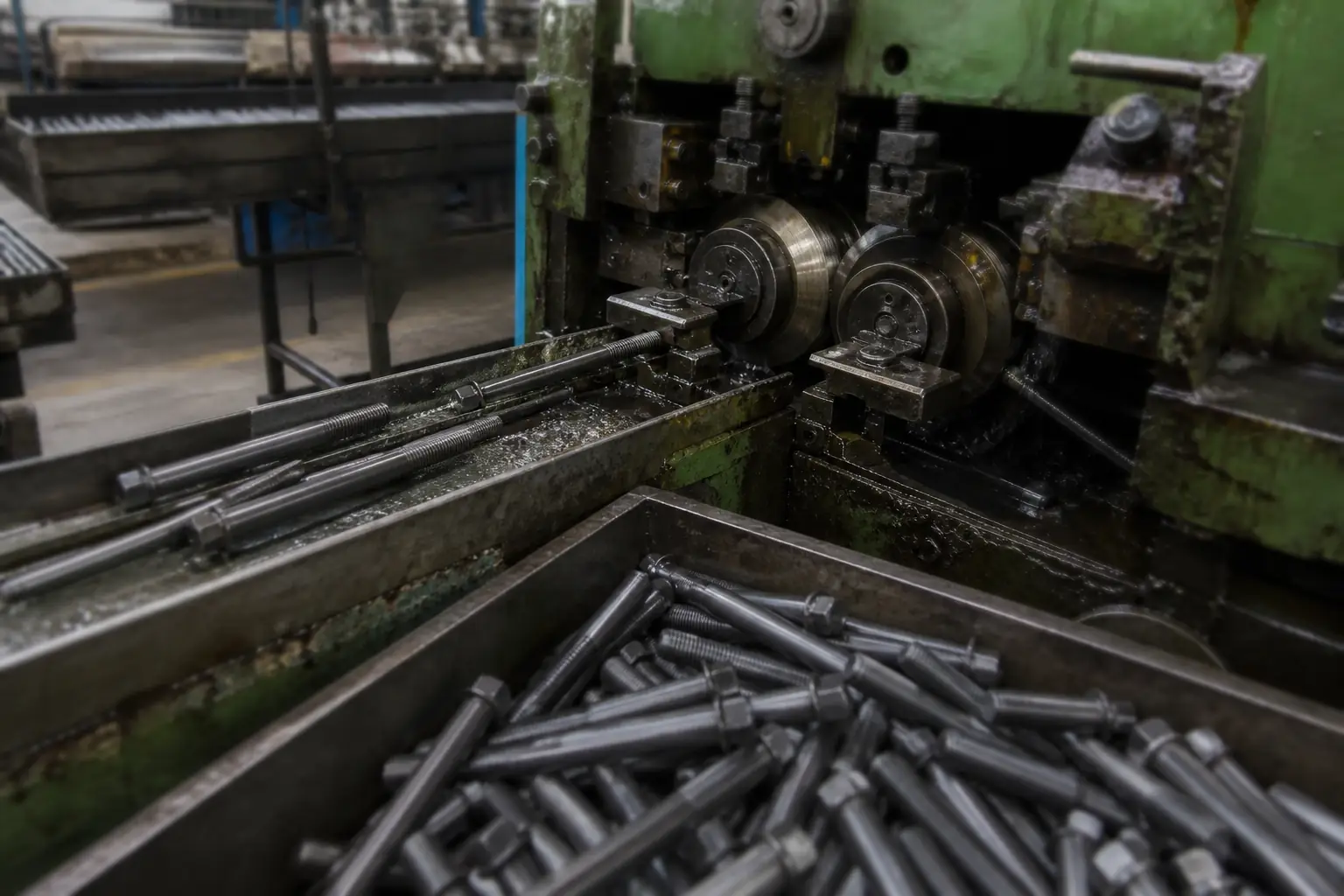
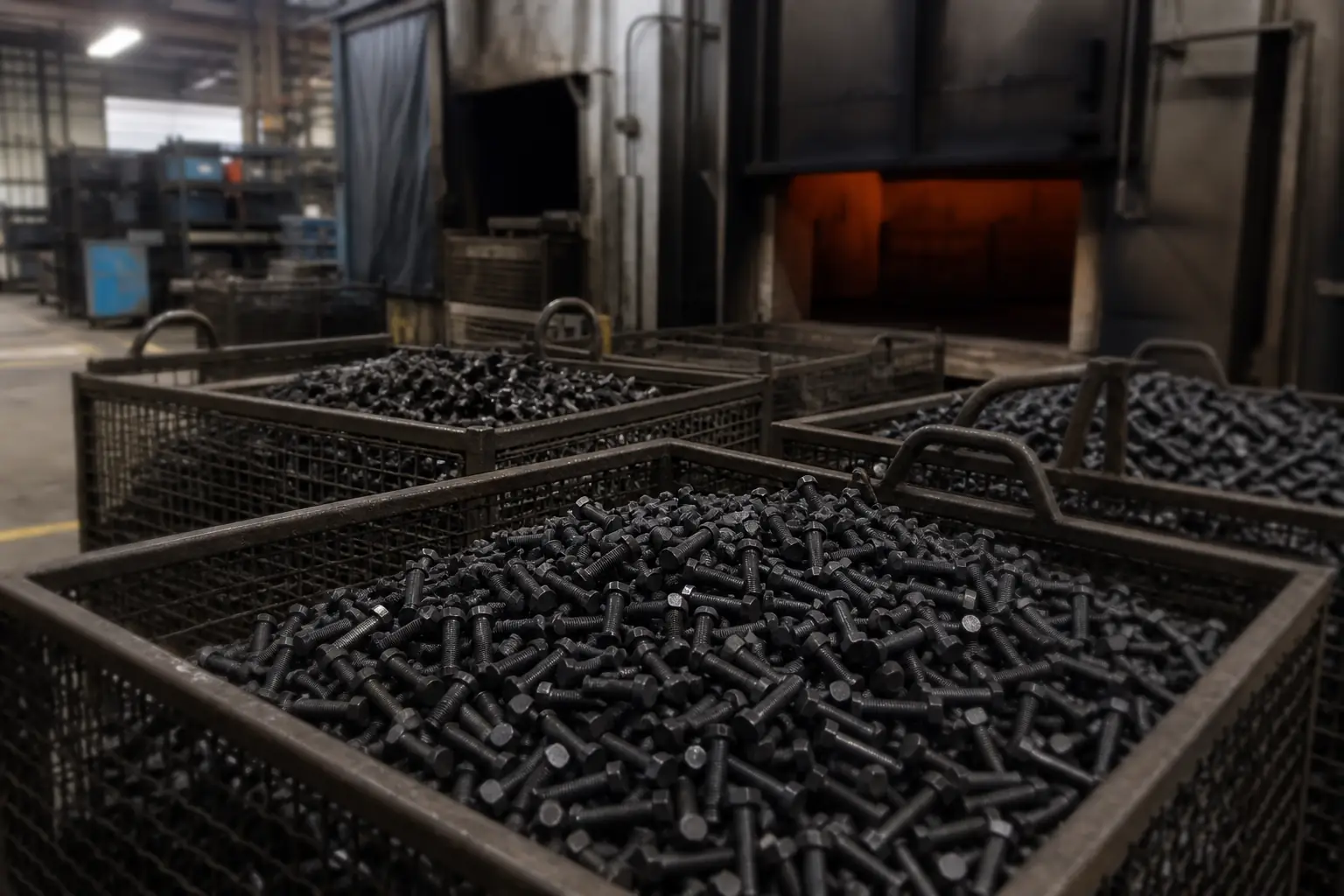
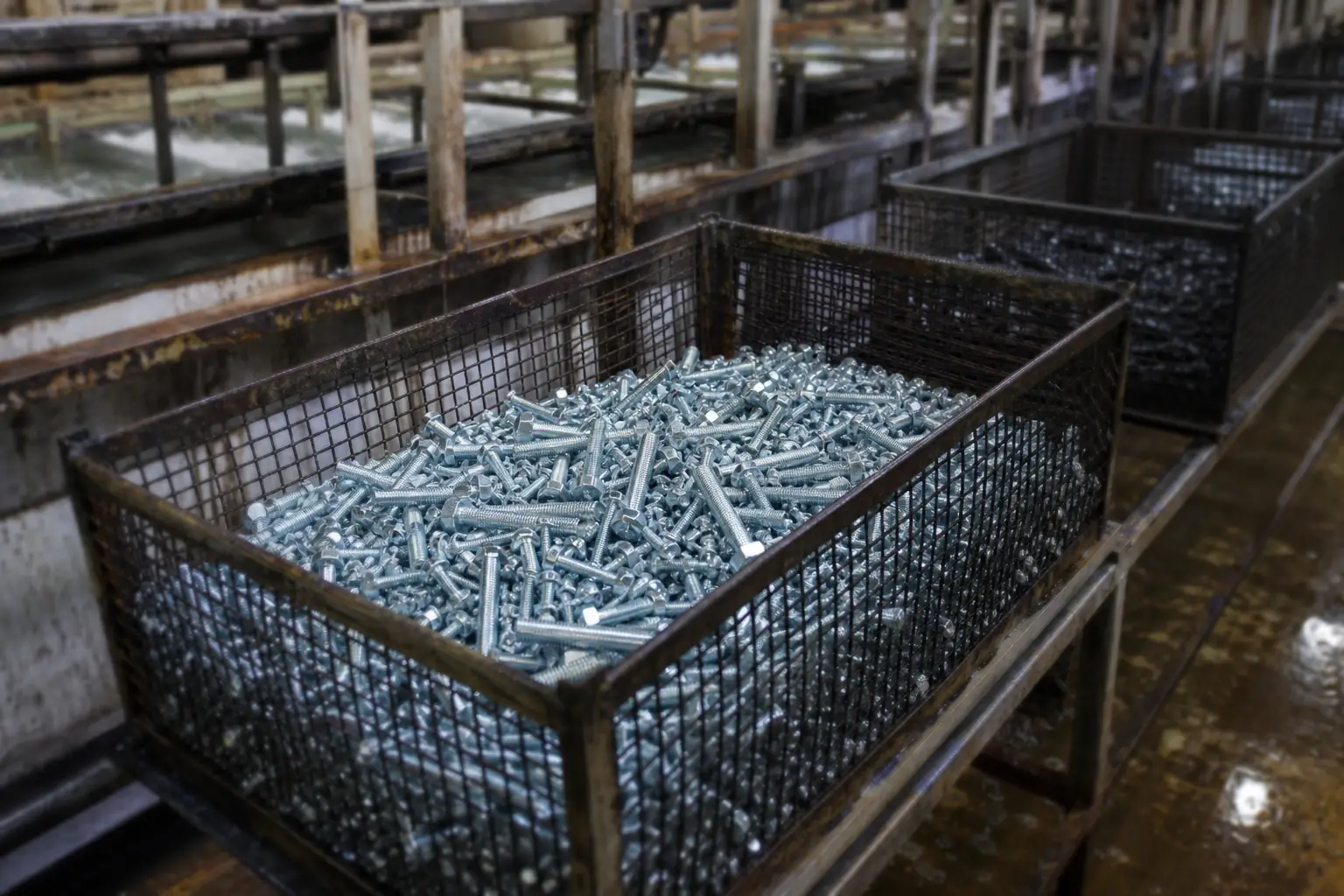
This part is cold-formed, threaded, heat-treated and finished in-house. The stages below are where its class and finish are actually decided.
01
Cold heading
Wire rod is drawn to size and cold-formed into blanks. Forming rather than cutting keeps the grain flow continuous around the head, which is where a bolt is most likely to fail.
Head dimensions and under-head radius checked at set-up and per shift.
02
Thread rolling
Threads are rolled between hardened dies rather than cut. Rolled threads are stronger in fatigue than cut threads and hold pitch and flank angle far more consistently across a batch.
Go / no-go ring gauges to ISO 965 tolerance class 6g.
03
Heat treatment
Quench-and-temper brings carbon and alloy steel to the property class ordered — 8.8, 10.9 or 12.9 — with the furnace charge tracked so a finished lot can be traced back to it.
Core hardness and tensile tested per lot to ISO 898-1.
04
Surface treatment
Zinc, zinc-nickel, hot-dip galvanizing, black oxide, phosphate and Dacromet, selected against the service environment rather than against the price list.
Coating thickness and neutral salt spray hours to ISO 9227.
Frequently Asked Questions
Can A4 Stainless Steel Plastic Expansion Wall Plugs gall during installation?
Yes — stainless on stainless is prone to thread galling under load, especially at smaller sizes. Use an anti-galling lubricant or wax thread compound, and slow the tightening rate where possible.
Is A4 Stainless Steel food-grade?
A4 (316) is the standard food-contact stainless grade in most jurisdictions, particularly where chloride exposure (brines, dairy CIP) is present.
Can A4 Stainless Steel Plastic Expansion Wall Plugs be used with aluminum?
Yes, but stainless drives mild galvanic corrosion of aluminum in wet service — isolate with a coating, sleeve or paint, or accept the trade-off if the joint is dry and indoor.
What's the service temperature limit for A4 Stainless Steel?
The practical service range is approx. -200 °C to +400 °C, subject to the property class and the joint.
How do I request a quotation?
Use the technical drawing on this page to pick the exact configuration, then submit it with the quote form. We respond within one business day.
This website uses only necessary and functional cookies to operate, secure, and improve basic website performance.
We do not use advertising cookies, Google Analytics, or cross-site tracking technologies.
Privacy Policy