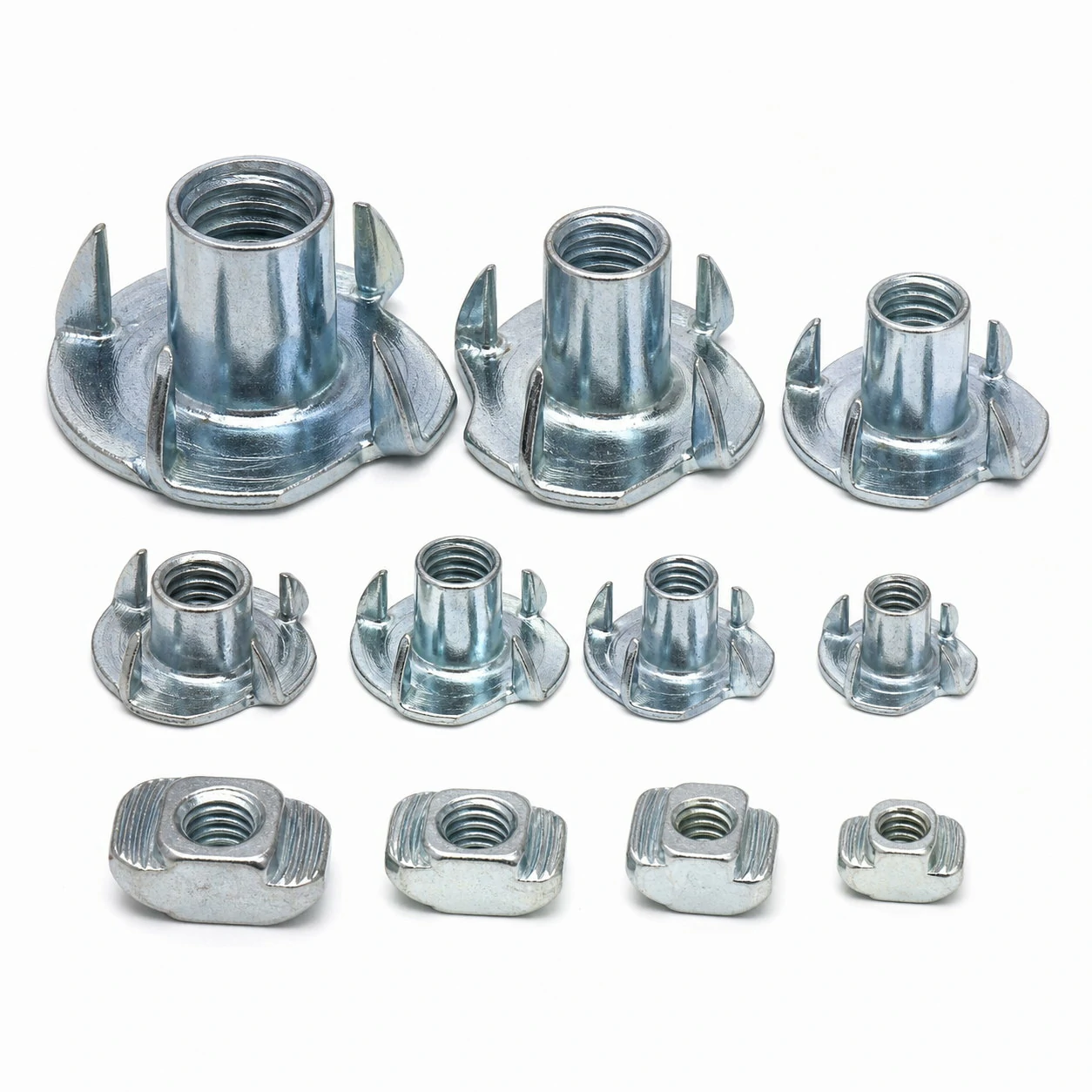
A4 Stainless Steel (ISO 3506 group A4 (316 / 1.4401), commonly supplied A4-80) is specified for marine, coastal and chemical applications. When tee nuts (pronged insert nuts) are specified in this grade, the dimensions remain per Trade series (pronged T-nut); the material determines corrosion behavior (superior, including marine and chloride environments) and the service temperature range (approx. -200 °C to +400 °C, subject to the property class and the joint). Both are covered below with the size table.
Why Choose A4 Stainless Steel for Tee Nuts (Pronged Insert Nuts)
Specified for marine, coastal and chemical applications. For tee nuts (pronged insert nuts), this matters when superior, including marine and chloride environments is the primary requirement.
Mechanical & Physical Properties
| Grade designation | ISO 3506 group A4 (316 / 1.4401), commonly supplied A4-80 |
|---|---|
| Magnetic response | Largely non-magnetic |
| Service temperature | approx. -200 °C to +400 °C, subject to the property class and the joint |
| Corrosion characteristic | Superior, including marine and chloride environments |
Galvanic & Galling Considerations
Two important notes for stainless tee nuts (pronged insert nuts): (1) stainless can gall on stainless threads under load — use a thread lubricant or anti-galling compound, especially for M6 and below; (2) when joined to aluminum or galvanized steel, stainless can drive galvanic corrosion of the less-noble metal in wet service — isolate with a coating or sleeve where appropriate.
Comparable Grades
For Tee Nuts (Pronged Insert Nuts), the alternative stainless grade is A2 (304). A2 (304) covers general indoor and outdoor service. A4 (316) adds molybdenum, which is what buys the chloride resistance for marine and de-icing-salt exposure. Where strength matters more than corrosion, plated alloy steel in class 8.8 or 10.9 is the swap to make.
Using Stainless Fasteners in Aluminum
Stainless steel is more noble than aluminum, so with an electrolyte present — rain, condensation, salt spray — the aluminum becomes the anode and corrodes at the joint. Area ratio decides how bad it gets: a small stainless fastener in a large aluminum section is normally acceptable, a large stainless fastener in thin aluminum is not. Where the joint gets wet, isolate the metals with a coated or nylon washer and a sealant, or specify an aluminum or coated fastener instead.
Sizes of Tee Nuts (Pronged Insert Nuts) Available in A4 Stainless Steel
| Thread size | Barrel diameter (mm) | Barrel length (mm) | Flange diameter (mm) | Prongs | Drill hole in timber (mm) | Material | Finish |
|---|---|---|---|---|---|---|---|
| M4 | 7.0 | 9.0 | 17.0 | 4 | 7.0 | Mild steel | Zinc plated |
| M5 | 8.0 | 9.0 | 19.0 | 4 | 8.0 | Mild steel | Zinc plated |
| M6 | 9.0 | 11.0 | 22.0 | 4 | 9.0 | Mild steel | Zinc plated |
| M8 | 11.0 | 13.0 | 25.0 | 4 | 11.0 | Mild steel | Zinc plated |
| M10 | 13.0 | 13.0 | 30.0 | 4 | 13.0 | Mild steel | Zinc plated |