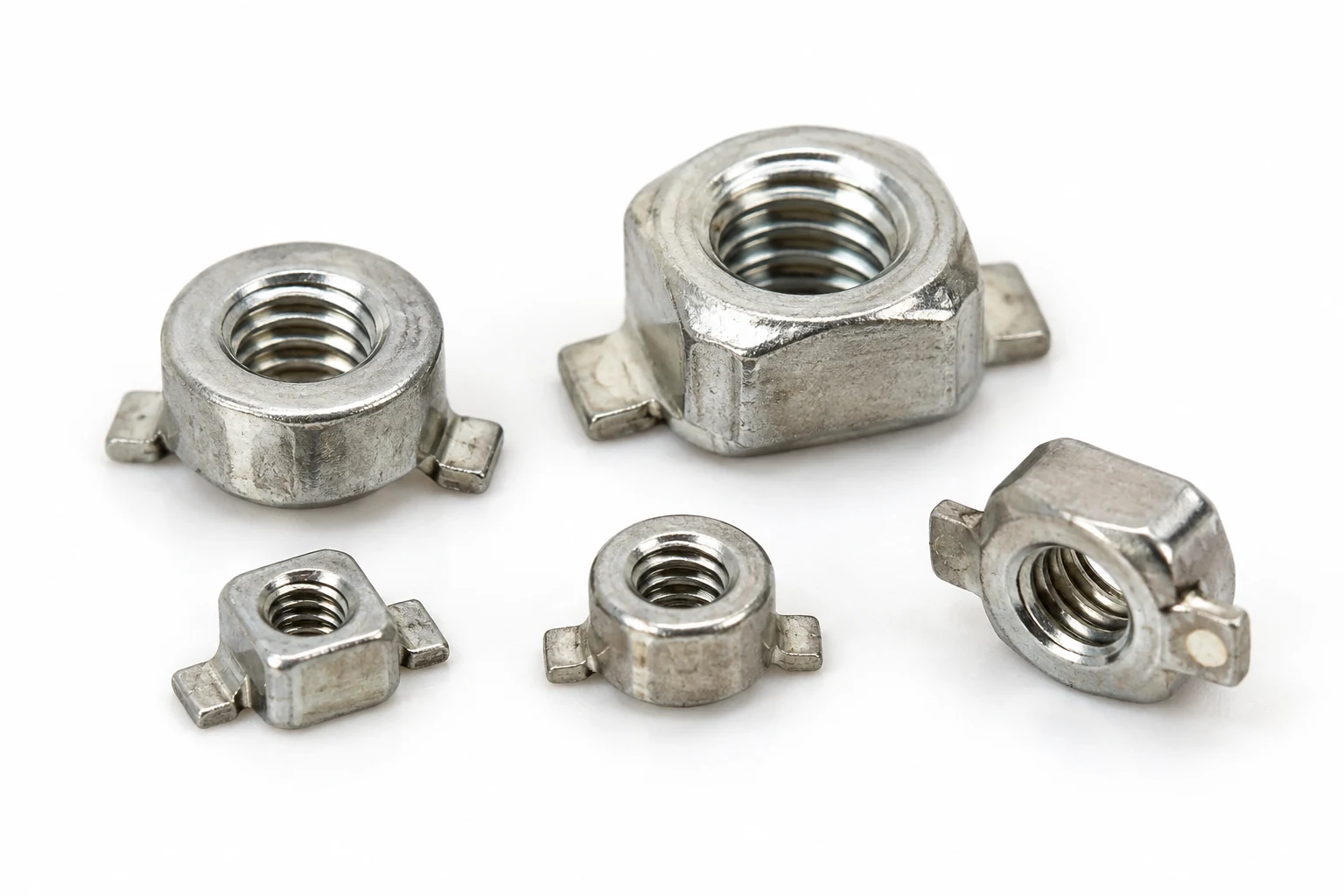
Mechanical properties, corrosion behaviour and the full dimensional range for this grade.
Property Class 8.8 Steel Solderable SMT Nuts are supplied to ISO 898-1 property class 8.8. Corrosion behaviour is requires plating (zinc) for corrosion protection, the material is magnetic, and the usable service range is commonly limited to approx. +300 °C; confirm against the coating and the load. In practice this grade is the workhorse medium-carbon alloy class for structural joints.
Grade
ISO 898-1 property class 8.8
Corrosion resistance
Requires plating (zinc) for corrosion protection
Magnetic response
Magnetic
Service temperature
commonly limited to approx. +300 °C; confirm against the coating and the load
Property values are typical for the grade. Certified mechanical test data is available on request for production orders.
Hidden Deck Fasteners Sourcing: Manufacturing, Types & Material Compatibility
Property Class 8.8 Steel Solderable SMT Nuts are supplied to Trade series (solderable SMT nuts). The grade provides requires plating (zinc) for corrosion protection and is magnetic; the practical service range is commonly limited to approx. +300 °C; confirm against the coating and the load. Property data, grade comparison and the full size table follow.
Why Choose Property Class 8.8 Steel for Solderable SMT Nuts
The workhorse medium-carbon alloy class for structural joints. For solderable smt nuts, this matters when requires plating (zinc) for corrosion protection is the primary requirement.
Mechanical & Physical Properties
Grade designation
ISO 898-1 property class 8.8
Magnetic response
Magnetic
Service temperature
commonly limited to approx. +300 °C; confirm against the coating and the load
Corrosion characteristic
Requires plating (zinc) for corrosion protection
Corrosion Behavior in Service
Carbon and alloy steel solderable smt nuts require a coating for corrosion protection. Zinc plating (with or without passivation) is the most common; hot-dip galvanizing is used for outdoor structural service; black-oxide is mainly a tarnish-prevention finish for tool-room use.
Galvanic & Galling Considerations
For solderable smt nuts in steel, the dominant compatibility issue is hydrogen embrittlement at high property classes (10.9 and above) when electroplated. Plating must be followed by an appropriate baking treatment, or a non-electroplated finish (mechanical zinc, zinc flake) should be substituted.
Sizes of Solderable SMT Nuts Available in Property Class 8.8 Steel
Thread size
Material
Supply
Board installation
Adhesive spot
M2
tinned steel
taped and reeled
solder into plated-through or non-plated hole
with or without
M2.5
tinned steel
taped and reeled
solder into plated-through or non-plated hole
with or without
M3
tinned steel
taped and reeled
solder into plated-through or non-plated hole
with or without
M4
tinned steel
taped and reeled
solder into plated-through or non-plated hole
with or without
M5
tinned steel
taped and reeled
solder into plated-through or non-plated hole
with or without
Technical Drawing
Customize the parameters below — every spec field is editable, and the drawing redraws to match the values you choose. Changing the size will snap the other fields to that size's standard values; you can then override any individual value.
Sends the selected values to the quote form below.
Request a Quote
The form below follows the current technical drawing configuration. Change the drawing values above and the request details update automatically.
Dimensions & Specifications (Trade series (solderable SMT nuts))
Thread size
Material
Supply
Board installation
Adhesive spot
M2
tinned steel
taped and reeled
solder into plated-through or non-plated hole
with or without
M2.5
tinned steel
taped and reeled
solder into plated-through or non-plated hole
with or without
M3
tinned steel
taped and reeled
solder into plated-through or non-plated hole
with or without
M4
tinned steel
taped and reeled
solder into plated-through or non-plated hole
with or without
M5
tinned steel
taped and reeled
solder into plated-through or non-plated hole
with or without
Materials & Grades
Select a material class to see the grades we supply it in. Each designation is listed with its ISO/EN, AISI/SAE, JIS and GB equivalents.
Control electronicsM2–M5 threads secure shields and board-mounted brackets.
Instrument modulesOptional adhesive spots help hold the part during soldering.
Machine building & OEMThe clamping counter-face on studs and bolts throughout an assembly.
Steel fabricationBolted structural and frame connections.
Typical applications
soldering a fine threaded nut into a plated or non-plated board hole
selecting M2 through M5 for the mating screw
using taped-and-reeled placement in production
choosing with or without an adhesive spot
joints re-torqued at a service interval
completing a bolted joint on a stud, rod or bolt
Service conditions to specify against
Marine and coastal
Available in A4 (316) stainless for chloride exposure — coastal structures, pool halls, water treatment and deck hardware, where A2 will eventually pit.
High load
Supplied in ISO 898-1 property classes, so the joint can be designed to a stated proof load and tightened to a calculated torque rather than by feel.
Match the class
A nut below the bolt property class strips before the bolt reaches its own limit — pair class 8 nuts with 8.8 bolts, class 10 with 10.9.
Where to use something else
Do not size the nut from the screw alone; the board hole, solder land and reflow process must accept the part.
This part is cold-formed, threaded, heat-treated and finished in-house. The stages below are where its class and finish are actually decided.
01
Cold heading
Wire rod is drawn to size and cold-formed into blanks. Forming rather than cutting keeps the grain flow continuous around the head, which is where a bolt is most likely to fail.
Head dimensions and under-head radius checked at set-up and per shift.
02
Thread rolling
Threads are rolled between hardened dies rather than cut. Rolled threads are stronger in fatigue than cut threads and hold pitch and flank angle far more consistently across a batch.
Go / no-go ring gauges to ISO 965 tolerance class 6g.
03
Heat treatment
Quench-and-temper brings carbon and alloy steel to the property class ordered — 8.8, 10.9 or 12.9 — with the furnace charge tracked so a finished lot can be traced back to it.
Core hardness and tensile tested per lot to ISO 898-1.
04
Surface treatment
Zinc, zinc-nickel, hot-dip galvanizing, black oxide, phosphate and Dacromet, selected against the service environment rather than against the price list.
Coating thickness and neutral salt spray hours to ISO 9227.
Frequently Asked Questions
Is Property Class 8.8 Steel prone to hydrogen embrittlement?
Class 10.9 and above can be susceptible to hydrogen embrittlement when electroplated. Specify post-plating baking, or use mechanical-zinc / zinc-flake finishes which avoid the cathodic plating step.
Which finish is best for outdoor Solderable SMT Nuts?
For outdoor service in steel, hot-dip galvanizing gives the longest life; zinc-flake (Geomet/Delta-Tone family) gives a thinner film with excellent salt-spray performance; standard zinc plating is the lowest-cost option for general indoor / shielded outdoor use.
What's the service temperature limit for Property Class 8.8 Steel?
The practical service range is commonly limited to approx. +300 °C; confirm against the coating and the load.
Can Property Class 8.8 Steel replace stainless steel structurally?
No — stainless A2/A4 cannot match class 10.9 / 12.9 strength. Stainless is selected for corrosion, not raw strength.
How do I request a quotation?
Use the technical drawing on this page to pick the exact configuration, then submit it with the quote form. We respond within one business day.
Need a fastener quote or a spec sheet?Message our engineers on WhatsApp — send a drawing or DIN number and get pricing back fast.Start WhatsApp Chat →
This website uses only necessary and functional cookies to operate, secure, and improve basic website performance.
We do not use advertising cookies, Google Analytics, or cross-site tracking technologies.
Privacy Policy