
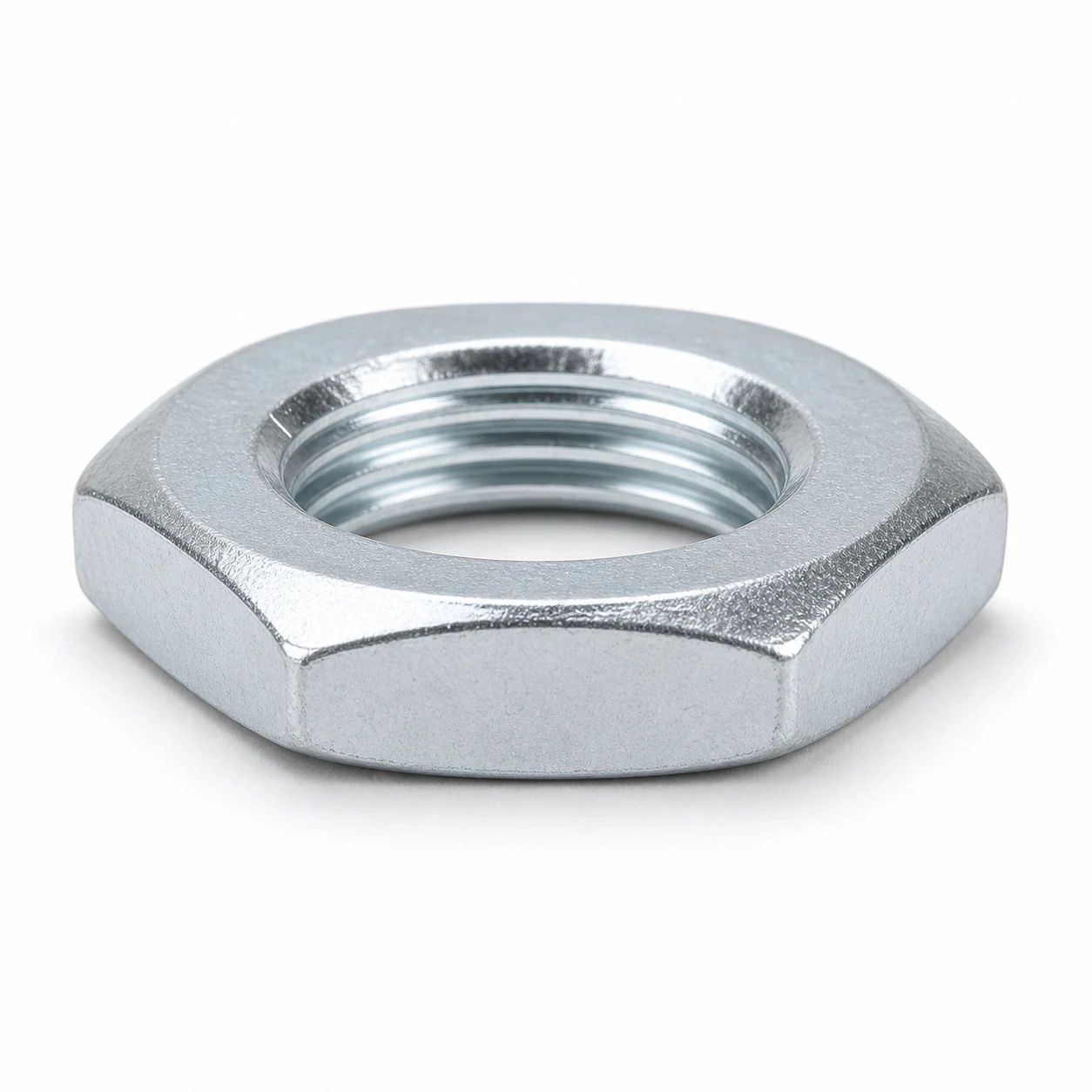
M10 Thin Hex Nut (GB/T 901 / DIN 939) are specified by thread size, length and head dimensions. The M10 row from the standard is reproduced below, followed by the drill sizes, spanner size and torque values used when installing this size.
M10 Dimensional Row (GB/T 901 / DIN 939)
| Size | Pitch (mm) | Width across flats s (mm) | Width across corners e (mm) | Nut height m (mm) | Reference standard |
|---|---|---|---|---|---|
| M10 | 1.5 | 16.0 | 17.77 | 5.0 | ISO 4035 / GB/T 6172 |
Spanner & Drive for M10 Thin Hex Nut — GB/T 901 / DIN 939 (Series 094)
M10 Thin Hex Nut — GB/T 901 / DIN 939 (Series 094) have a width across flats of 16.0 mm — fit a 16.0 mm open-ended spanner or socket. Use a 6-point socket for tight clearances and to reduce rounding; for repeated assembly choose a torque wrench so the joint preload is repeatable.
Common Applications for M10 Thin Hex Nut — GB/T 901 / DIN 939 (Series 094)
M10 Thin Hex Nut — GB/T 901 / DIN 939 (Series 094) are commonly specified for general-purpose joints in machinery, fixturing and equipment frames.
Mating Parts for M10
Pair M10 with the matching M10 bolt or screw, plus a M10 flat washer where required to distribute load on softer materials.
When to Step Up or Down from M10
When the joint preload approaches the proof load of M10 class 8.8, step up to M12 class 8.8 (or move to M10 class 10.9). When the joint is over-specified, M8 often saves weight and cost without losing the safety margin.