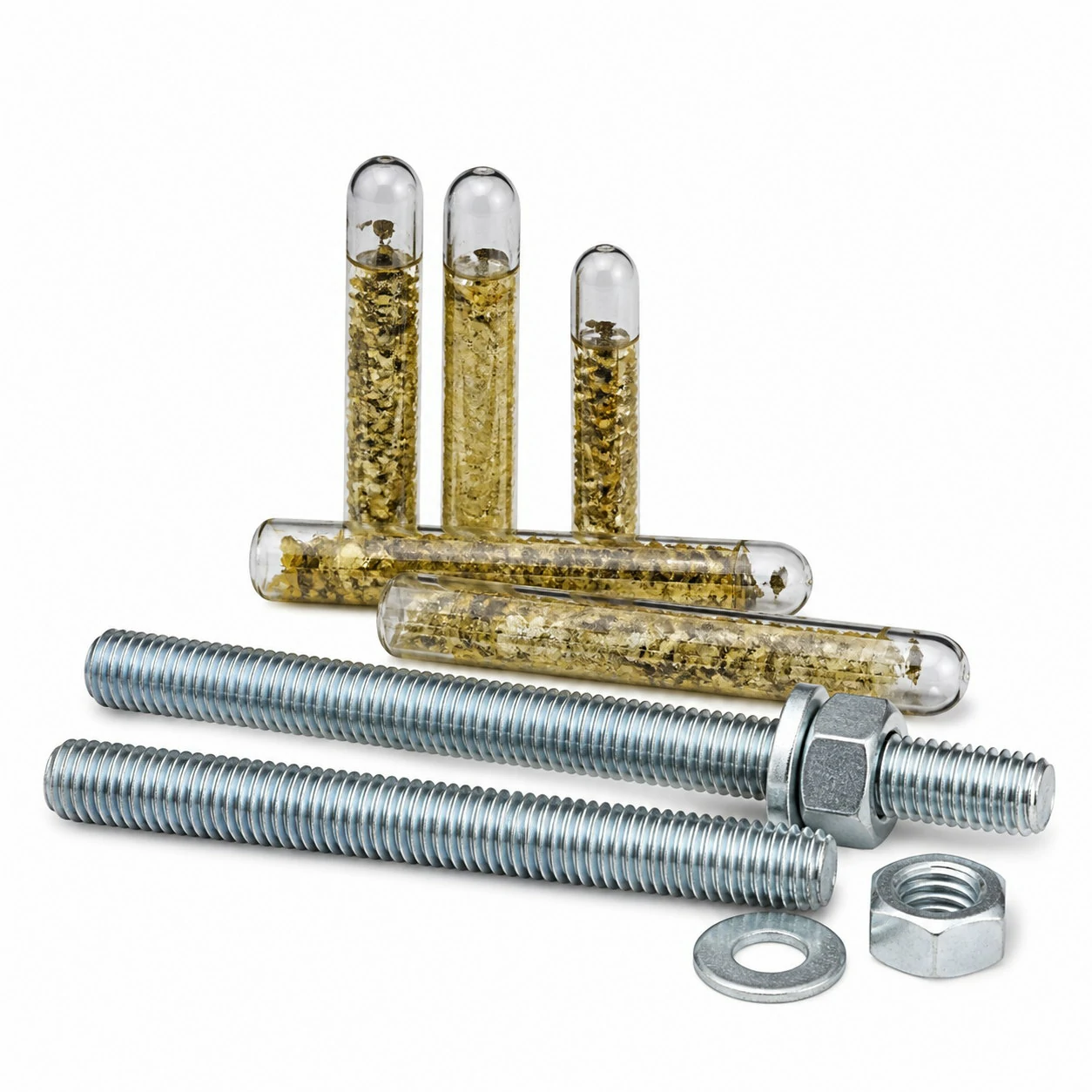
The M12 size of Chemical Anchor Studs (Resin-Bonded) is dimensioned by Trade series (bonded anchor stud). The table below gives the dimensional row from the standard, followed by the installation notes for this type.
Values are taken from the governing standard rather than from a general machine-thread table, because this type is not selected on one.
M12 Dimensional Row (Trade series (bonded anchor stud))
| Thread size | Drill hole diameter (mm) | Embedment depth (mm) | Stud length (mm) | Gel time at 20 °C (min) | Full cure at 20 °C (min) | Stud material | Resin |
|---|
| M12 | 14 | 110 | 160 | 6 | 45 | Class 8.8 zinc / A4 | Vinylester |
Custom manufacturing · Made to drawing
Need chemical anchor studs (resin-bonded) in a size this table does not list?
This page covers M12 chemical anchor studs (resin-bonded). Embedment depth, thread size, body length and corrosion protection are the variables; capacity remains a concrete design value, not a property of the anchor alone. Made by hot forging or thread rolling.
Minimum order from 2,000 pieces; samples within 7 days of drawing approval.
Custom anchor & concrete fixing manufacturingSend a drawing
Applications & Industries for M12 Chemical Anchor Studs
Chemical Anchor Studs are bought for a small number of well-defined jobs. These are the ones we ship them for. Stocked from M8 to M24.
Industries that specify Chemical Anchor Studs
-
Rebar & retrofit connections
Starter bars and post-installed reinforcement.
-
Hollow block & masonry
Resin with a sleeve where expansion would break the block.
-
Close-to-edge fixings
Anchors near a slab edge or at tight spacing.
-
Fit-out & drylining
Fixings into board, block and hollow wall.
-
Construction & structural
Base plates, brackets and steelwork fixed to concrete.
-
Building services
Suspending tray, duct, pipe and sprinkler runs from a soffit.
Typical applications
- hole cleaning is most of the installation quality
- cure time roughly halves for every 10 °C above 20 °C
- bonded fixings with no expansion force in the substrate
- fixing a steel fixture through to a solid substrate
- suspended services on threaded rod
- making a load-bearing threaded fixing in concrete or masonry
Service conditions to specify against
- Marine and coastal
- Available in A4 (316) stainless for chloride exposure — coastal structures, pool halls, water treatment and deck hardware, where A2 will eventually pit.
- Sealed joints
- Used where the fixing has to keep water or air out as well as hold — the elastomer, not the fastener, decides service life.
- Hole preparation
- Drilled diameter, depth and cleanliness are part of the specification; an uncleaned hole is the single most common cause of a failed anchor.
- The concrete governs
- Capacity is a property of the base material and the geometry — grade, edge distance, spacing and cracked or uncracked — not of the anchor alone. Work to the anchor manufacturer's ETA or ICC-ES report.
Where to use something else
- Not for a substrate the type is not qualified in — an expansion anchor near an edge or in hollow block will split it.
Need help matching Chemical Anchor Studs to your application? Send the assembly, the load and the environment with your enquiry and we will specify the size, material and finish against them.