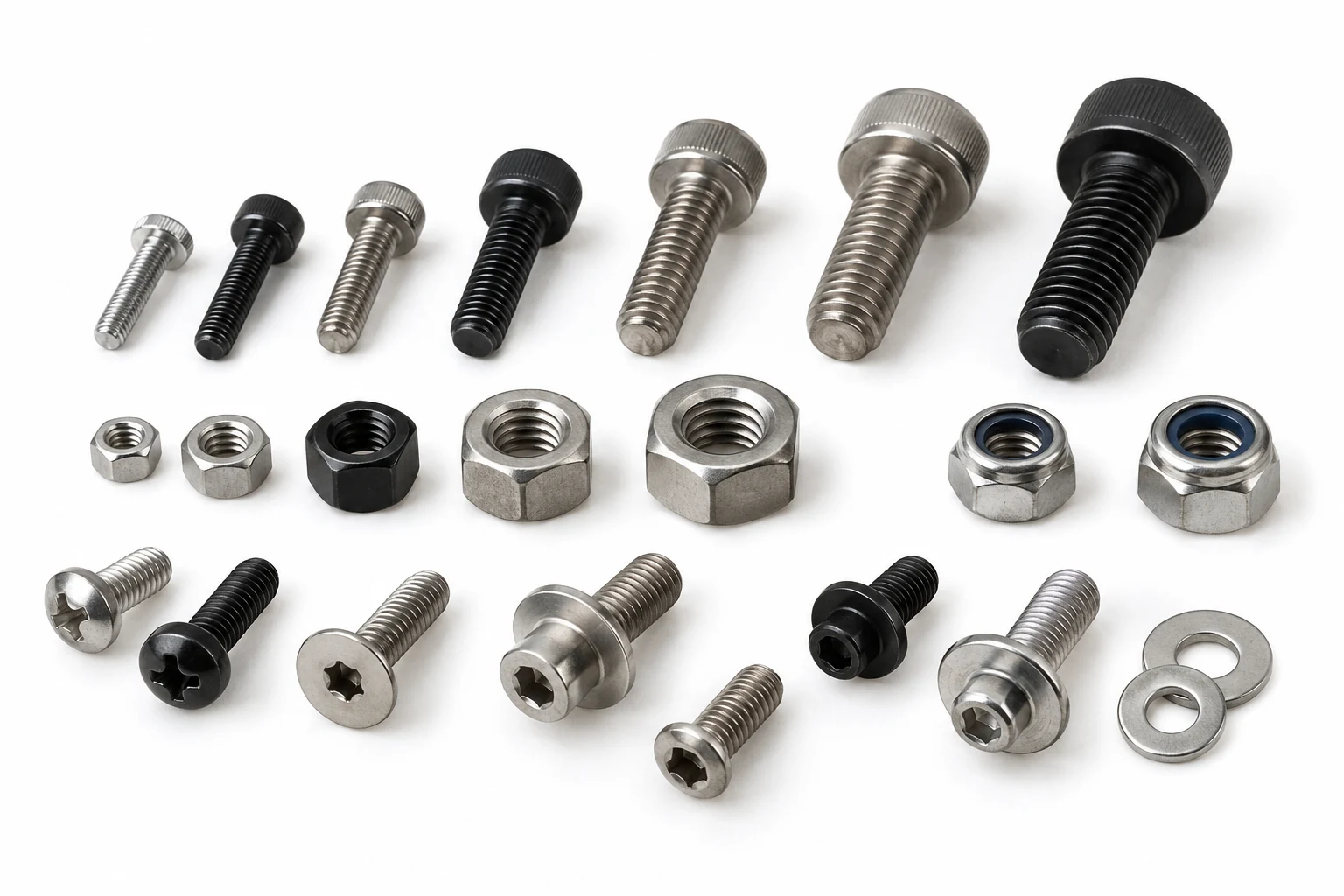
M3 Bicycle General Threaded Fasteners dimensions to Trade series (bicycle threaded fasteners): coarse thread pitch 0.5 mm, clearance hole (ISO 273 medium) 3.4 mm, tapping drill 2.5 mm. Tighten to approximately 1.3 Nm at property class 8.8 in a dry, as-supplied condition.
- Coarse thread pitch
- 0.5 mm
- Clearance hole (ISO 273 medium)
- 3.4 mm
- Tapping drill
- 2.5 mm
- Tightening torque (class 8.8)
- 1.3 Nm
Figures are nominal values from the governing standard. Confirm against the tolerance class for your application before machining or ordering.
M3 Bicycle General Threaded Fasteners (Trade series (bicycle threaded fasteners)) are specified by thread size, length and head dimensions. The M3 row from the standard is reproduced below, followed by the drill sizes, spanner size and torque values used when installing this size.
M3 Dimensional Row (Trade series (bicycle threaded fasteners))
| Thread designation | Pitch | Typical bicycle location |
|---|
| M3 | 0.5 | dropout adjustment and small accessory hardware |
Spanner & Drive for M3 Bicycle General Threaded Fasteners
Drive geometry for M3 Bicycle General Threaded Fasteners is given by the row above; match the tool to the listed values.
Hole Sizes for M3
| Coarse-thread pitch (ISO 724) | 0.5 mm |
|---|
| Through-hole / clearance (ISO 273 medium) | 3.4 mm |
|---|
| Tapping drill, coarse thread | 2.5 mm |
|---|
Tightening Torque for M3
| Class 8.8 (dry, ~µ 0.125) | ≈ 1.3 Nm |
|---|
| Class 10.9 (dry, ~µ 0.125) | ≈ Nm |
|---|
| Class 12.9 (dry, ~µ 0.125) | ≈ 2.2 Nm |
|---|
Indicative dry-joint values. Lubrication can lower the required torque by 15–25%. Always confirm against the joint design, especially when going up a strength class.
Proof Load & Strength for M3
| Tensile stress area As (ISO 724) | 5 mm² |
|---|
| Proof load, class 8.8 | 2.9 kN |
|---|
| Proof load, class 12.9 | 4.9 kN |
|---|
| Min. ultimate tensile load, class 8.8 | 4 kN |
|---|
Proof load = tensile stress area × the proof stress Sp of the class, per ISO 898-1 — Sp is a lower figure than the yield stress Rp0.2 and the two are not interchangeable. The stress area is computed from this size's own diameter and pitch, so a fine-pitch designation gives the fine-pitch figure. Design the joint so the working preload stays below the proof load of the class selected.
Mating Parts for M3
For M3, pair with a M3 hex nut (ISO 4032 / DIN 934) and, where used, a M3 flat washer (ISO 7089 / DIN 125A) under the head and under the nut.
When to Step Up or Down from M3
When the joint preload approaches the proof load of M3 class 8.8, step up to M4 class 8.8 (or move to M3 class 10.9). When the joint is over-specified, M2 often saves weight and cost without losing the safety margin.
Custom manufacturing · Made to drawing
Need bicycle general threaded fasteners in a size this table does not list?
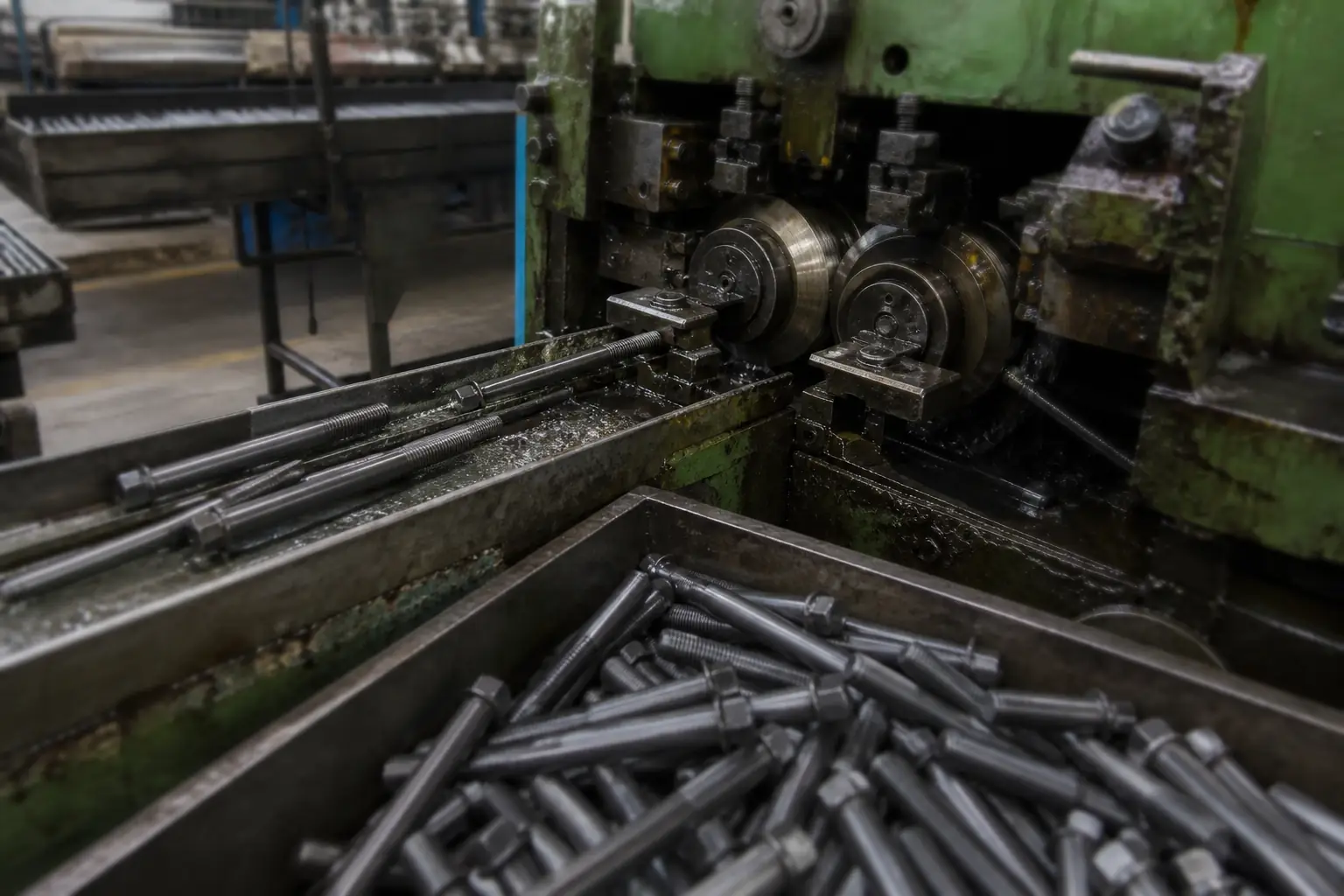
This page covers M3 bicycle general threaded fasteners. Head form and drive can be specified to the assembly rather than to a standard: a larger bearing face, a security drive, or a socket sized for the tool already on the bench. Made by cold heading or warm forging.
Minimum order from 2,000 pieces; samples within 7 days of drawing approval.
Custom screw manufacturingSend a drawing
Applications & Industries for M3 Bicycle General Threaded Fasteners
Bicycle General Threaded Fasteners are bought for a small number of well-defined jobs. These are the ones we ship them for. Stocked from M3 to 2.2 mm spoke.
Industries that specify Bicycle General Threaded Fasteners
-
Wheel building
The spoke thread is a separate selection from the machine fasteners.
-
Bicycle assembly
Metric thread families cover adjustment, brake, rack and accessory hardware.
-
Bike service shops
The pitch distinction prevents a similar-size replacement from cross-threading.
-
Performance bicycles
M5 and M6 hardware secures common frame and brake points.
-
Food, pharma & cleanroom
Stainless assemblies that are washed down, where the finish matters as much as the strength.
-
Machine building & OEM
The default fastener on production equipment: covers, brackets, motor mounts and sub-assemblies tightened to a specified torque.
Typical applications
- keeping spoke threading separate from metric bolt threading
- identifying the exact bicycle thread and pitch
- matching M4 0.7 to M4 0.75 where required
- selecting M5 or M6 hardware by frame location
- joints where the property class is stated on the drawing
- clamping two machined faces to a calculated preload
Service conditions to specify against
- Marine and coastal
- Available in A4 (316) stainless for chloride exposure — coastal structures, pool halls, water treatment and deck hardware, where A2 will eventually pit.
- High load
- Supplied in ISO 898-1 property classes, so the joint can be designed to a stated proof load and tightened to a calculated torque rather than by feel.
- Torque and preload
- The joint is designed around bolt tension, so lubrication, coating and the friction coefficient all change the torque figure — state them together.
Where to use something else
- Do not infer bicycle compatibility from diameter alone; pitch, head style and frame boss depth all matter.
- Do not use a machine thread into unthreaded sheet or timber; use a tapping screw, rivet nut or insert made for that parent material.
Full application guide: where Bicycle General Threaded Fasteners are used, how to specify them, and the cases they are wrong for