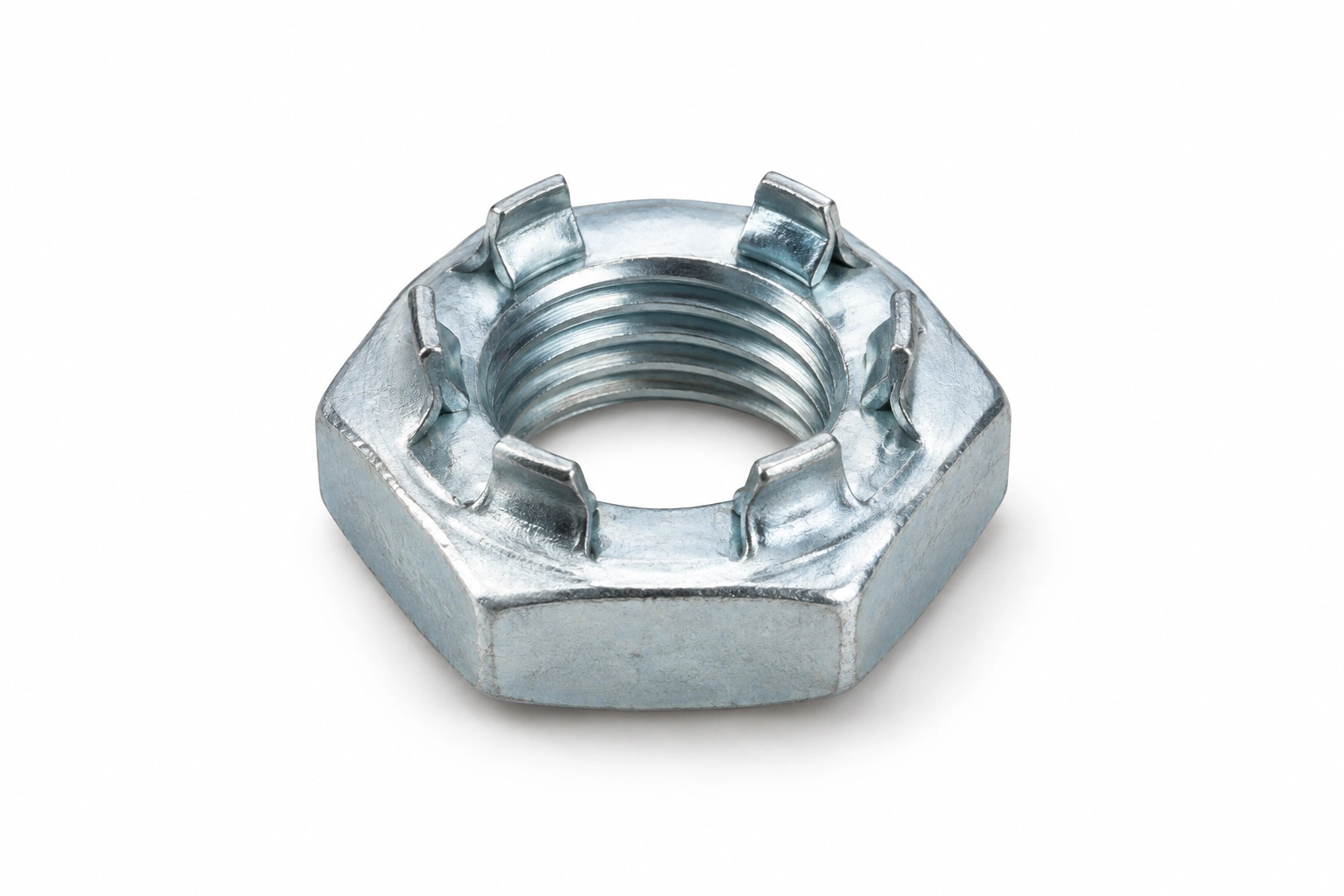
M30 Self-Locking Counter Nuts dimensions to DIN 7967: width across flats (spanner size) 46 mm, nut height 8 mm, coarse thread pitch 3.5 mm. Tighten to approximately 1443 Nm at property class 8.8 in a dry, as-supplied condition.
- Width across flats (spanner size)
- 46 mm
- Nut height
- 8 mm
- Coarse thread pitch
- 3.5 mm
- Tightening torque (class 8.8)
- 1443 Nm
Figures are nominal values from the governing standard. Confirm against the tolerance class for your application before machining or ordering.
The M30 size of Self-Locking Counter Nuts is dimensioned by DIN 7967. The table below gives the dimensional row from the standard, followed by the drive and the installation notes for this type.
Values are taken from the governing standard rather than from a general machine-thread table, because this type is not selected on one.
M30 Dimensional Row (DIN 7967)
| Size | od (mm) | id (mm) | Nut height m (mm) | Width across flats s (mm) | t (mm) | Reference standard |
|---|
| M30 | 30 | 26.6 | 8 | 46 | 1.1 | DIN 7967 |
Spanner & Drive for M30 Self-Locking Counter Nuts
Drive geometry for M30 Self-Locking Counter Nuts is given by the row above; match the tool to the listed values.
Tightening Torque for M30
| Class 8.8 (dry, ~µ 0.125) | ≈ 1443 Nm |
|---|
| Class 10.9 (dry, ~µ 0.125) | ≈ 2055 Nm |
|---|
| Class 12.9 (dry, ~µ 0.125) | ≈ 2405 Nm |
|---|
Indicative dry-joint values. Lubrication can lower the required torque by 15–25%. Always confirm against the joint design, especially when going up a strength class.
Proof Load & Strength for M30
Nuts are graded to ISO 898-2 by the proof load the nut itself will hold (classes 04, 05, 5, 6, 8, 10 and 12), not by the 8.8 / 10.9 / 12.9 scale used for bolts. A class-8 nut is the correct mate for a class-8.8 bolt, and the joint is designed on the bolt, so no bolt-tension figure is quoted here.
Installation Tips for M30 Self-Locking Counter Nuts
- At M30 the stretch in the bolt becomes the controlling factor — for critical joints, use angle-controlled or stretch-controlled tightening instead of pure torque.
Mating Parts for M30
Pair M30 with the matching M30 bolt or screw, plus a M30 flat washer where required to distribute load on softer materials.
Custom manufacturing · Made to drawing
Need self-locking counter nuts in a size this table does not list?
This page covers M30 self-locking counter nuts. Locking method is specifiable independently of the rest: nylon insert, all-metal deformed thread, serrated flange, or none. Made by cold heading or tapping.
Minimum order from 2,000 pieces; samples within 7 days of drawing approval.
Custom nut manufacturingSend a drawing
Applications & Industries for M30 Self-Locking Counter Nuts
What Self-Locking Counter Nuts are specified for, industry by industry. Stocked from M4 to M52.
Industries that specify Self-Locking Counter Nuts
-
HVAC
fan and motor mounts.
-
Transport
brackets subject to vibration.
-
Agricultural machinery
locking nuts on vibrating frames.
-
Sheet-metal work
light locking where space is short.
-
Machine building & OEM
The clamping counter-face on studs and bolts throughout an assembly.
-
Steel fabrication
Bolted structural and frame connections.
Typical applications
- using on standard threaded rods
- quick installation with a wrench
- locking an existing nut without replacing it
- adding vibration resistance with little height
- completing a bolted joint on a stud, rod or bolt
- locking an adjustment so it cannot drift
Service conditions to specify against
- Marine and coastal
- Available in A4 (316) stainless for chloride exposure — coastal structures, pool halls, water treatment and deck hardware, where A2 will eventually pit.
- High load
- Supplied in ISO 898-1 property classes, so the joint can be designed to a stated proof load and tightened to a calculated torque rather than by feel.
- Vibration
- Specified where cyclic load would loosen a plain nut or screw — rotating plant, rail, mobile equipment and anything that is not re-torqued in service.
- Match the class
- A nut below the bolt property class strips before the bolt reaches its own limit — pair class 8 nuts with 8.8 bolts, class 10 with 10.9.
Where to use something else
- Do not use a counter nut as the load-carrying nut; it only locks the nut beneath it.
Full application guide: where Self-Locking Counter Nuts are used, how to specify them, and the cases they are wrong for