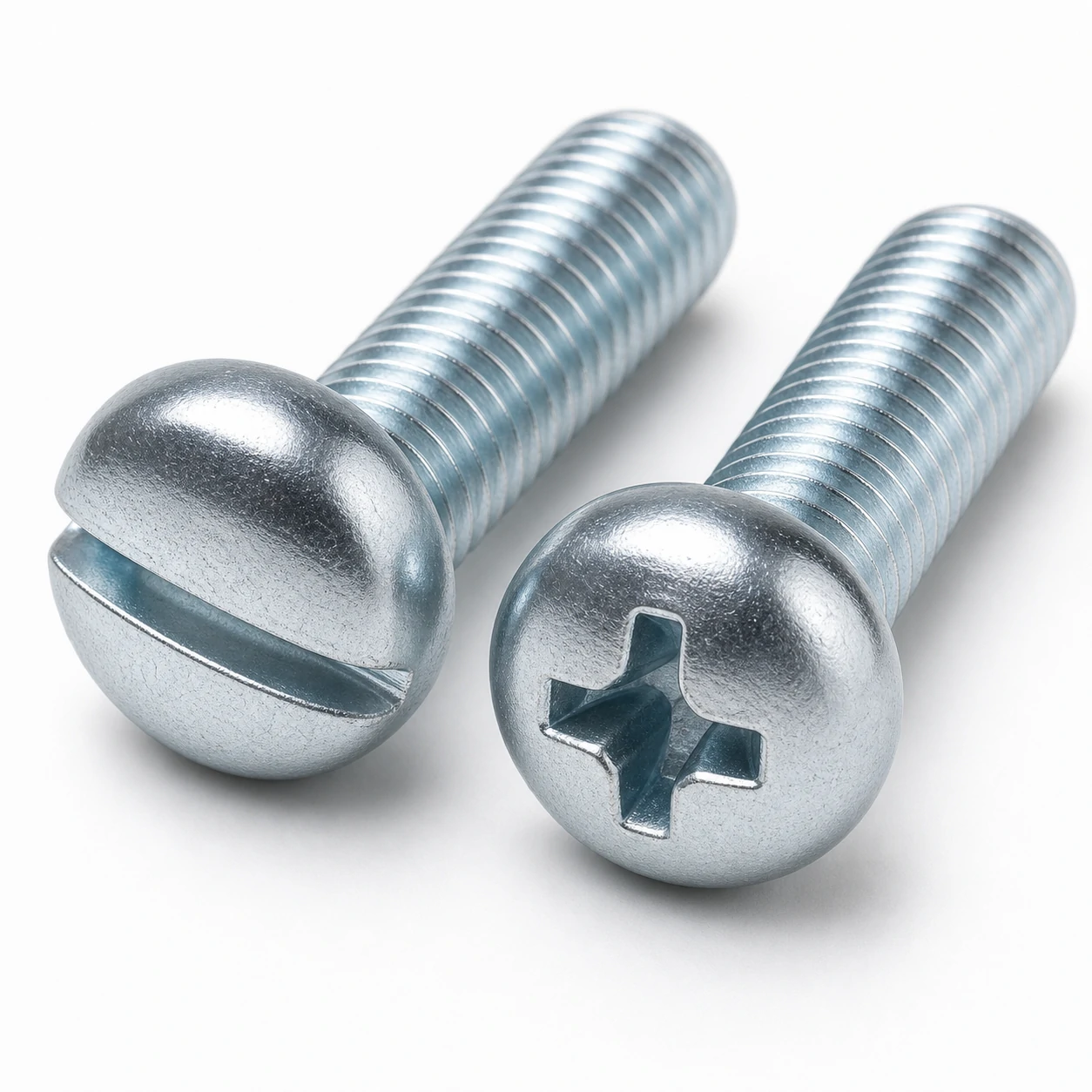
Dimensional and assembly data for M4 Pan Head Screws to ISO 1207 / ISO 7045 / DIN 7985. Includes head size and width across flats, clearance-hole and tapping-drill diameters, tightening torque per property class, and the sizes to step up or down to when the joint requires it.
M4 Dimensional Row (ISO 1207 / ISO 7045 / DIN 7985)
| Size | Pitch (mm) | Head diameter dk (mm) | Head height k (mm) | Cross recess | Reference standard |
|---|---|---|---|---|---|
| M4 | 0.7 | 8.0 | 2.4 | PH2 | ISO 1207 / ISO 7045 / DIN 7985 |
Spanner & Drive for M4 Pan Head Screws
M4 Pan Head Screws use a PH2 cross recess. Match the driver bit to the recess (Phillips PH / Pozi PZ are NOT interchangeable).
Hole Sizes for M4
| Coarse-thread pitch (ISO 724) | 0.7 mm |
|---|---|
| Through-hole / clearance (ISO 273 medium) | 4.5 mm |
| Tapping drill, coarse thread | 3.3 mm |
Tightening Torque for M4
| Class 8.8 (dry, ~µ 0.125) | ≈ 2.9 Nm |
|---|---|
| Class 10.9 (dry, ~µ 0.125) | ≈ 4.1 Nm |
| Class 12.9 (dry, ~µ 0.125) | ≈ 4.9 Nm |
Indicative dry-joint values. Lubrication can lower the required torque by 15–25%. Always confirm against the joint design, especially when going up a strength class.
Proof Load & Strength for M4
| Tensile stress area As (ISO 898-1) | 8.78 mm² |
|---|---|
| Proof load, class 8.8 | 5.1 kN |
| Proof load, class 10.9 | 7.3 kN |
| Proof load, class 12.9 | 8.5 kN |
| Min. ultimate tensile, class 8.8 | 7 kN |
Proof load = stress area × proof stress per ISO 898-1. Design joints so the working preload stays below the proof load of the selected class.
Common Applications for M4 Pan Head Screws
M4 Pan Head Screws are commonly specified for electronics, PCB hardware, optical mounts and small-scale machinery.
Installation Tips for M4 Pan Head Screws
- Pozidriv (PZ) drivers ride out of Phillips (PH) recesses and vice versa — confirm the recess marking on the head before assembly.
- For automated assembly, an ACR (Anti-Cam-Out Ribs) or torx-equivalent driver gives noticeably longer bit life than plain PH.
- At M4 the joint is sensitive to over-torque — use a torque-limiting driver and check the head doesn't bury into a softer counterpart.
When to Step Up or Down from M4
When the joint preload approaches the proof load of M4 class 8.8, step up to M5 class 8.8 (or move to M4 class 10.9). When the joint is over-specified, M3 often saves weight and cost without losing the safety margin.