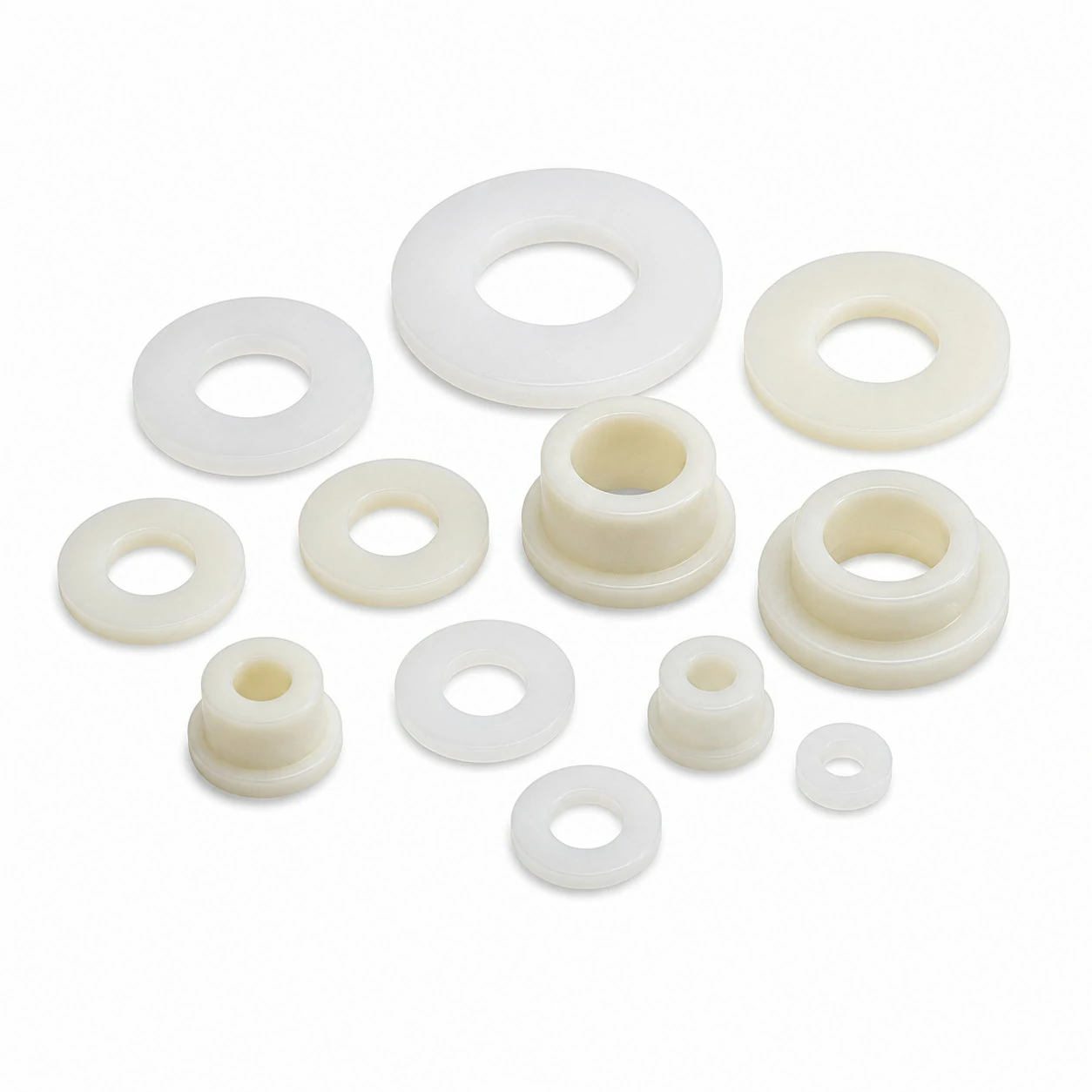
This page covers M5 Insulating Fibre Washers to Trade series (vulcanised fibre washer). M5 is the nominal bolt size; the dimensional row below is reproduced from the product table, followed by the tolerance, material and selection notes that apply to this size.
M5 Dimensional Row (Trade series (vulcanised fibre washer))
For bolt size
Inner diameter d1 (mm)
Outer diameter d2 (mm)
Thickness t (mm)
Dielectric strength (kV/mm)
Max temperature (u00b0C)
Material
Moisture
M5
5.3
10.0
0.8
10
105
Vulcanised fibre
Hygroscopic u2014 indoor use
Mating Parts for M5
A M5 flat washer pairs with a M5 bolt/screw and matching M5 nut.
Technical Drawing
Customize the parameters below — every spec field is editable, and the drawing redraws to match the values you choose. Changing the size will snap the other fields to that size's standard values; you can then override any individual value.
Sends the selected values to the quote form below.
Request a Quote
The form below follows the current technical drawing configuration. Change the drawing values above and the request details update automatically.
Dimensions & Specifications (Trade series (vulcanised fibre washer))
For bolt size
Inner diameter d1 (mm)
Outer diameter d2 (mm)
Thickness t (mm)
Dielectric strength (kV/mm)
Max temperature (u00b0C)
Material
Moisture
M3
3.2
7.0
0.5
10
105
Vulcanised fibre
Hygroscopic u2014 indoor use
M4
4.3
9.0
0.5
10
105
Vulcanised fibre
Hygroscopic u2014 indoor use
M5
5.3
10.0
0.8
10
105
Vulcanised fibre
Hygroscopic u2014 indoor use
M6
6.4
12.0
0.8
10
105
Vulcanised fibre
Hygroscopic u2014 indoor use
M8
8.4
16.0
1.0
10
105
Vulcanised fibre
Hygroscopic u2014 indoor use
M10
10.5
20.0
1.0
10
105
Vulcanised fibre
Hygroscopic u2014 indoor use
Applications & Industries for M5 Insulating Fibre Washers
The sectors that buy Insulating Fibre Washers, and the duty each one buys them for. Stocked from M3 to M10 (nominal bolt size).
Industries that specify Insulating Fibre Washers
Food & pharma equipmentNon-marking, non-contaminating washers in washdown areas.
Electrical & electronicsInsulating and isolating fixings in panels and boards.
Chemical & processChemically resistant seating under a fastener.
Machine building & OEMSetting bearing area on soft alloy, plastic and oversized holes.
Timber & constructionLarge-diameter washers that stop pull-through in softer material.
Rotating & vibrating plantSpring, tooth and wedge types that maintain or lock bolt tension.
Typical applications
protecting a soft or finished surface under a head
insulating a fastener electrically from the panel
separating dissimilar metals to break a galvanic cell
maintaining bolt tension in a joint that settles
spreading clamp load over a soft or oversized bearing face
protecting a painted or plated surface under a turned nut
Service conditions to specify against
Marine and coastal
Available in A4 (316) stainless for chloride exposure — coastal structures, pool halls, water treatment and deck hardware, where A2 will eventually pit.
Hardness matters
Under a high-strength bolt a soft washer embeds into the joint and preload is lost — specify a hardened washer for structural bolting.
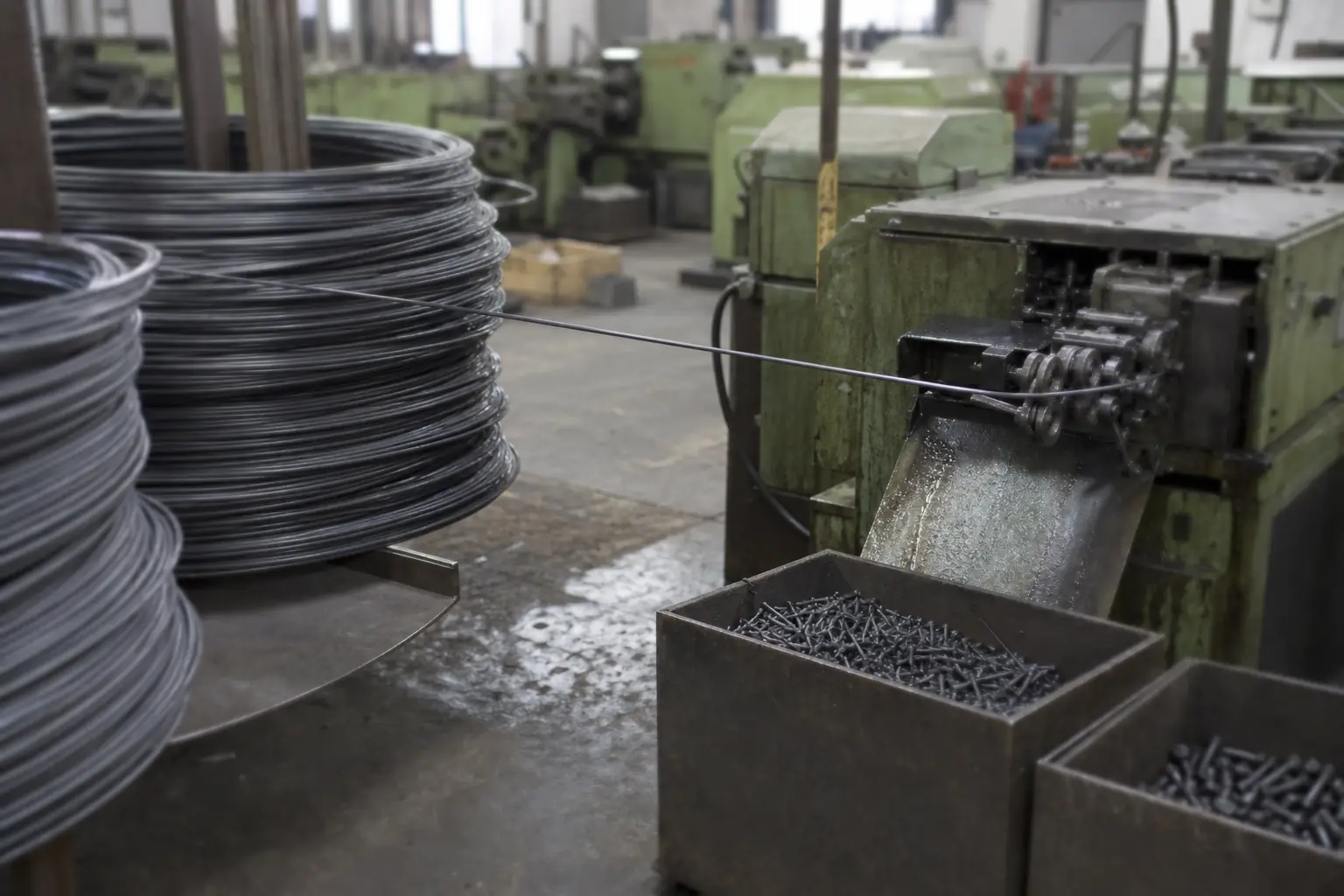
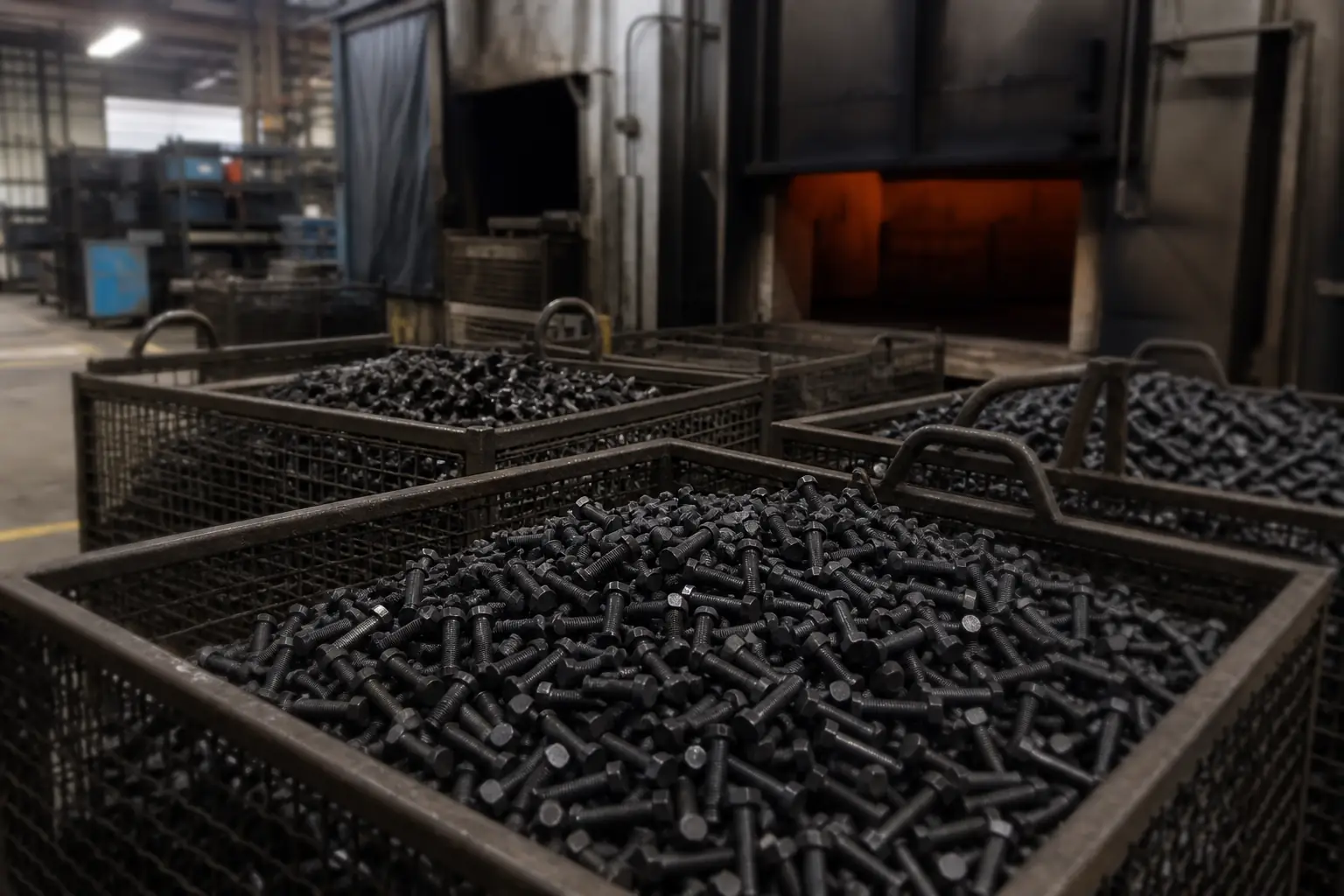
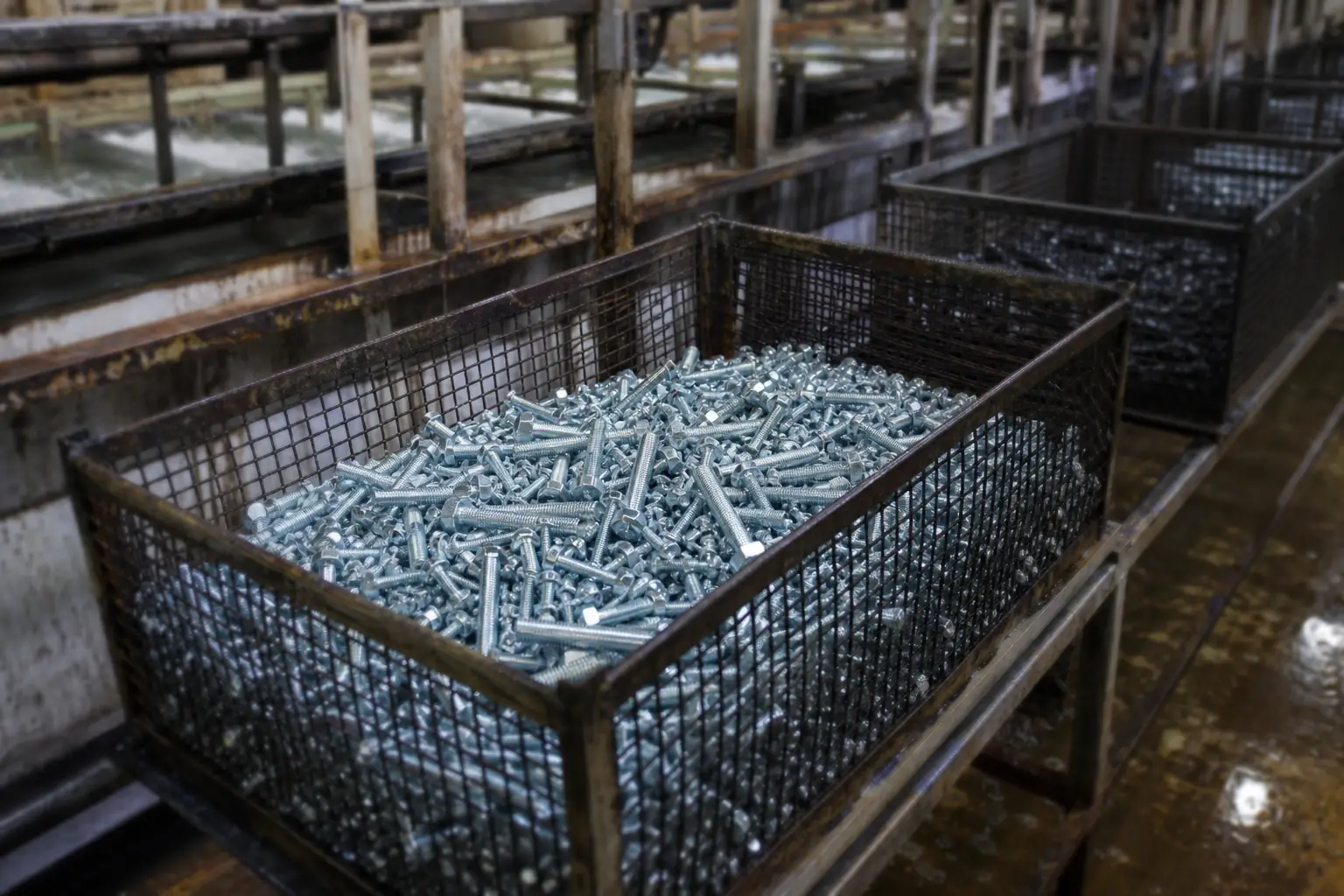
This part is cold-formed, threaded, heat-treated and finished in-house. The stages below are where its class and finish are actually decided.
01
Cold heading
Wire rod is drawn to size and cold-formed into blanks. Forming rather than cutting keeps the grain flow continuous around the head, which is where a bolt is most likely to fail.
Head dimensions and under-head radius checked at set-up and per shift.
02
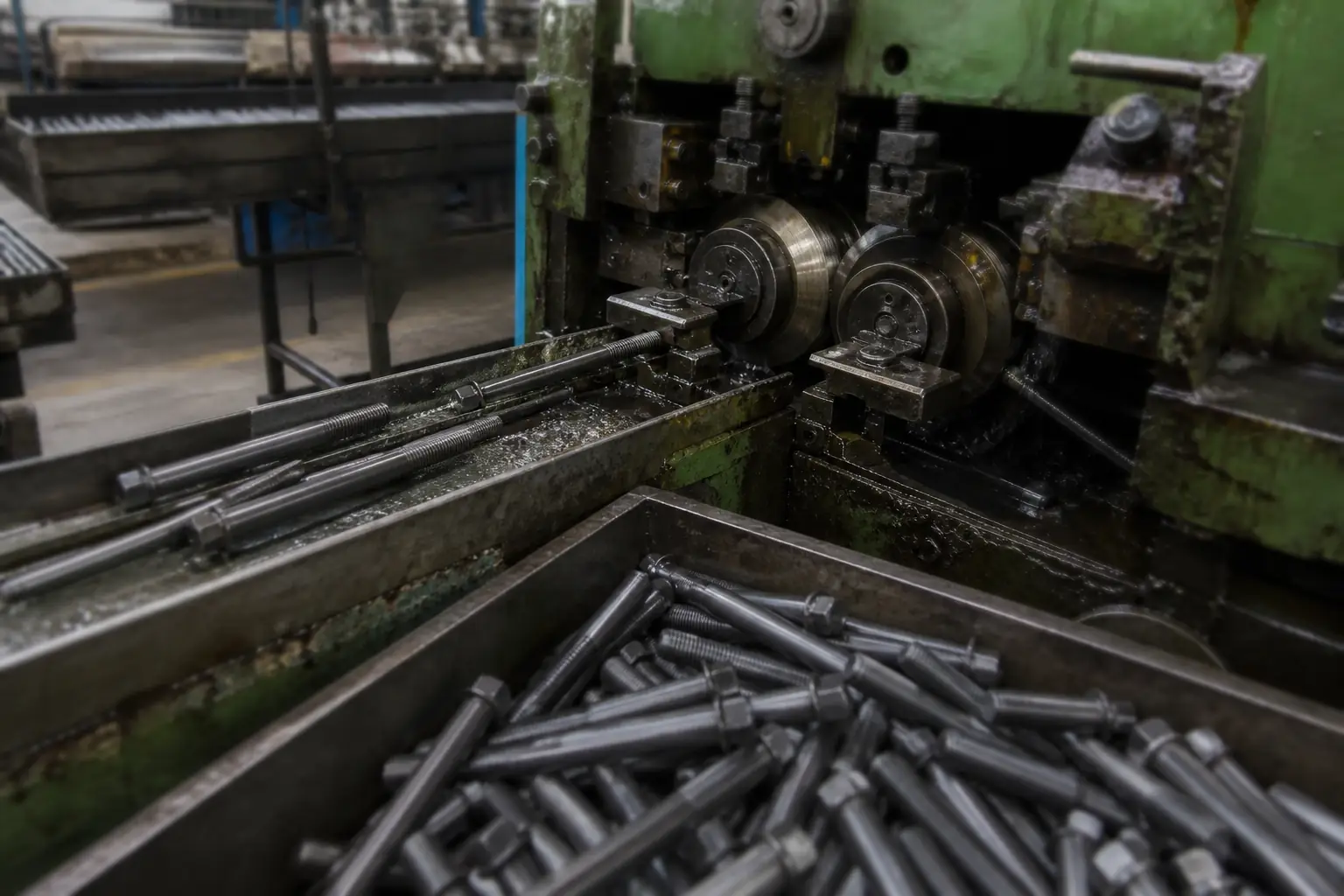
Thread rolling
Threads are rolled between hardened dies rather than cut. Rolled threads are stronger in fatigue than cut threads and hold pitch and flank angle far more consistently across a batch.
Go / no-go ring gauges to ISO 965 tolerance class 6g.
03
Heat treatment
Quench-and-temper brings carbon and alloy steel to the property class ordered — 8.8, 10.9 or 12.9 — with the furnace charge tracked so a finished lot can be traced back to it.
Core hardness and tensile tested per lot to ISO 898-1.
04
Surface treatment
Zinc, zinc-nickel, hot-dip galvanizing, black oxide, phosphate and Dacromet, selected against the service environment rather than against the price list.
Coating thickness and neutral salt spray hours to ISO 9227.
Frequently Asked Questions
What clearance and tapping drill suit M5?
Use a 5.5 mm clearance hole (ISO 273 medium) for through-fixing, or a 4.2 mm tapping drill for a coarse M5 thread.
Is M5 Insulating Fibre Washers suitable for electronics and small mechanisms?
M5 Insulating Fibre Washers is in the micro range and is widely used in electronics, instrument enclosures and small precision mechanisms. Watch the over-torque margin — micro joints strip easily.
What's the typical proof load behavior of M5 class 8.8?
Micro-thread joints are sensitive to plastic deformation in the first turn under load — use a torque-limiting driver and check the bearing surface deformation on softer mating materials.
Which washer dimensions matter most for M5?
For a flat washer, the outside diameter (the bearing surface) and the thickness control how the load is spread under the head and how much elastic preload is preserved. The inside diameter must clear the bolt body but not be so large that the head bears mostly on the washer's outer rim.
How do I request a quotation?
Use the technical drawing on this page to pick the exact configuration, then submit it with the quote form. We respond within one business day.
Need a fastener quote or a spec sheet?Message our engineers on WhatsApp — send a drawing or DIN number and get pricing back fast.Start WhatsApp Chat →
This website uses only necessary and functional cookies to operate, secure, and improve basic website performance.
We do not use advertising cookies, Google Analytics, or cross-site tracking technologies.
Privacy Policy