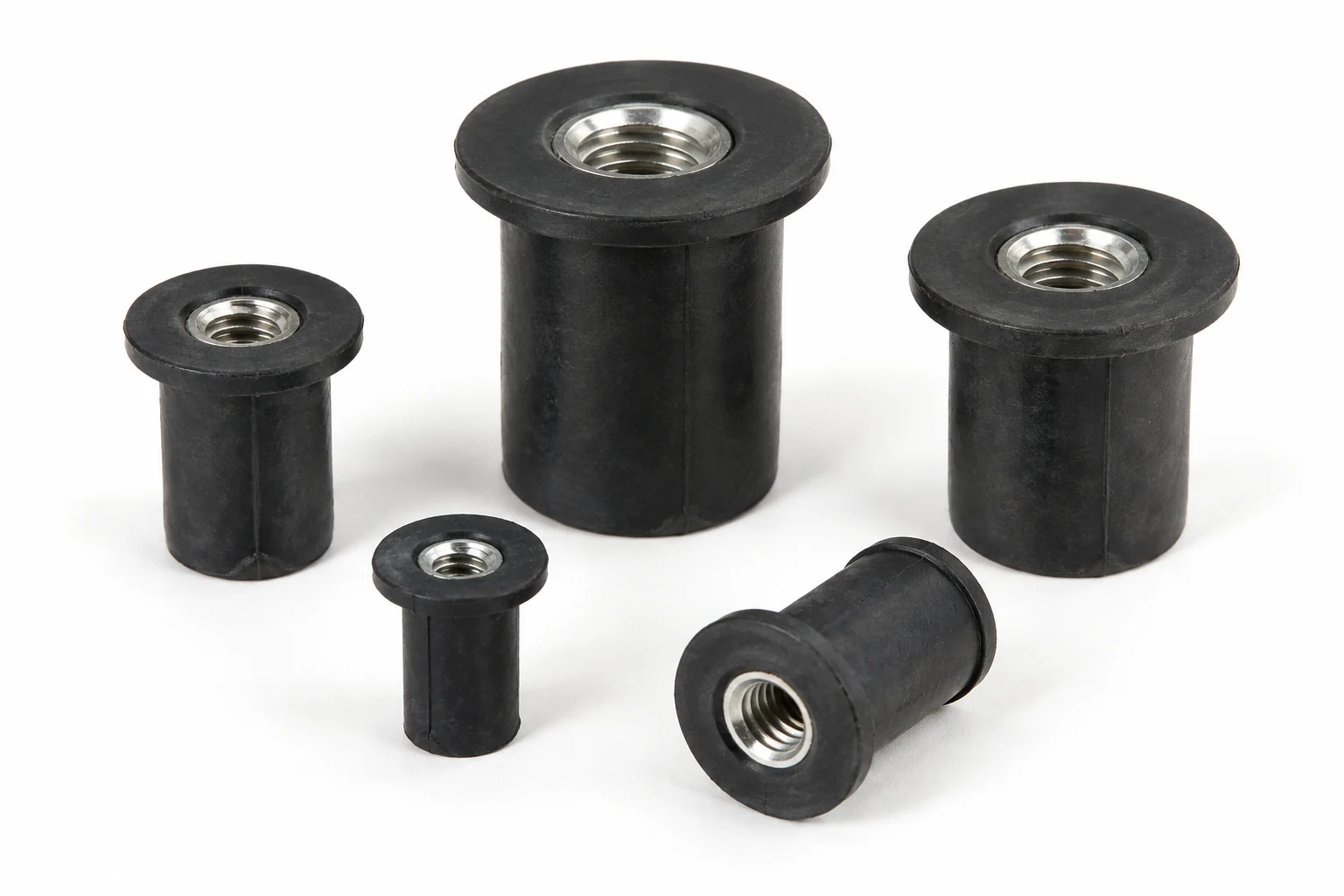
Controlling dimensions to Trade series (rubber blind nuts), with spanner or drive size and tightening torque.
M6 EPDM Rubber Well Nuts dimensions to Trade series (rubber blind nuts): coarse thread pitch 1 mm. Tighten to approximately 10 Nm at property class 8.8 in a dry, as-supplied condition.
Coarse thread pitch
1 mm
Tightening torque (class 8.8)
10 Nm
Figures are nominal values from the governing standard. Confirm against the tolerance class for your application before machining or ordering.
Hidden Deck Fasteners Sourcing: Manufacturing, Types & Material Compatibility
Dimensional data for M6 EPDM Rubber Well Nuts to Trade series (rubber blind nuts), with the drive and the installation notes for this type.
Values are taken from the governing standard rather than from a general machine-thread table, because this type is not selected on one.
M6 Dimensional Row (Trade series (rubber blind nuts))
Thread size
Representative hole diameter (mm)
Representative grip range (mm)
Temperature range (u00b0C)
Representative tightening torque (Nu00b7m)
Body / insert
M6
12.8
0.4~4.0 or 0.8~4.7
-30~+80
1.0
EPDM rubber / stainless threaded insert
Spanner & Drive for M6 EPDM Rubber Well Nuts
Drive geometry for M6 EPDM Rubber Well Nuts is given by the row above; match the tool to the listed values.
Tightening Torque for M6
Class 8.8 (dry, ~µ 0.125)
≈ 10 Nm
Class 10.9 (dry, ~µ 0.125)
≈ 14 Nm
Class 12.9 (dry, ~µ 0.125)
≈ 17 Nm
Indicative dry-joint values. Lubrication can lower the required torque by 15–25%. Always confirm against the joint design, especially when going up a strength class.
Proof Load & Strength for M6
Tensile stress area As (ISO 898-1)
20.1 mm²
Proof load, class 8.8
12 kN
Proof load, class 10.9
17 kN
Proof load, class 12.9
19 kN
Min. ultimate tensile, class 8.8
16 kN
Proof load = stress area × proof stress per ISO 898-1. Design joints so the working preload stays below the proof load of the selected class.
Mating Parts for M6
Pair M6 with the matching M6 bolt or screw, plus a M6 flat washer where required to distribute load on softer materials.
When to Step Up or Down from M6
When the joint preload approaches the proof load of M6 class 8.8, step up to M8 class 8.8 (or move to M6 class 10.9). When the joint is over-specified, M5 often saves weight and cost without losing the safety margin.
Technical Drawing
Customize the parameters below — every spec field is editable, and the drawing redraws to match the values you choose. Changing the size will snap the other fields to that size's standard values; you can then override any individual value.
Sends the selected values to the quote form below.
Request a Quote
The form below follows the current technical drawing configuration. Change the drawing values above and the request details update automatically.
Dimensions & Specifications (Trade series (rubber blind nuts))
Thread size
Representative hole diameter (mm)
Representative grip range (mm)
Temperature range (u00b0C)
Representative tightening torque (Nu00b7m)
Body / insert
M3
8.0
0.4~4.0
-30~+80
0.5
EPDM rubber / stainless threaded insert
M4
8.0
0.4~4.0
-30~+80
0.4
EPDM rubber / stainless threaded insert
M5
9.7
0.4~4.9
-30~+80
0.6
EPDM rubber / stainless threaded insert
M6
12.8
0.4~4.0 or 0.8~4.7
-30~+80
1.0
EPDM rubber / stainless threaded insert
M8
16.0
0.4~4.0
-30~+80
1.5
EPDM rubber / stainless threaded insert
Applications & Industries for M6 EPDM Rubber Well Nuts
Where EPDM Rubber Well Nuts are used, and what decides the specification in each case. Stocked from M3 to M8.
Industries that specify EPDM Rubber Well Nuts
Vehicle body panelsRubber well nuts isolate and seal trim fasteners through thin skins.
Motorcycle serviceBlind rubber inserts provide a thread where the rear face is inaccessible.
Outdoor enclosuresEPDM accommodates panel movement and keeps a small hole sealed.
Equipment coversStainless inserts resist corrosion while the rubber body clamps the panel.
Maintenance & MROReplacements matched to the existing bolt class, thread and finish.
Building servicesThreaded rod, channel and suspension assemblies.
Typical applications
adding a blind threaded point to a thin panel
matching hole diameter and grip range to the EPDM body
tightening only to the representative torque for the size
using the rubber body for isolation and sealing
completing a bolted joint on a stud, rod or bolt
locking an adjustment so it cannot drift
Service conditions to specify against
Marine and coastal
Available in A4 (316) stainless for chloride exposure — coastal structures, pool halls, water treatment and deck hardware, where A2 will eventually pit.
High load
Supplied in ISO 898-1 property classes, so the joint can be designed to a stated proof load and tightened to a calculated torque rather than by feel.
Sealed joints
Used where the fixing has to keep water or air out as well as hold — the elastomer, not the fastener, decides service life.
Match the class
A nut below the bolt property class strips before the bolt reaches its own limit — pair class 8 nuts with 8.8 bolts, class 10 with 10.9.
Where to use something else
Do not over-tighten a well nut; excess compression can pull the insert through the panel or damage the seal.
This part is cold-formed, threaded, heat-treated and finished in-house. The stages below are where its class and finish are actually decided.
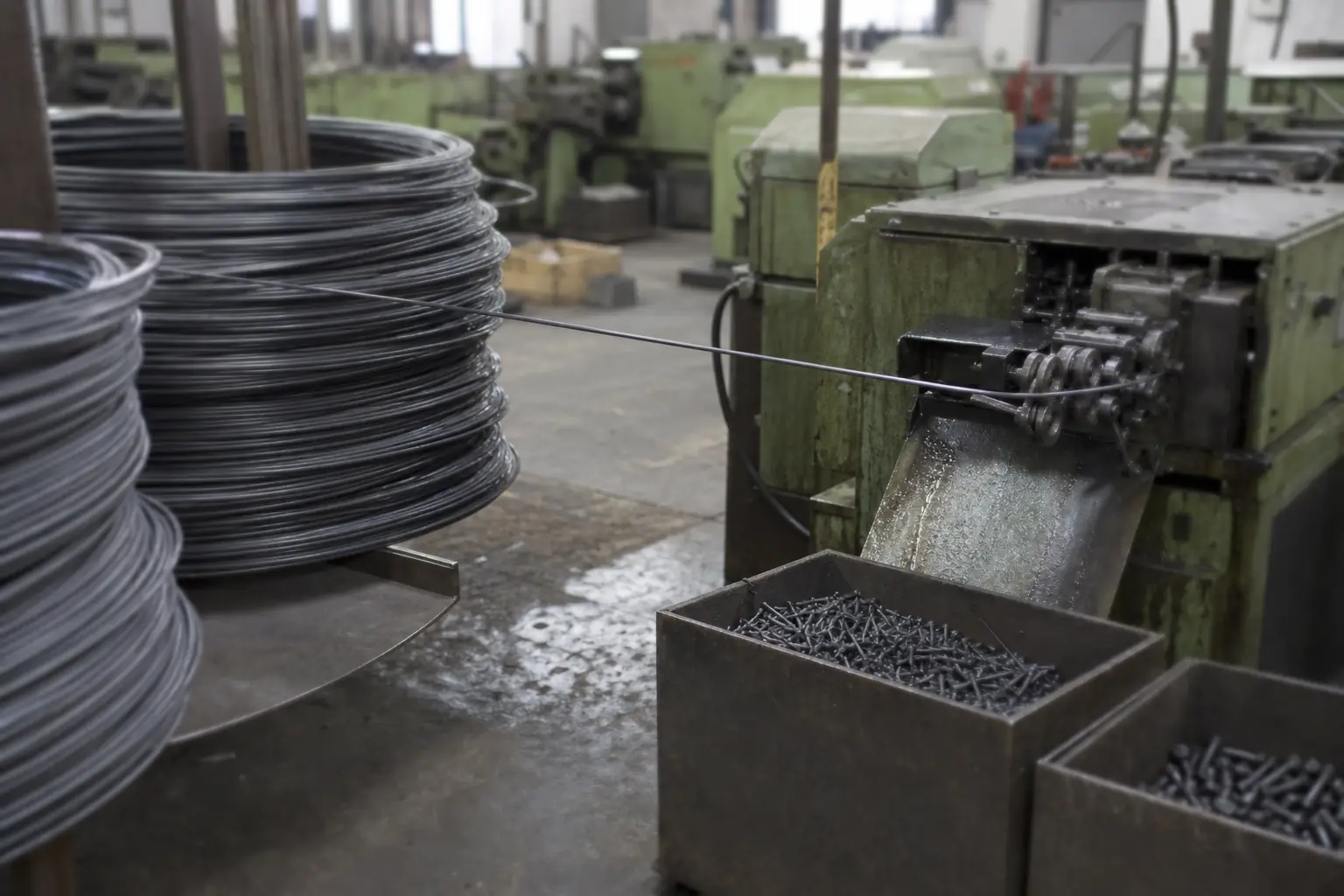
01
Cold heading
Wire rod is drawn to size and cold-formed into blanks. Forming rather than cutting keeps the grain flow continuous around the head, which is where a bolt is most likely to fail.
Head dimensions and under-head radius checked at set-up and per shift.
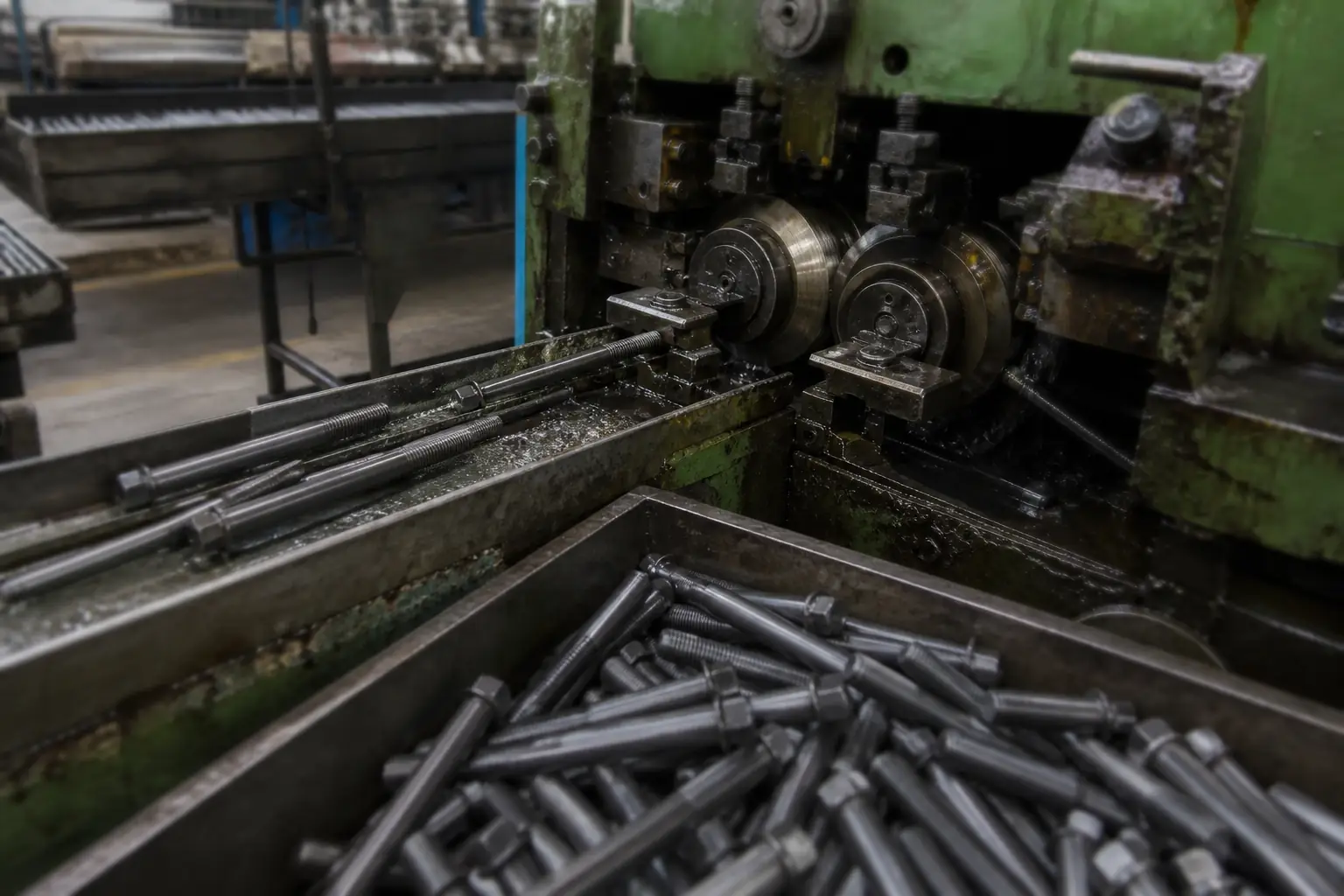
02
Thread rolling
Threads are rolled between hardened dies rather than cut. Rolled threads are stronger in fatigue than cut threads and hold pitch and flank angle far more consistently across a batch.
Go / no-go ring gauges to ISO 965 tolerance class 6g.
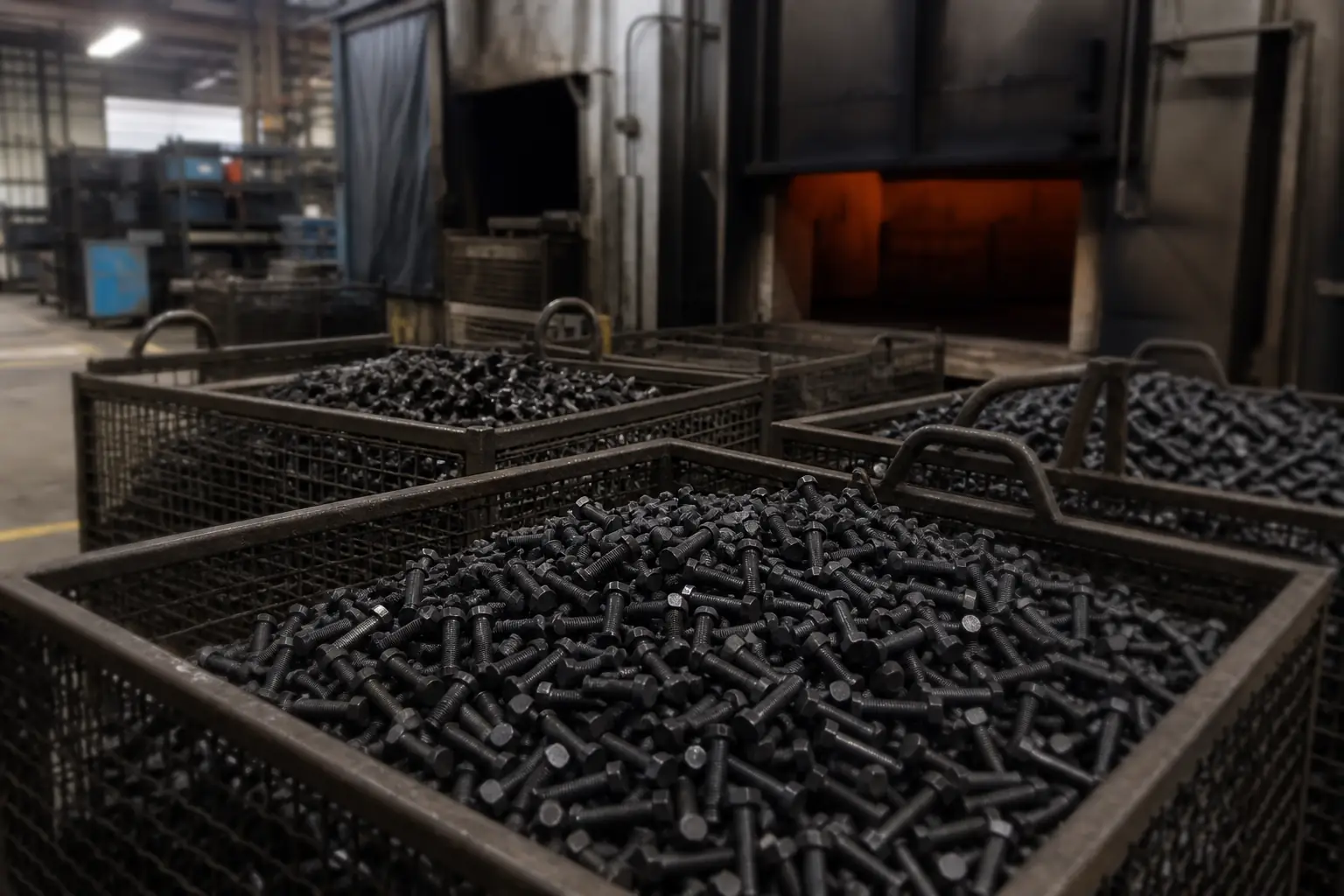
03
Heat treatment
Quench-and-temper brings carbon and alloy steel to the property class ordered — 8.8, 10.9 or 12.9 — with the furnace charge tracked so a finished lot can be traced back to it.
Core hardness and tensile tested per lot to ISO 898-1.
04
Surface treatment
Zinc, zinc-nickel, hot-dip galvanizing, black oxide, phosphate and Dacromet, selected against the service environment rather than against the price list.
Coating thickness and neutral salt spray hours to ISO 9227.
Frequently Asked Questions
What is the height of an M6 nut?
The nominal height of a style-1 ISO 4032 M6 nut is in the spec table on this page. Style-2 (thick) is approximately 1.1× this height; thin (ISO 4035 / DIN 439) is approximately 0.5×.
What is the coarse-thread pitch of M6 for EPDM Rubber Well Nuts?
For M6 the standard coarse pitch is 1 mm — this is the value used for EPDM Rubber Well Nuts.
What clearance and tapping drill suit M6?
Use a 6.6 mm clearance hole (ISO 273 medium) for through-fixing, or a 5 mm tapping drill for a coarse M6 thread.
How do I request a quotation?
Use the technical drawing on this page to pick the exact configuration, then submit it with the quote form. We respond within one business day.
Need a fastener quote or a spec sheet?Message our engineers on WhatsApp — send a drawing or DIN number and get pricing back fast.Start WhatsApp Chat →
This website uses only necessary and functional cookies to operate, secure, and improve basic website performance.
We do not use advertising cookies, Google Analytics, or cross-site tracking technologies.
Privacy Policy