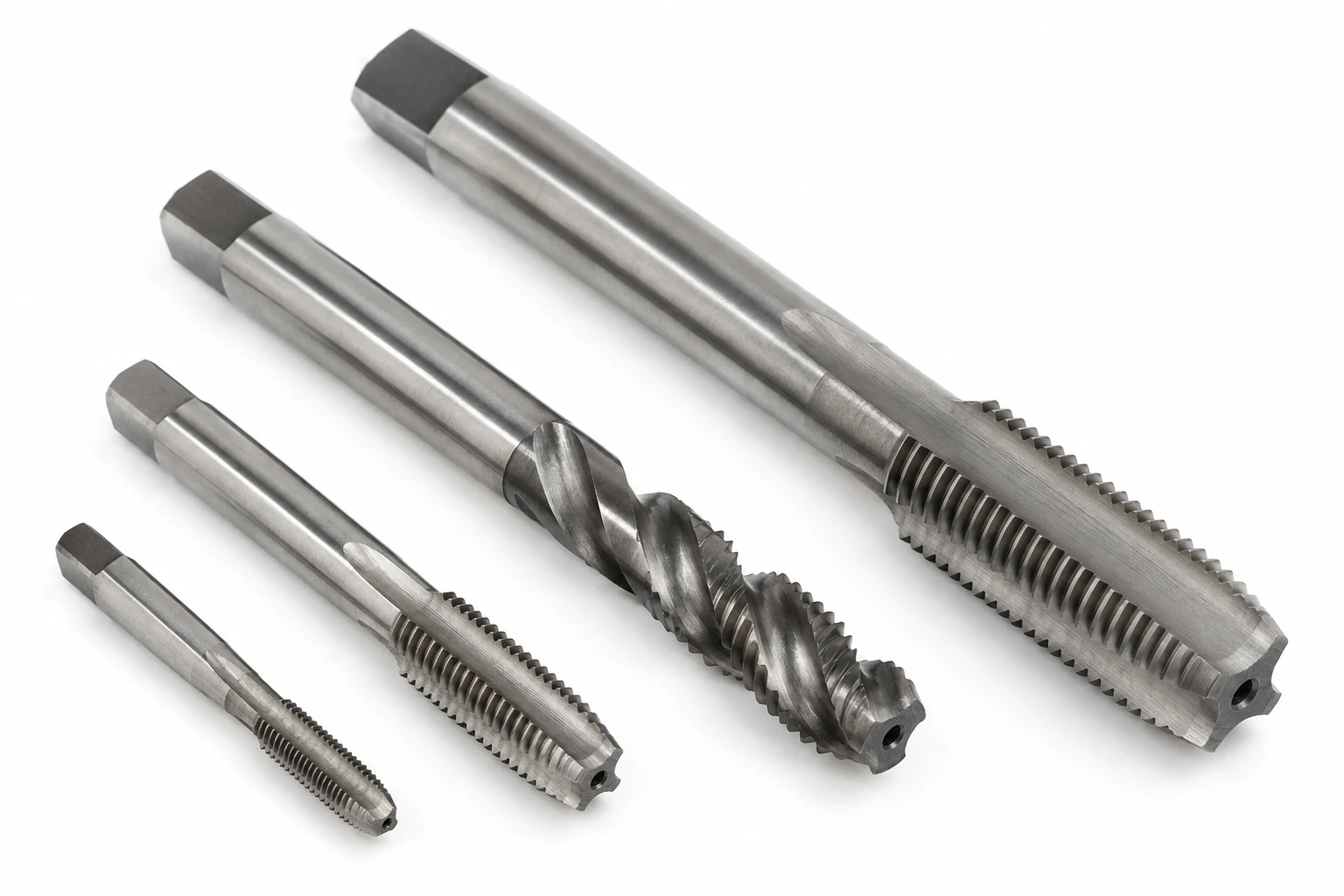
For machine taps (din 371 / din 376), DIN 376 is the governing document for the dimensions listed below. Mechanical and performance requirements for this part family are set by its own standards, not by the bolt and screw property-class documents.
DIN 376 — Scope
DIN 376 specifies the dimensional requirements for machine taps (din 371 / din 376).
Material, surface condition and any performance rating are set by separate documents specific to this part family — ISO 898-1 and ISO 898-2, which govern bolt and nut property classes, do not apply here.
Tolerance & Product Grades
Tolerances for machine taps (din 371 / din 376) are given as limits on the individual dimensions in the table rather than as a fastener product grade.
Where a general-tolerance class is cited on the drawing instead, it applies to the dimensions not otherwise toleranced.
Dimensions Specified by DIN 376
| Tap form | Chip behaviour | Hole type | Suited to |
|---|---|---|---|
| spiral point (gun nose) | pushes chips ahead of the tap | through holes only | steel, stainless, general production |
| spiral flute | pulls chips back out of the hole | blind holes | steel, aluminium, blind tapping |
| straight flute | chips break and collect in the flute | short through or blind holes | cast iron, brass, hand and machine use |
| thread-forming (fluteless) | no chips at all | through or blind | aluminium, copper, mild steel, thin sections |
| DIN 371 shank | n/a | n/a | M1 to M10, short shank |
| DIN 376 shank | n/a | n/a | M10 to M30, long shank |
Equivalent Standards
Where direct equivalents exist (ISO ↔ DIN, ISO ↔ ASME), they are listed on the parent Machine Taps (DIN 371 / DIN 376) page.
Always confirm against the dimensions on this page, since some "equivalent" standards differ in tolerances and head geometry.
When to Specify DIN 376
DIN 376 is still widely used in European mechanical engineering and as a cross-reference on legacy drawings; its ISO equivalent is preferred for new designs.