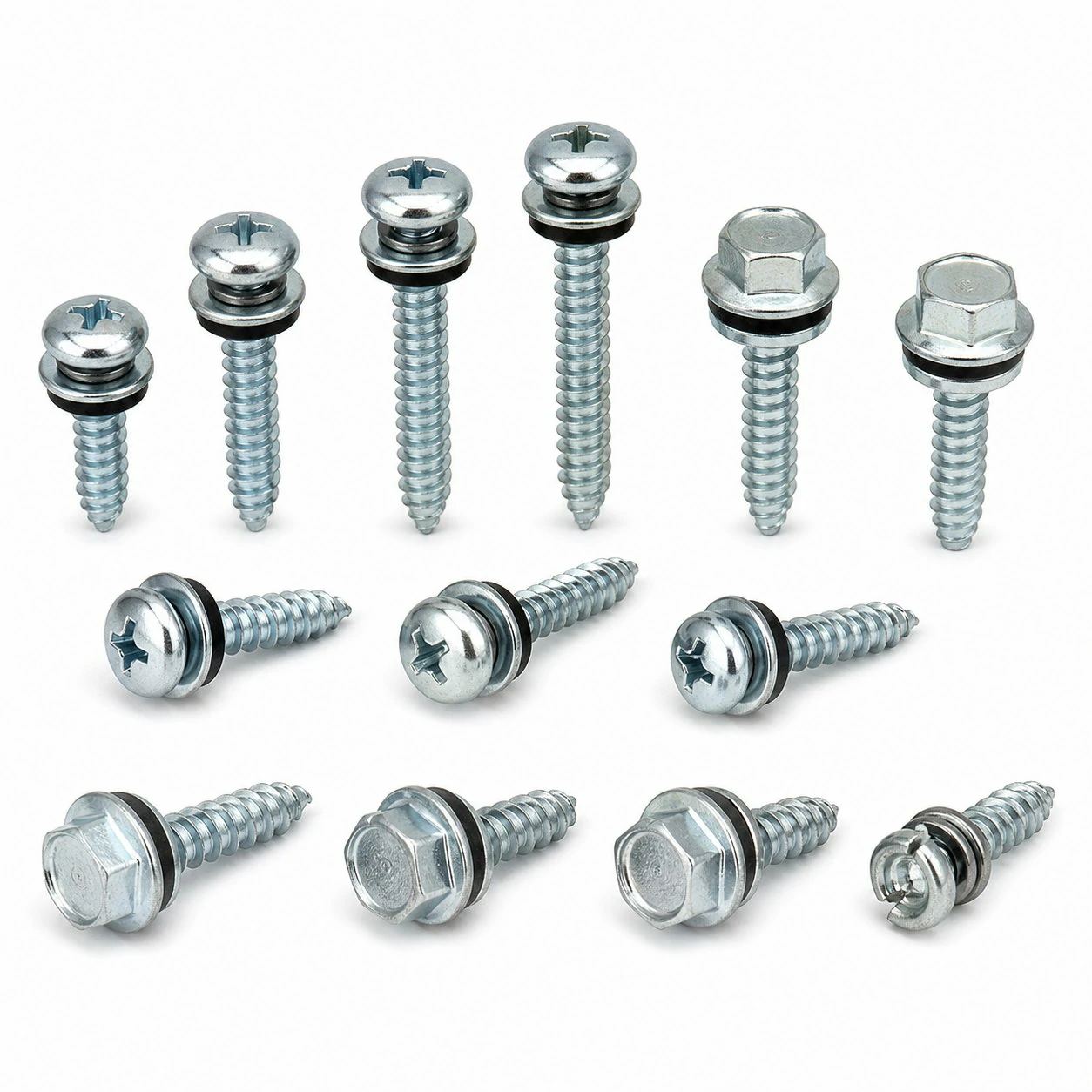
DIN 6900-4 specifies the dimensions and tolerances for sems screws with captive spring washer. The full dimensional table is reproduced below, followed by the DIN, ISO and ASME parts that match or supersede it.
- Standard
- DIN 6900-4
- Product
- SEMS Screws with Captive Spring Washer
- Governing standards
- DIN 6900-4
Equivalence between national standards is dimensional, not always metallurgical. Check the property class separately when substituting.
The table below lists the dimensions catalogued for sems screws with captive spring washer under DIN 6900-4. The scope of DIN 6900-4 itself is not summarised here — where a figure matters, confirm it against the published document.
DIN 6900-4 — Scope
The table below lists the dimensions catalogued for sems screws with captive spring washer under DIN 6900-4. The scope of DIN 6900-4 itself is not summarised here — where a figure matters, confirm it against the published document.
Tolerance & Product Grades
Product grade is a concept from dimensional fastener standards and does not apply to DIN 6900-4. Tolerances for this part are the limits shown against each dimension in the table.
Dimensions Specified by DIN 6900-4
| Thread size | Pitch (mm) | Head diameter dk (mm) | Head height k (mm) | Washer outer diameter (mm) | Cross recess | Common length range (mm) | Reference standard |
|---|
| M3 | 0.5 | 5.6 | 2.4 | 6.2 | PH1 / PZ1 | 5~30 | DIN 6900-4 |
| M4 | 0.7 | 8.0 | 3.1 | 8.0 | PH2 / PZ2 | 6~40 | DIN 6900-4 |
| M5 | 0.8 | 9.5 | 3.7 | 10.0 | PH2 / PZ2 | 8~50 | DIN 6900-4 |
| M6 | 1.0 | 12.0 | 4.6 | 12.2 | PH3 / PZ3 | 8~60 | DIN 6900-4 |
| M8 | 1.25 | 16.0 | 6.0 | 15.4 | PH4 / PZ4 | 10~60 | DIN 6900-4 |
| M10 | 1.5 | 20.0 | 7.5 | 18.4 | PH4 / PZ4 | 12~60 | DIN 6900-4 |
Equivalent Standards
Where direct equivalents exist (ISO ↔ DIN, ISO ↔ ASME), they are listed on the parent SEMS Screws with Captive Spring Washer page.
Always confirm against the dimensions on this page, since some "equivalent" standards differ in tolerances and head geometry.
When to Specify DIN 6900-4
DIN 6900-4 is still widely used in European mechanical engineering and as a cross-reference on legacy drawings; its ISO equivalent is preferred for new designs.
Custom manufacturing · Made to drawing
Need a screw to this standard in a non-standard size?
Parts built to DIN 6900 4 are already in the catalog, so a special is usually a variation on existing tooling rather than a new design — which is what keeps the cost down. Made by cold heading or warm forging.
Minimum order from 2,000 pieces; samples within 7 days of drawing approval.
Custom screw manufacturingSend a drawing
Applications & Industries
Where SEMS Screws with Captive Spring Washer are used, and what decides the specification in each case. Stocked from M3 to M10.
Industries that specify SEMS Screws with Captive Spring Washer
-
Machine building & OEM
The default fastener on production equipment: covers, brackets, motor mounts and sub-assemblies tightened to a specified torque.
-
Automotive & transport
Chassis, driveline and body fixings that see vibration and are assembled to a controlled preload.
-
Steel fabrication
Bolted connections in frames, enclosures, walkways and weldments, on the bench and on site.
-
Energy & infrastructure
Tower, pipework, switchgear and plant fixings specified for long service life and inspectable joints.
-
Maintenance & MRO
Stocked replacements matched to an existing property class, thread and finish.
-
Food, pharma & cleanroom
Stainless assemblies that are washed down, where the finish matters as much as the strength.
Typical applications
- clamping two machined faces to a calculated preload
- bolting brackets, motors and gearboxes to a frame
- assemblies that are dismantled for service and re-torqued
- joints where the property class is stated on the drawing
Service conditions to specify against
- Marine and coastal
- Available in A4 (316) stainless for chloride exposure — coastal structures, pool halls, water treatment and deck hardware, where A2 will eventually pit.
- High load
- Supplied in ISO 898-1 property classes, so the joint can be designed to a stated proof load and tightened to a calculated torque rather than by feel.
- Torque and preload
- The joint is designed around bolt tension, so lubrication, coating and the friction coefficient all change the torque figure — state them together.
Where to use something else
- Do not use a machine thread into unthreaded sheet or timber; use a tapping screw, rivet nut or insert made for that parent material.
Full application guide: where SEMS Screws with Captive Spring Washer are used, how to specify them, and the cases they are wrong for