
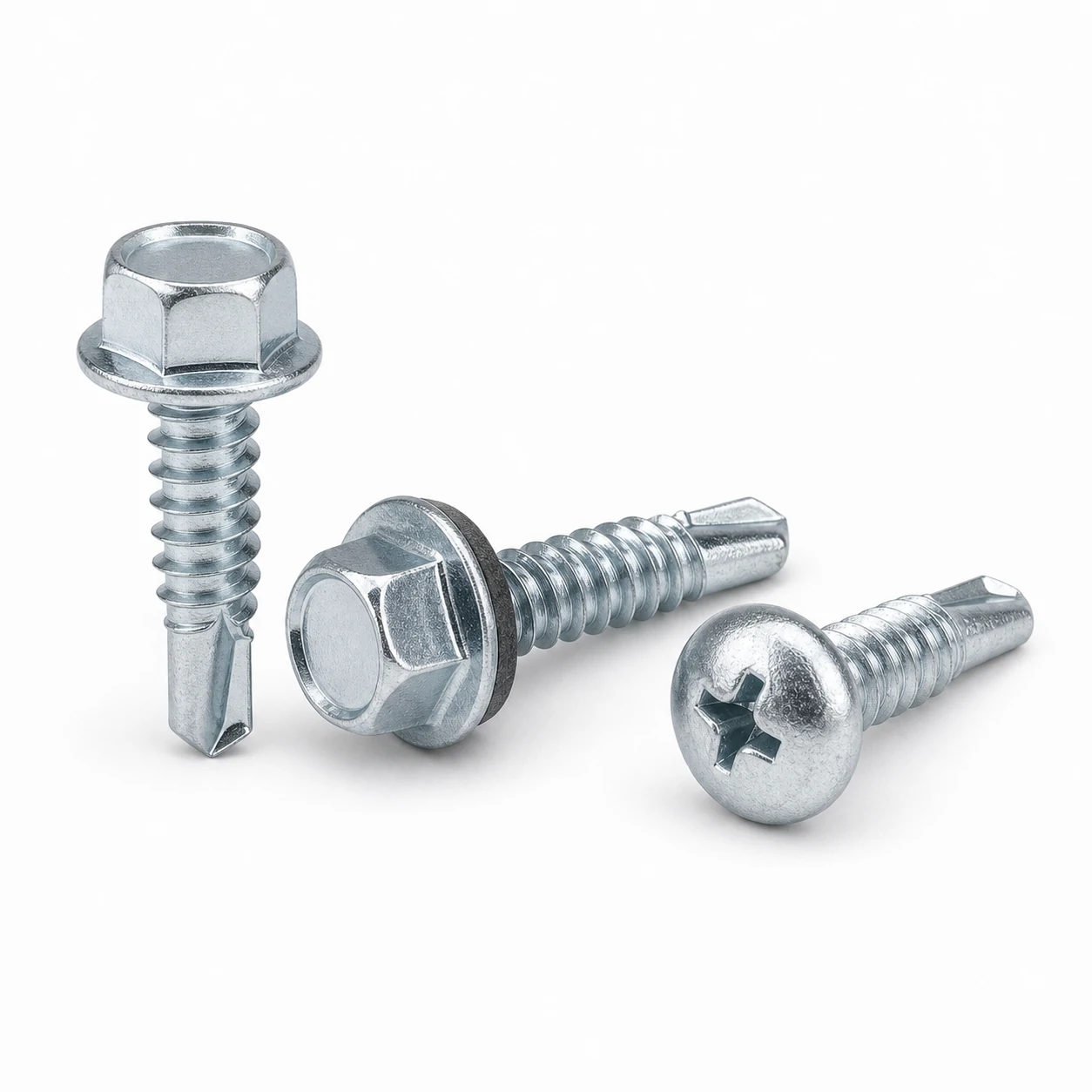
Specification summary of DIN 7504 as applied to self-drilling screws: the dimensions the standard fixes, the full size range supplied, and the related designations commonly cross-referenced.
DIN 7504 — Scope
DIN 7504 specifies the dimensional requirements for self-drilling screws. Material, surface condition and any performance rating are set by separate documents specific to this part family — ISO 898-1 and ISO 898-2, which govern bolt and nut property classes, do not apply here.
Tolerance & Product Grades
Tolerances for self-drilling screws are given as limits on the individual dimensions in the table rather than as a fastener product grade. Where a general-tolerance class is cited on the drawing instead, it applies to the dimensions not otherwise toleranced.
Dimensions Specified by DIN 7504
| Size | Nominal diameter (mm) | Pitch (mm) | Head diameter dk (mm) | Head height k (mm) | Drill point capacity (mm) | Common length range (mm) | Reference standard | Notes |
|---|---|---|---|---|---|---|---|---|
| ST3.5 | 3.5 | 1.27 | 6.9 | 2.1 | 0.7~2.0 | 13~25 | DIN 7504 K/N | Tek self-drilling screw, drill flute point |
| ST3.9 | 3.9 | 1.29 | 7.5 | 2.3 | 0.7~2.5 | 13~32 | DIN 7504 K/N | Tek self-drilling screw, drill flute point |
| ST4.2 | 4.2 | 1.41 | 8.2 | 2.5 | 0.7~3.0 | 13~38 | DIN 7504 K/N | Tek self-drilling screw, drill flute point |
| ST4.8 | 4.8 | 1.59 | 9.5 | 2.9 | 0.7~4.0 | 16~50 | DIN 7504 K/N | Tek self-drilling screw, drill flute point |
| ST5.5 | 5.5 | 1.81 | 10.9 | 3.3 | 1.0~5.0 | 19~60 | DIN 7504 K/N | Tek self-drilling screw, drill flute point |
| ST6.3 | 6.3 | 1.81 | 12.5 | 3.8 | 1.0~6.0 | 19~80 | DIN 7504 K/N | Tek self-drilling screw, drill flute point |
Equivalent Standards
Where direct equivalents exist (ISO ↔ DIN, ISO ↔ ASME), they are listed on the parent Self-Drilling Screws page. Always confirm against the dimensions on this page, since some "equivalent" standards differ in tolerances and head geometry.
Companion Standards
DIN 7504 controls only the geometry of self-drilling screws. Surface finish is governed by separate finish standards (for example ISO 4042 for electroplating), and corrosion testing by ISO 9227 (neutral salt spray). Mechanical performance is set by the standards specific to this part family, not by ISO 898-1 or ISO 898-2, which apply to bolts, screws and nuts.




