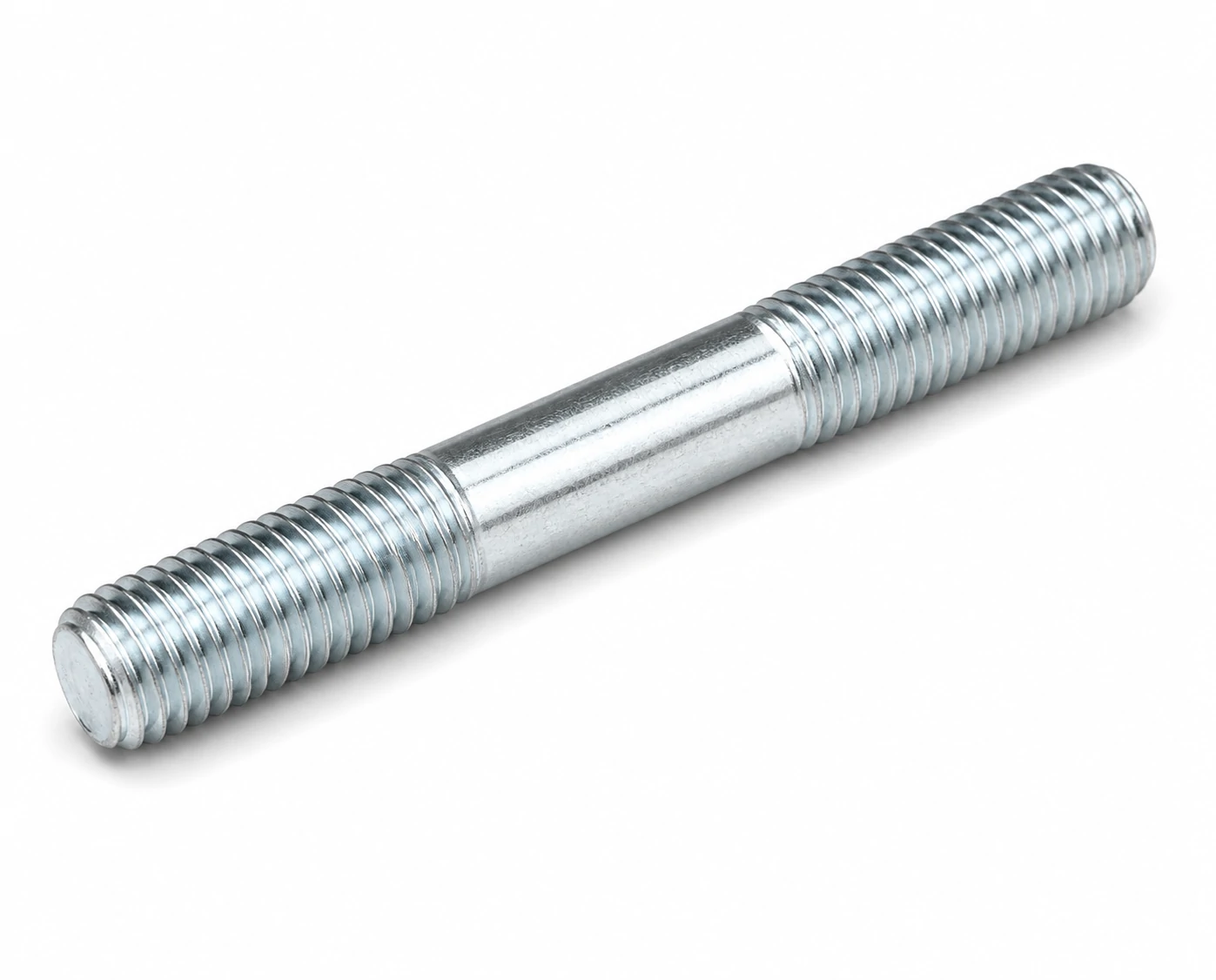
For equal-end stud bolt, DIN 939 fixes the geometry and the tolerances. The sections below describe the scope of the document, the properties it deliberately leaves to companion standards, and the equivalent designations across standards bodies.
DIN 939 — Scope
DIN 939 is "Double end studs — Metal end 1.25 d".
Material, property class, surface finish and packaging are governed by separate documents — ISO 898-1 and ISO 898-2 for mechanical property classes, ISO 4042 for electroplated finishes.
Tolerance & Product Grades
DIN 939 does not divide equal-end stud bolt — gb/t 901 / din 939 (series 093) into product grades. Tolerances are given as limits on the individual dimensions in the table.
Where a general-tolerance class is cited on the drawing instead, it applies to the dimensions not otherwise toleranced.
Dimensions Specified by DIN 939
| Thread size | Pitch (mm) | Length L (mm) | Engagement depth bm (mm) | Material | Reference standard |
|---|---|---|---|---|---|
| M6 | 1.0 | 50 | 8 | Cl. 8.8 alloy steel | DIN 939 / GB/T 901 |
| M8 | 1.25 | 60 | 10 | Cl. 8.8 alloy steel | DIN 939 / GB/T 901 |
| M10 | 1.5 | 80 | 15 | Cl. 8.8 alloy steel | DIN 939 / GB/T 901 |
| M12 | 1.75 | 100 | 18 | Cl. 8.8 alloy steel | DIN 939 / GB/T 901 |
| M14 | 2.0 | 120 | 21 | Cl. 8.8 alloy steel | DIN 939 / GB/T 901 |
| M16 | 2.0 | 150 | 24 | Cl. 8.8 alloy steel | DIN 939 / GB/T 901 |
| M20 | 2.5 | 180 | 30 | Cl. 8.8 alloy steel | DIN 939 / GB/T 901 |
| M24 | 3.0 | 200 | 36 | Cl. 8.8 alloy steel | DIN 939 / GB/T 901 |
| M30 | 3.5 | 240 | 45 | Cl. 8.8 alloy steel | DIN 939 / GB/T 901 |
| M36 | 4.0 | 280 | 54 | Cl. 8.8 alloy steel | DIN 939 / GB/T 901 |
Companion Standards
DIN 939 controls only the geometry of equal-end stud bolt — gb/t 901 / din 939 (series 093). The mechanical strength is set by ISO 898-1 (bolts, screws and studs) or ISO 898-2 (nuts); the surface finish is governed by separate finish standards such as ISO 4042 for electroplating. For corrosion testing, the relevant document is ISO 9227 (neutral salt spray).
When to Specify DIN 939
DIN 939 is still widely used in European mechanical engineering and as a cross-reference on legacy drawings; its ISO equivalent is preferred for new designs.
Custom manufacturing · Made to drawing
Need a bolt to this standard in a non-standard size?
Parts built to DIN 939 are already in the catalog, so a special is usually a variation on existing tooling rather than a new design — which is what keeps the cost down. Made by cold heading or hot forging.
Minimum order from 2,000 pieces; samples within 7 days of drawing approval.