
By the Engineering Hardware sourcing & engineering team · Reviewed November 2026
Quick answer: Match the drill point number to the total steel thickness: a #2 point handles light gauge up to roughly 2.5 mm, #3 roughly 2.5–4.5 mm, #4 roughly 4.5–6 mm and #5 roughly 6–12.5 mm. The flute must finish drilling before the thread engages, so the screw’s unthreaded point length has to be longer than the steel you are drilling.
- The drill point number tells you how thick a steel stack the screw can drill — not the screw diameter.
- If the thread engages before drilling is finished, the screw binds and snaps.
- Winged points ream a clearance hole in wood so the threads only engage the steel.
- Use 300-series stainless caps or bi-metal screws outdoors; plain 410 stainless rusts lightly in coastal air.
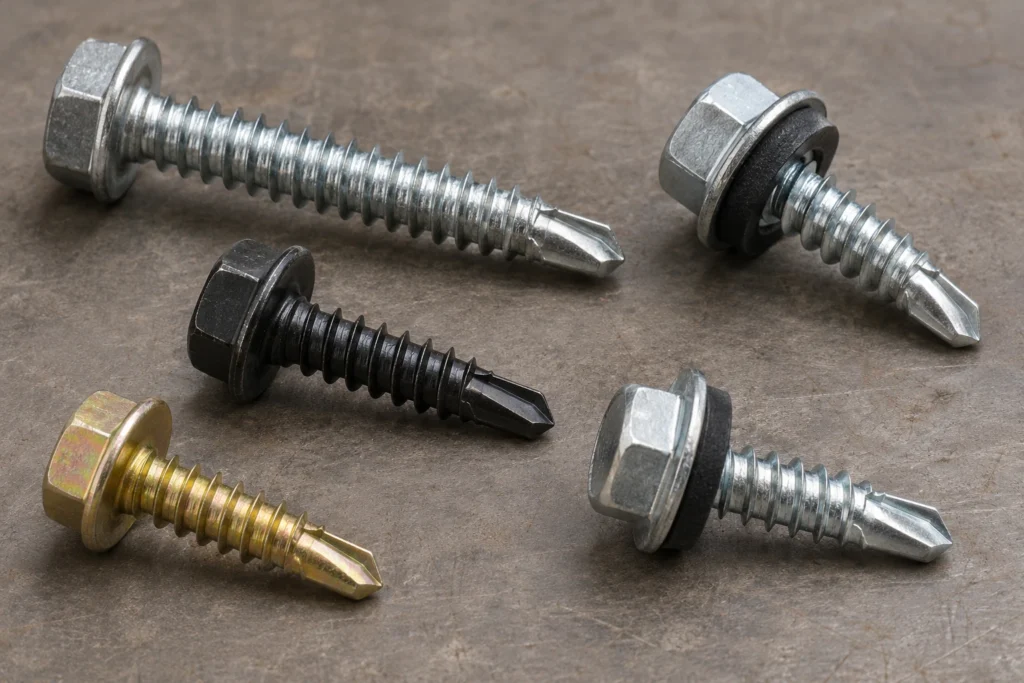
Self-drilling screws — often called Tek screws — combine a drill bit and a thread-forming screw in one part. They save a drilling step on steel framing, roofing and cladding, but only if the point matches the steel. The wrong point either burns out before it breaks through, or the thread grabs too early and the screw snaps.
Drill point chart
Typical capacities for carbon-steel self-drilling screws in mild steel. Different manufacturers publish slightly different ranges, so use their chart for critical work.
| Point | Typical total steel thickness | Typical use |
|---|---|---|
| #1 | up to ~0.9 mm (20 ga and thinner) | Thin sheet, ductwork |
| #2 | ~0.9–2.5 mm | Light steel framing, panels to light purlins |
| #3 | ~2.5–4.5 mm | Heavier studs, multiple sheet layers |
| #4 | ~4.5–6.3 mm | Light structural sections |
| #5 | ~6.3–12.5 mm | Structural steel, heavy purlins |
Count every layer. Two 1.2 mm sheets on a 3 mm purlin is 5.4 mm of steel, which needs a #4 point even though each piece looks thin.
Why point length matters
Look at the screw from the side: between the cutting tip and the first full thread is the pilot section. The drill must completely pass through the steel within that length. If the first thread reaches the steel while the point is still cutting, the thread tries to advance faster than the drill can cut, torque spikes and the screw breaks or the head twists off. This is the single most common self-drilling screw failure on site.
Head styles and what they are for
- Hex washer head — highest drive torque; standard for roofing and framing.
- Pan / modified truss head — low profile for steel stud-to-track and panel work.
- Flat (countersunk) head — sits flush; often with wings for fixing wood or board to steel.
- Bonded EPDM washer — seals roofing and cladding, e.g. the #10 410 stainless roofing screw with EPDM. See our Bulk metal roof fasteners: ordering guide.
Wings for wood-to-steel
When you fix timber or thick board to steel, the threads would otherwise jack the wood away from the steel. Winged screws have two small wings behind the drill point that ream a clearance hole through the wood, then break off when they hit the steel. The thread then engages only the steel and clamps the wood tight.
Materials and coatings
| Option | Strength | Corrosion | Notes |
|---|---|---|---|
| Carbon steel, zinc plated | High | Indoor | Most economical |
| Carbon steel, mechanical zinc / ceramic coating | High | Outdoor | Common for roofing; specify the coating class |
| 410 stainless (e.g. #10 hex washer 410 Tek screw) | High (hardenable) | Good, light surface rust in marine air | Drills steel because it can be hardened |
| Bi-metal (304 body, hardened steel point) | Medium | Excellent | For stainless or aluminum cladding outdoors |
300-series stainless cannot be through-hardened, so a solid 304 screw cannot drill steel — that is why bi-metal screws exist. Fixing aluminum? Read Stainless fasteners in aluminum: preventing galvanic corrosion.
Driving tips
- Use a screw gun with a depth-sensing nosepiece or clutch; impact drivers overdrive.
- Typical speeds are around 1,800–2,500 rpm for small diameters and slower for larger points — check the maker’s recommendation.
- Apply steady pressure until the point breaks through, then let the thread pull the screw in.
- Stop when the washer is compressed but not squeezed out — about the point where the EPDM just bulges at the edge.
Products from our catalog
Hand-picked from the Self-Drilling & Tek Screws category. Every listing shows price tiers, MOQ and the full specification table; one inquiry gets you a confirmed quote, lead time and shipping.
 #10 Hex Washer Head Self Drilling Sheet Metal Tek Screws 410 Stainless Steel Self Tapping Screw
 #10 X 1-1/4″ 410 Ss Hex Washer Head Self Drilling Screws
 #10 Self Drilling Roofing Screws Hex Washer Head EPDM Rubber 410 Stainless Steel Hardened
 #10 X 1-1/2 Self Drilling Tek Roofing Screws Wood Screw Assembled with Washer
Frequently asked questions
What does the number on a Tek screw drill point mean?
It indicates the thickness of steel the point can drill: #1 for very thin sheet up to #5 for steel around 6–12.5 mm. It is not the screw diameter.
Why do self-drilling screws snap?
Most often the steel is thicker than the drill point can finish before the thread engages, so the thread binds. Use a higher point number or a longer pilot section, and reduce drive speed.
Can 304 stainless self-drilling screws drill steel?
Solid 304 cannot be hardened enough to drill steel. Use 410 stainless, or a bi-metal screw with a 304 body and a hardened carbon-steel drill point.
Do I need a pilot hole for self-drilling screws?
No — that is the point of the design. You only pre-drill when the steel is thicker than the largest available drill point.
Related reading
Sources & further reading
Figures in this article are typical values for orientation. Always confirm against the governing standard and the manufacturer’s data for your part, and have safety-critical connections designed by a qualified engineer.