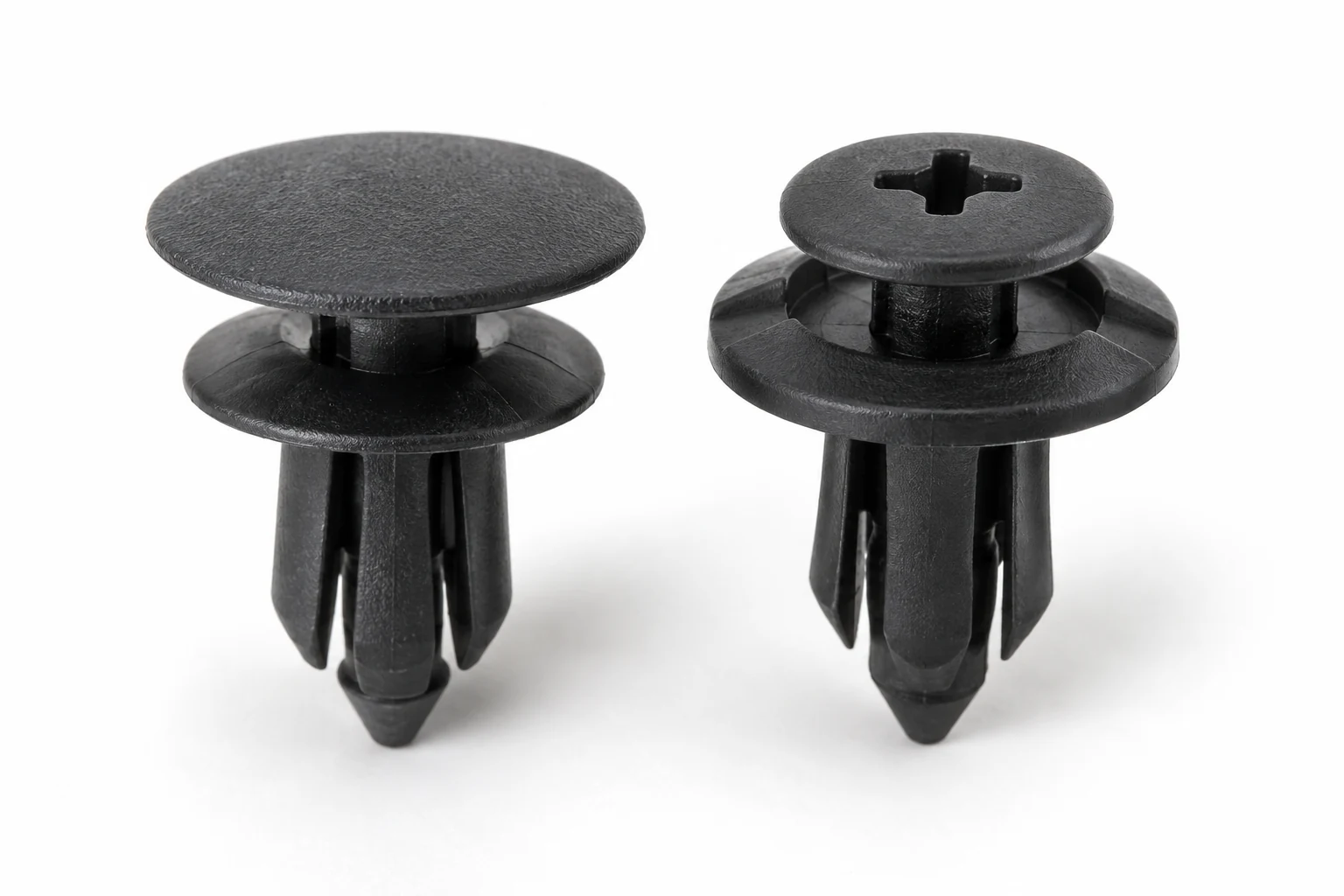
Application guide for Automotive Push-Type Retainers to Trade series (automotive push-type retainers). The core duty of the type is permanent, vibration-proof joints in sheet and plate. The typical industries, the how-to-specify checklist, assembly practice and the exclusion cases are set out below.
Typical Applications for Automotive Push-Type Retainers
The most common settings where these are specified:
- Maintenance & repair (MRO): a stocked size for servicing existing plant where the original fastener spec must be matched.
- Fabrication & metalwork: bench and on-site assembly of steel frames, enclosures and weldments.
- Sheet-metal assembly: permanent joints in ductwork, panels and enclosures.
- Bodywork & trailers: blind joints where only one side is accessible.
- Signage & cladding: fast, vibration-resistant fixing of thin panels.
How to Specify Automotive Push-Type Retainers for Your Application
- Size: Match the size to the mating part — see the dimension table below for each option.
- Material: Choose the material and finish for the service environment — plated steel for general use, stainless for corrosion resistance.
- Environment: For damp, coastal or chemical exposure prefer A4/316 stainless or a suitable coating; indoors, plated steel or A2 is usually sufficient.
- Standard: This product is supplied to Trade series (automotive push-type retainers). Quoting the standard on your order guarantees interchangeable dimensions between suppliers.
Installation & Assembly Practice
- Drill the hole 0.1 mm over the nominal rivet diameter and deburr both sides before setting.
- Grip range must match the total joint thickness — a rivet set outside its grip range clamps poorly and works loose.
Common Selection Mistakes with Automotive Push-Type Retainers
- Setting a rivet outside its grip range, which leaves the joint loose from day one.
- Using aluminum rivets on steel sheet outdoors — galvanic corrosion eats the rivet.
Where Automotive Push-Type Retainers Are Not the Right Choice
Not where the joint must later be disassembled, and not for high-tension structural connections.