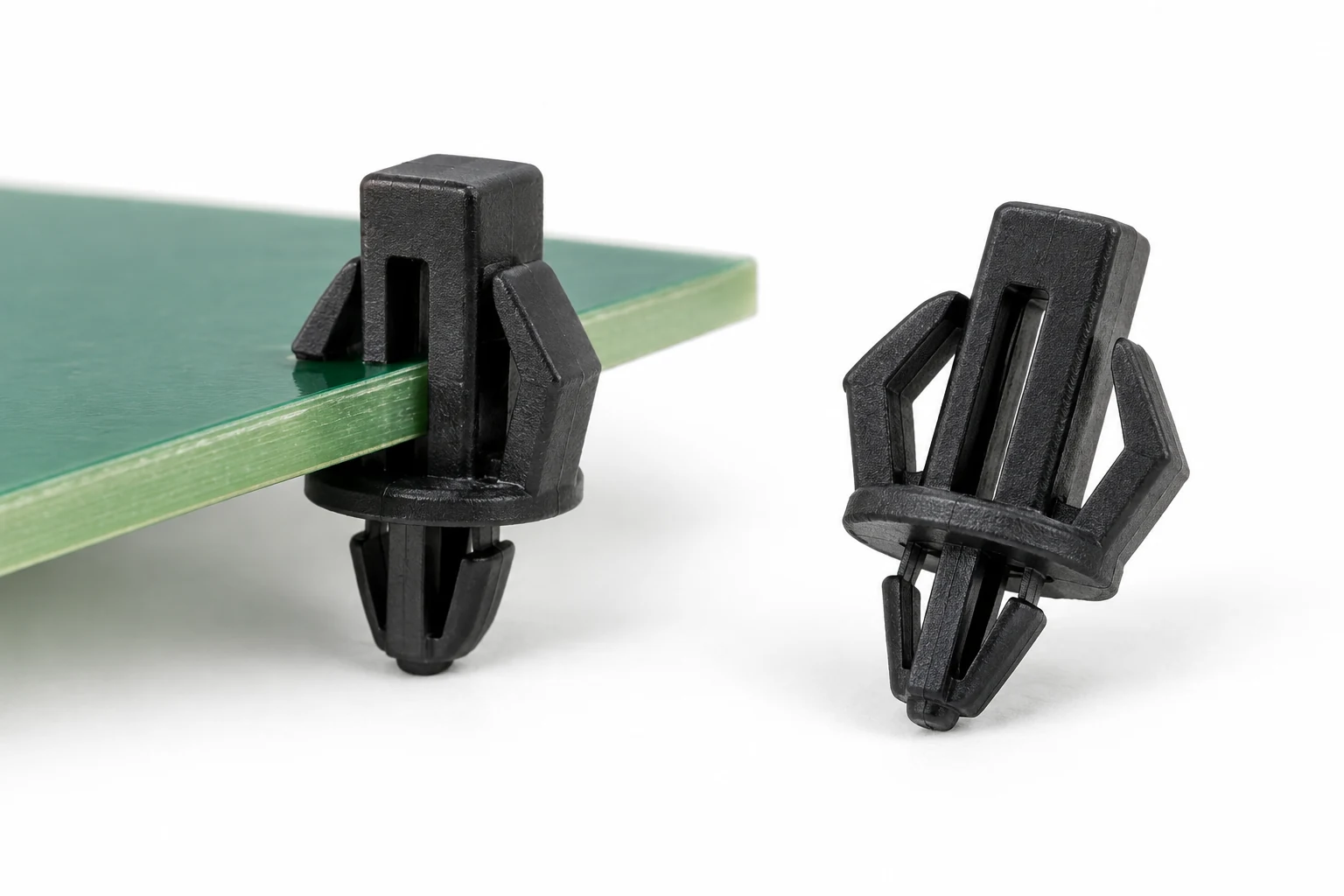
The primary duty of PCB Edge-Locking Supports is setting a fixed distance on a screw that passes straight through it, with no thread of its own. Below: the sectors that specify them in volume, the checklist used to select the right size and material for the application, installation notes, and the known limits of the type.
Typical Applications for PCB Edge-Locking Supports
The most common settings where these are specified:
- Electronics assembly: holding boards off a chassis and stacking multiple boards at a fixed pitch.
- Enclosures & panels: spacing a fascia, guard or label plate off the surface behind it.
- Machine alignment: setting and correcting the height of a component on its mounting.
- General machine building: fastening covers, brackets, motors and sub-assemblies on production equipment.
- Maintenance & repair (MRO): a stocked size for servicing existing plant where the original fastener spec must be matched.
How to Specify PCB Edge-Locking Supports for Your Application
- Size: Match the size to the mating part — see the dimension table below for each option.
- Material: Choose the material and finish for the service environment — plated steel for general use, stainless for corrosion resistance.
- Environment: For damp, coastal or chemical exposure prefer A4/316 stainless or a suitable coating; indoors, plated steel or A2 is usually sufficient.
- Standard: This product is supplied to Trade series (edge-locking board supports). Quoting the standard on your order guarantees interchangeable dimensions between suppliers.
Where PCB Edge-Locking Supports Are Not the Right Choice
Match the fastener to the load, environment and whether the joint must be reopened; the wrong class or style is the usual cause of joint failure.