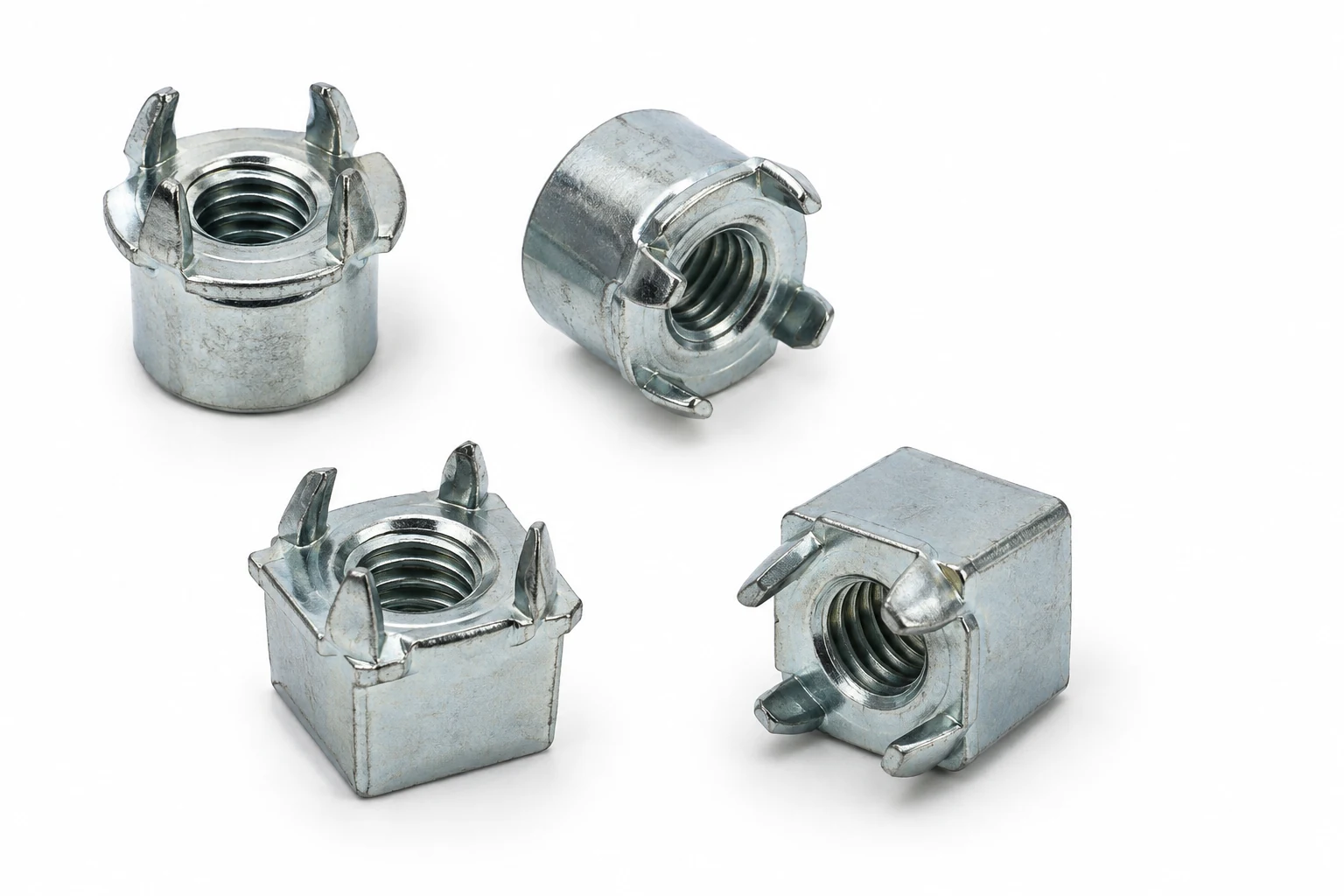
Tube-End Threaded Inserts (Trade series (pressed tube-end inserts)) are specified where the joint requires adding a retained internal thread to a round or square tube through a pressed crown or flange. The sections below cover the typical end-uses by industry, the size and material decisions for each, assembly practice, and the applications this fastener type is not suited to.
Typical Applications for Tube-End Threaded Inserts
The most common settings where these are specified:
- Tubular furniture: Pressed end inserts add a threaded point without welding a nut inside the tube.
- Display frames: Round and square tube versions support removable brackets.
- Light machinery: Crown retention holds a stud or screw connection at the tube end.
- Fabricated enclosures: Zinc-plated steel provides a practical general-purpose insert.
How to Specify Tube-End Threaded Inserts for Your Application
- Size: Match the size to the mating part — see the dimension table below for each option.
- Tap & length: Drill and tap to the specified STI size, and pick insert length (commonly 1.5×D or 2×D) for the load and parent material strength.
- Environment: For damp, coastal or chemical exposure prefer A4/316 stainless or a suitable coating; indoors, plated steel or A2 is usually sufficient.
- Standard: This product is supplied to Trade series (pressed tube-end inserts). Quoting the standard on your order guarantees interchangeable dimensions between suppliers.
Installation & Assembly Practice
- Drill and tap with the specified STI tap — a standard tap will not produce the correct thread for the insert.
- Install to the specified depth (typically 0.25–0.5 mm below the surface) and remove the tang where the design requires it.
Common Selection Mistakes with Tube-End Threaded Inserts
- Fitting an insert into strong steel that already holds a thread — added cost for no gain.
- Skipping the tang removal, which then blocks the mating screw.
Where Tube-End Threaded Inserts Are Not the Right Choice
Not a fix for a hole that is already oversized beyond the STI tap range, and not needed in steel that already holds a thread well.