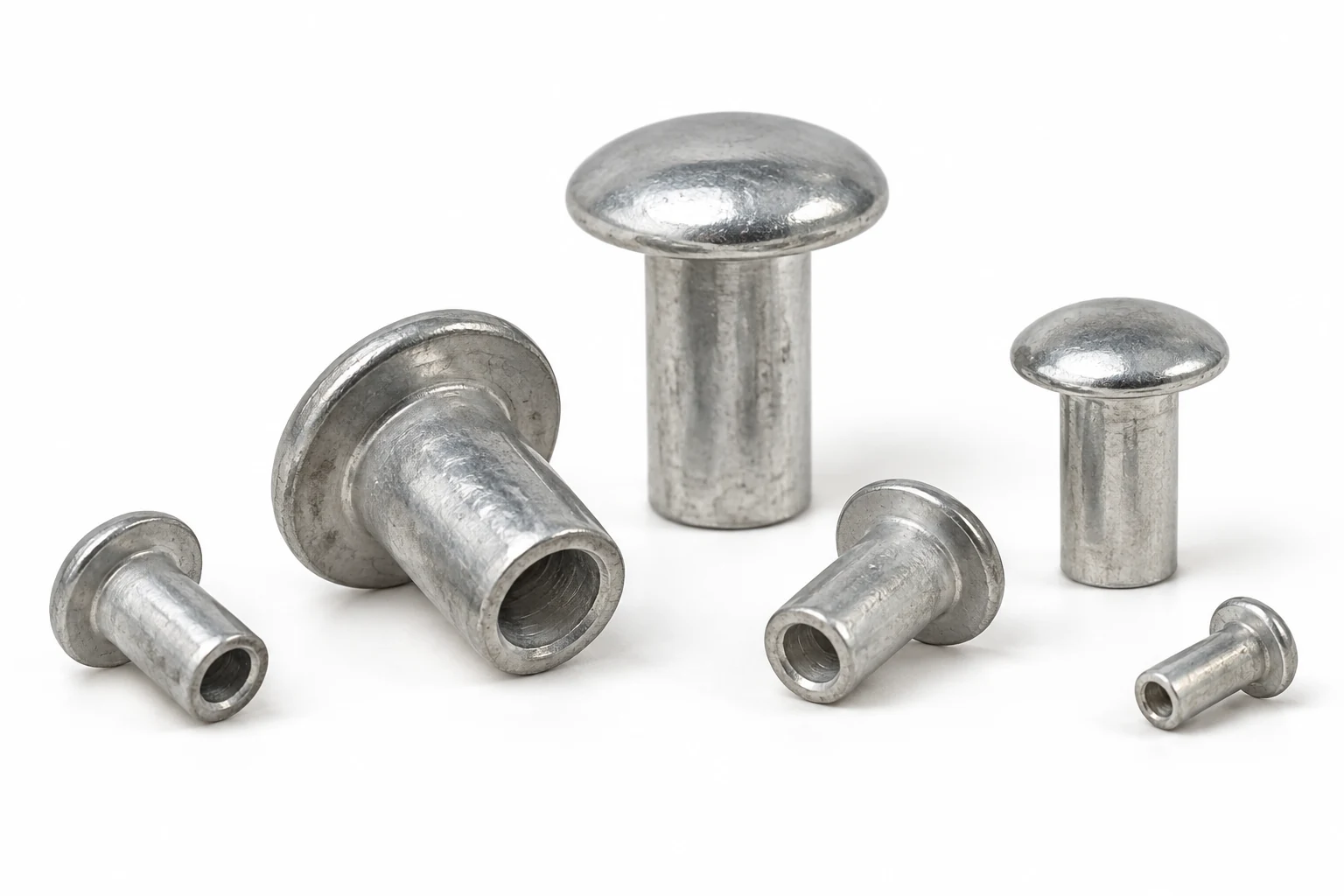
A2 Stainless Steel (ISO 3506 group A2 (304 / 1.4301), commonly supplied A2-70) is the most common stainless group for indoor and general outdoor fasteners. When semi-tubular rivets are specified in this grade, the dimensions remain per Trade series (semi-tubular rivet); the material determines corrosion behavior (good general corrosion resistance) and the service temperature range (approx. -200 °C to +400 °C, subject to the property class and the joint). Both are covered below with the size table.
Why Choose A2 Stainless Steel for Semi-Tubular Rivets
The most common stainless group for indoor and general outdoor fasteners. For semi-tubular rivets, this matters when good general corrosion resistance is the primary requirement.
Mechanical & Physical Properties
| Grade designation | ISO 3506 group A2 (304 / 1.4301), commonly supplied A2-70 |
|---|---|
| Magnetic response | Largely non-magnetic |
| Service temperature | approx. -200 °C to +400 °C, subject to the property class and the joint |
| Corrosion characteristic | Good general corrosion resistance |
Galvanic & Galling Considerations
For stainless semi-tubular rivets the compatibility question is galvanic rather than galling: joined to aluminum or galvanized steel in wet service, stainless drives corrosion of the less-noble metal. Isolate with a coating, sleeve or non-conductive washer where the joint sees moisture. Note also that stainless is softer than hardened carbon steel, so where the part carries a wear or shear duty, check the load against the grade before substituting.
Comparable Grades
For Semi-Tubular Rivets, the alternative stainless grade is A4 (316). The practical dividing line is chlorides: A2 (304) is fine until salt is involved, and A4 (316) exists for the cases where it is — coastal, marine and road-salt service. Neither reaches the strength of a plated class 8.8 or 10.9 fastener.
Using Stainless Fasteners in Aluminum
Stainless steel is more noble than aluminum, so with an electrolyte present — rain, condensation, salt spray — the aluminum becomes the anode and corrodes at the joint. Area ratio decides how bad it gets: a small stainless fastener in a large aluminum section is normally acceptable, a large stainless fastener in thin aluminum is not. Where the joint gets wet, isolate the metals with a coated or nylon washer and a sealant, or specify an aluminum or coated fastener instead.
Sizes of Semi-Tubular Rivets Available in A2 Stainless Steel
| Shank diameter d (mm) | Head diameter dk (mm) | Head height k (mm) | Length L (mm) | Hole depth (mm) | Grip range (mm) | Material | Setting force vs solid |
|---|---|---|---|---|---|---|---|
| 2.0 | 4.0 | 0.8 | 4 | 2.4 | 1.5~2.5 | Steel / brass | approx. 25% |
| 3.0 | 6.0 | 1.2 | 6 | 3.6 | 2.5~4.0 | Steel / brass | approx. 25% |
| 3.0 | 6.0 | 1.2 | 10 | 6.0 | 6.0~8.0 | Steel / brass | approx. 25% |
| 4.0 | 8.0 | 1.6 | 8 | 4.8 | 4.0~6.0 | Steel / aluminium | approx. 25% |
| 5.0 | 10.0 | 2.0 | 12 | 7.2 | 7.0~9.5 | Steel | approx. 25% |
| 6.0 | 12.0 | 2.4 | 16 | 9.6 | 10~13 | Steel | approx. 25% |