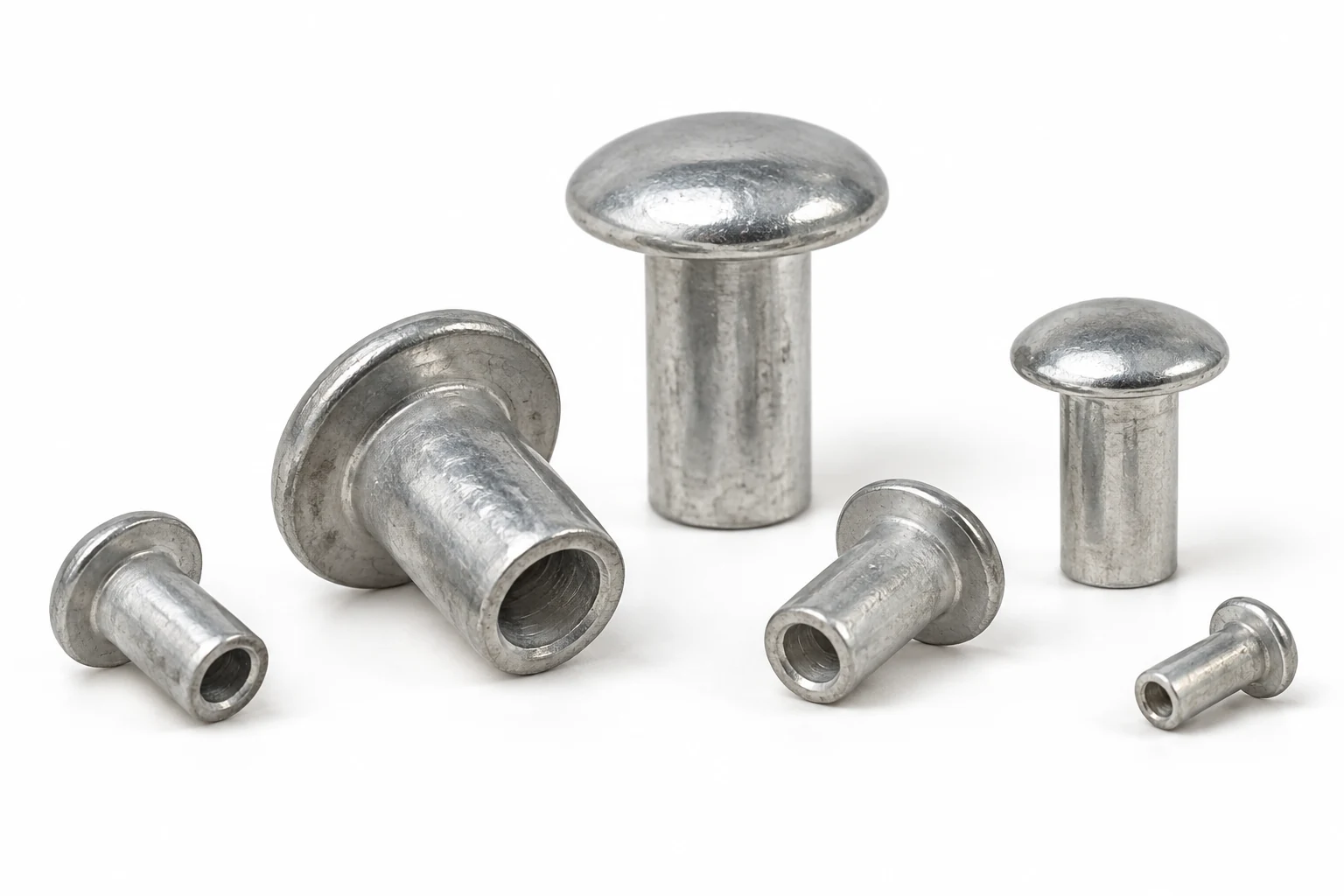
Semi-Tubular Rivets manufactured in A4 Stainless Steel (ISO 3506 group A4 (316 / 1.4401), commonly supplied A4-80) are dimensioned to Trade series (semi-tubular rivet). The sections below give the mechanical and physical properties of the grade, its behavior in corrosive and elevated-temperature service, and the full size table.
Why Choose A4 Stainless Steel for Semi-Tubular Rivets
Specified for marine, coastal and chemical applications. For semi-tubular rivets, this matters when superior, including marine and chloride environments is the primary requirement.
Mechanical & Physical Properties
| Grade designation | ISO 3506 group A4 (316 / 1.4401), commonly supplied A4-80 |
|---|---|
| Magnetic response | Largely non-magnetic |
| Service temperature | approx. -200 °C to +400 °C, subject to the property class and the joint |
| Corrosion characteristic | Superior, including marine and chloride environments |
Corrosion Behavior in Service
A4 (316) adds 2–3% molybdenum to the A2 (304) composition, which dramatically improves resistance to chloride-pitting corrosion. For Semi-Tubular Rivets in marine, coastal, swimming-pool or food-processing environments, A4 is the default selection.
Comparable Grades
For Semi-Tubular Rivets, the alternative stainless grade is A2 (304). Choose A2 (304) for general use and A4 (316) wherever chlorides are present; the molybdenum in A4 is the whole difference. Remember that stainless is the corrosion answer, not the strength answer — for load, look at class 8.8 or 10.9 instead.
Using Stainless Fasteners in Aluminum
The galvanic couple here runs the wrong way: aluminum is the less noble metal, so it corrodes and the fastener does not. What governs the rate is the ratio of areas — a large anode and a small cathode is a tolerable combination, the reverse concentrates the attack into thin material around the hole. An isolating washer plus sealant breaks the circuit; where that is impractical, match the fastener to the substrate.
Sizes of Semi-Tubular Rivets Available in A4 Stainless Steel
| Shank diameter d (mm) | Head diameter dk (mm) | Head height k (mm) | Length L (mm) | Hole depth (mm) | Grip range (mm) | Material | Setting force vs solid |
|---|---|---|---|---|---|---|---|
| 2.0 | 4.0 | 0.8 | 4 | 2.4 | 1.5~2.5 | Steel / brass | approx. 25% |
| 3.0 | 6.0 | 1.2 | 6 | 3.6 | 2.5~4.0 | Steel / brass | approx. 25% |
| 3.0 | 6.0 | 1.2 | 10 | 6.0 | 6.0~8.0 | Steel / brass | approx. 25% |
| 4.0 | 8.0 | 1.6 | 8 | 4.8 | 4.0~6.0 | Steel / aluminium | approx. 25% |
| 5.0 | 10.0 | 2.0 | 12 | 7.2 | 7.0~9.5 | Steel | approx. 25% |
| 6.0 | 12.0 | 2.4 | 16 | 9.6 | 10~13 | Steel | approx. 25% |