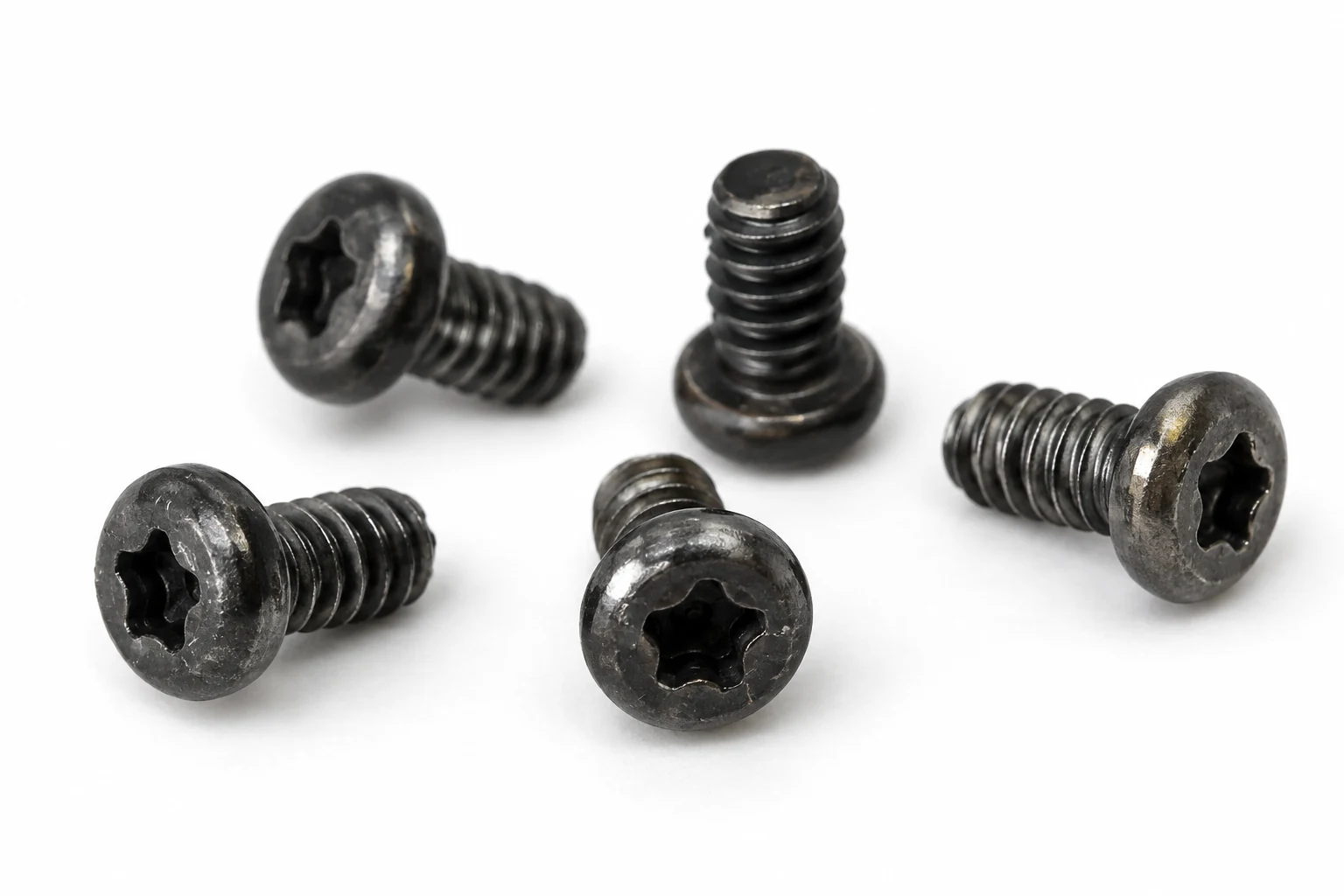
Property Class 8.8 Steel Five-Lobe Bottom Service Screws for Mobile Devices are supplied to ISO 898-1 property class 8.8. Corrosion behaviour is requires plating (zinc) for corrosion protection, the material is magnetic, and the usable service range is commonly limited to approx. +300 °C; confirm against the coating and the load. In practice this grade is the workhorse medium-carbon alloy class for structural joints.
- Grade
- ISO 898-1 property class 8.8
- Corrosion resistance
- Requires plating (zinc) for corrosion protection
- Magnetic response
- Magnetic
- Service temperature
- commonly limited to approx. +300 °C; confirm against the coating and the load
Property values are typical for the grade. Certified mechanical test data is available on request for production orders.
Material page for five-lobe bottom service screws for mobile devices in Property Class 8.8 Steel (ISO 898-1 property class 8.8). The sizes below are the ones we supply; there is no published dimensional standard for this article, so the table rather than a standard number is what to quote. Corrosion behaviour is requires plating (zinc) for corrosion protection and the service range is commonly limited to approx. +300 °C; confirm against the coating and the load.
Why Choose Property Class 8.8 Steel for Five-Lobe Bottom Service Screws for Mobile Devices
The workhorse medium-carbon alloy class for structural joints. For five-lobe bottom service screws for mobile devices, this matters when requires plating (zinc) for corrosion protection is the primary requirement.
Mechanical & Physical Properties
| Grade designation | ISO 898-1 property class 8.8 |
|---|
| Magnetic response | Magnetic |
|---|
| Service temperature | commonly limited to approx. +300 °C; confirm against the coating and the load |
|---|
| Corrosion characteristic | Requires plating (zinc) for corrosion protection |
|---|
Corrosion Behavior in Service
Carbon and alloy steel five-lobe bottom service screws for mobile devices require a coating for corrosion protection. Zinc plating (with or without passivation) is the most common; hot-dip galvanizing is used for outdoor structural service; black-oxide is mainly a tarnish-prevention finish for tool-room use.
Comparable Grades
For Five-Lobe Bottom Service Screws for Mobile Devices, class 10.9 or 12.9 is the comparable strength step. Move up when the joint preload approaches the proof load of the current class; move down when the joint is over-specified. For corrosion-critical service, switch to stainless A2 or A4.
Sizes of Five-Lobe Bottom Service Screws for Mobile Devices Available in Property Class 8.8 Steel
| Service position | Drive | Driver size (mm) | Typical length (mm) | Length reference | Use |
|---|
| bottom-edge pair | five-lobe | 0.8 | 6.75~6.8 | under head | device-specific replacement part |
Dimensions are independent of the material: every size above is available in Property Class 8.8 Steel.
Custom manufacturing · Made to drawing
Need this screw in a grade that is not listed?
Grade 8 8 Steel is one of the grades the catalog describes. Head form and drive can be specified to the assembly rather than to a standard: a larger bearing face, a security drive, or a socket sized for the tool already on the bench. Made by cold heading or warm forging.
Minimum order from 2,000 pieces; samples within 7 days of drawing approval.
Custom screw manufacturingSend a drawing
Applications & Industries
Where Five-Lobe Bottom Service Screws for Mobile Devices are used, and what decides the specification in each case.
Industries that specify Five-Lobe Bottom Service Screws for Mobile Devices
-
Smartphone service
Five-lobe screws retain the bottom edge where a five-lobe driver is specified.
-
Consumer electronics repair
Short under-head lengths suit thin exterior panels.
-
Device refurbishment
Model-matched replacement sets restore the original service interface.
-
Mobile equipment labs
The small head and P2 drive fit a confined case edge.
-
Maintenance & MRO
Stocked replacements matched to an existing property class, thread and finish.
-
Food, pharma & cleanroom
Stainless assemblies that are washed down, where the finish matters as much as the strength.
Typical applications
- servicing a five-point bottom-edge screw with a P2 driver
- measuring the length under the head
- matching the replacement to the exact device model
- keeping the original head clearance at the case edge
- clamping two machined faces to a calculated preload
- bolting brackets, motors and gearboxes to a frame
Service conditions to specify against
- Marine and coastal
- Available in A4 (316) stainless for chloride exposure — coastal structures, pool halls, water treatment and deck hardware, where A2 will eventually pit.
- High load
- Supplied in ISO 898-1 property classes, so the joint can be designed to a stated proof load and tightened to a calculated torque rather than by feel.
- Torque and preload
- The joint is designed around bolt tension, so lubrication, coating and the friction coefficient all change the torque figure — state them together.
Where to use something else
- Do not replace a pentalobe screw with a Phillips screw simply because the diameter looks similar; the drive and length are different.
- Do not use a machine thread into unthreaded sheet or timber; use a tapping screw, rivet nut or insert made for that parent material.
Full application guide: where Five-Lobe Bottom Service Screws for Mobile Devices are used, how to specify them, and the cases they are wrong for