
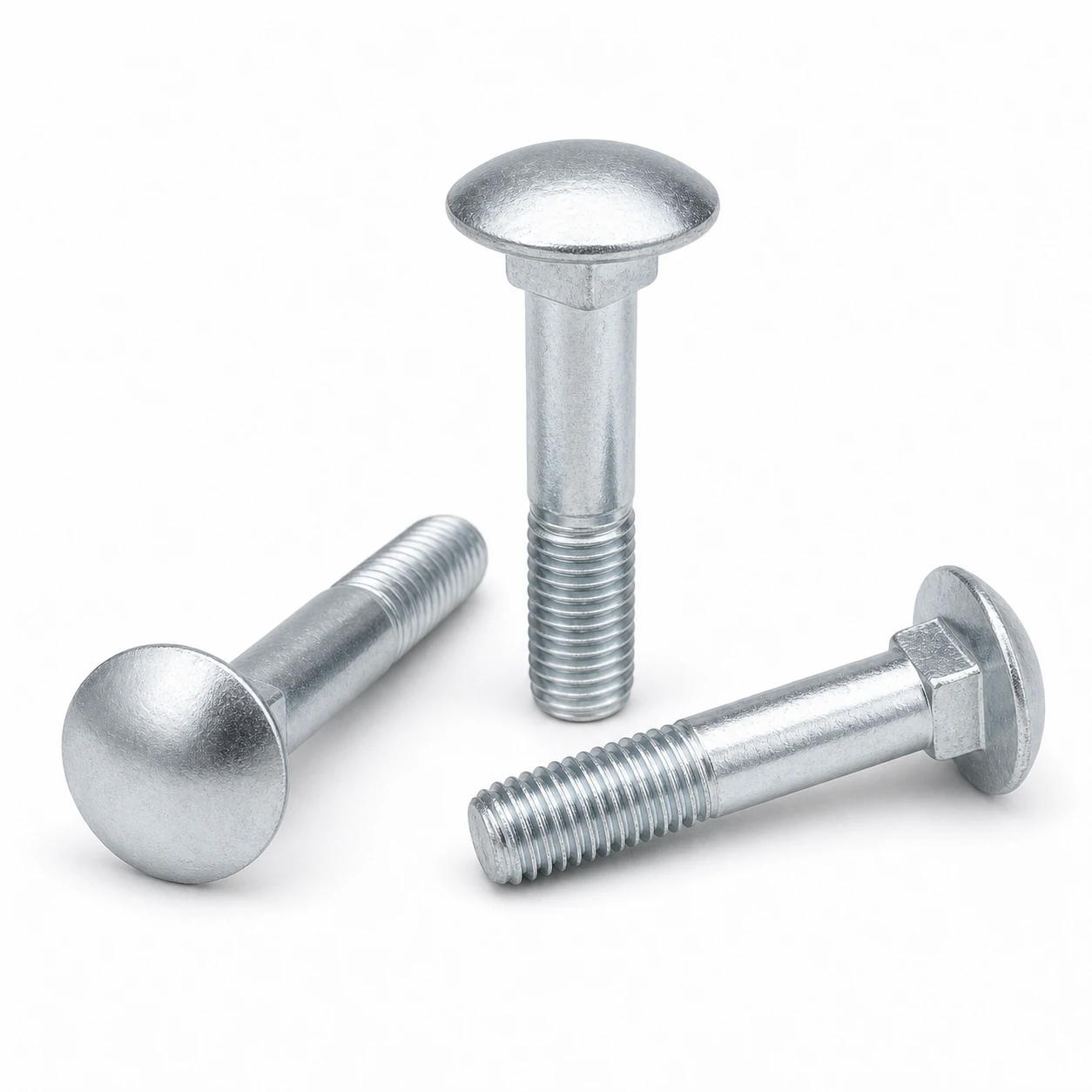
Dimensional data for M14 Carriage Bolts to DIN 603, with the installation notes for this type.
Values are taken from the governing standard rather than from a general machine-thread table, because this type is not selected on one.
M14 Dimensional Row (DIN 603)
| Size | Pitch (mm) | Head diameter dk (mm) | Head height k (mm) | Square neck width (mm) | Square neck depth (mm) | Common length range (mm) | Reference standard |
|---|---|---|---|---|---|---|---|
| M14 | 2.0 | 35.0 | 8.0 | 14.0 | 7.0 | 40~260 | DIN 603 / ISO 8677 |
Tightening Torque for M14
| Class 8.8 (dry, ~µ 0.125) | ≈ 134 Nm |
|---|---|
| Class 10.9 (dry, ~µ 0.125) | ≈ 197 Nm |
| Class 12.9 (dry, ~µ 0.125) | ≈ 231 Nm |
Indicative dry-joint values. Lubrication can lower the required torque by 15–25%. Always confirm against the joint design, especially when going up a strength class.
Proof Load & Strength for M14
| Tensile stress area As (ISO 724) | 115 mm² |
|---|---|
| Proof load, class 8.8 | 67 kN |
| Proof load, class 10.9 | 96 kN |
| Proof load, class 12.9 | 112 kN |
| Min. ultimate tensile load, class 8.8 | 92 kN |
Proof load = tensile stress area × the proof stress Sp of the class, per ISO 898-1 — Sp is a lower figure than the yield stress Rp0.2 and the two are not interchangeable. The stress area is computed from this size's own diameter and pitch, so a fine-pitch designation gives the fine-pitch figure. Design the joint so the working preload stays below the proof load of the class selected.
Mating Parts for M14
For M14, pair with a M14 hex nut (ISO 4032 / DIN 934) and, where used, a M14 flat washer (ISO 7089 / DIN 125A) under the head and under the nut.
Custom manufacturing · Made to drawing
Need carriage bolts in a size this table does not list?
This page covers M14 carriage bolts. A non-standard bolt is quoted from the drawing; where one already exists in the catalog, the special is usually a variation on its tooling. Made by cold heading or hot forging.
Minimum order from 2,000 pieces; samples within 7 days of drawing approval.



