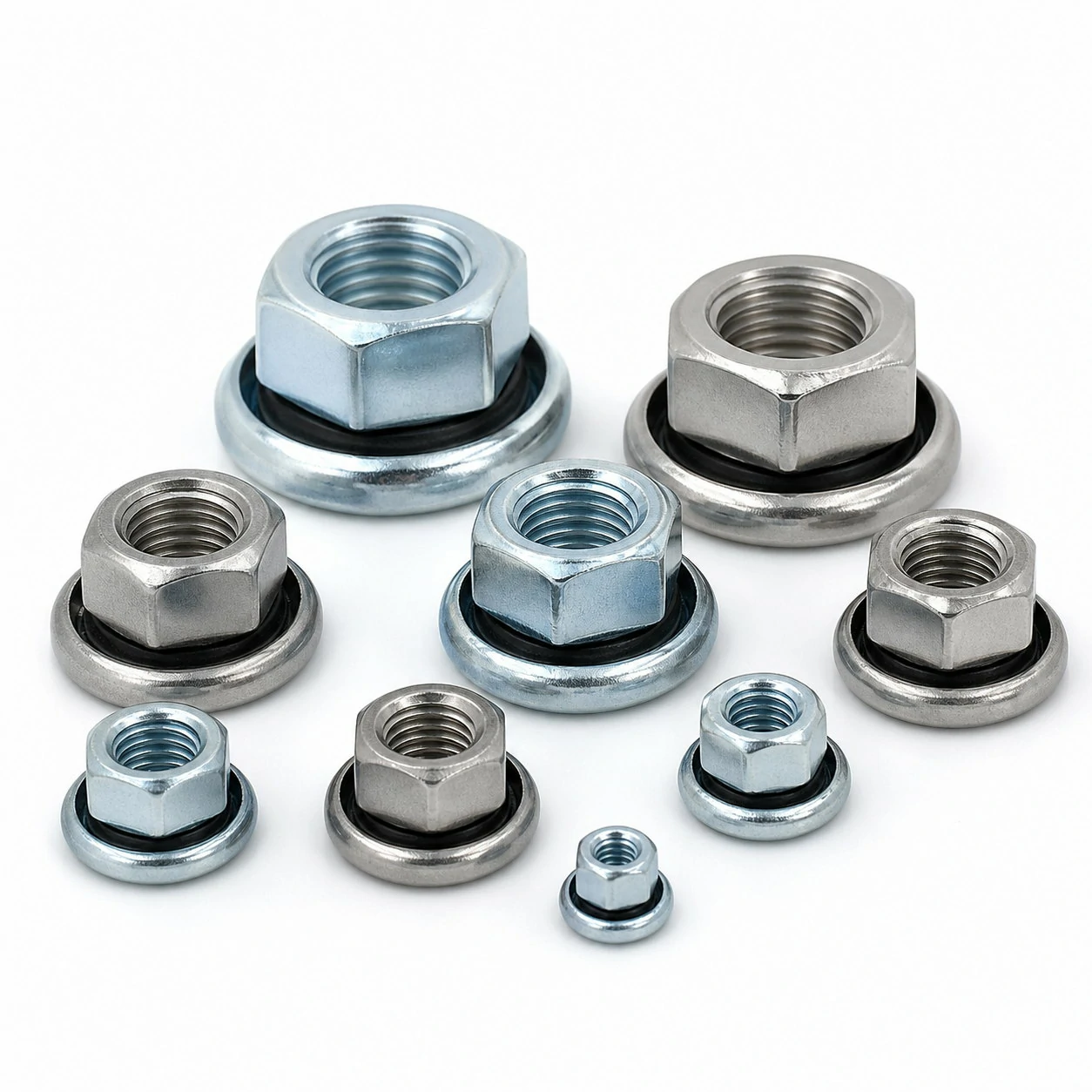
Dimensional data for M16 Sealing Cap Nuts to DIN 1587, with the drive and the installation notes for this type. Values are taken from the governing standard rather than from a general machine-thread table, because this type is not selected on one.
M16 Dimensional Row (DIN 1587)
| Thread size | Pitch (mm) | Across flats s (mm) | Across corners e (mm) | Total height m (mm) | Dome diameter (mm) | O-ring seat | Reference standard |
|---|---|---|---|---|---|---|---|
| M16 | 2.0 | 24 | 26.75 | 28 | 24 | 15.5 x 2.5 NBR | DIN 1587 + O-ring |
Spanner & Drive for M16 Sealing Cap Nuts
Drive geometry for M16 Sealing Cap Nuts is given by the row above; match the tool to the listed values.
Tightening Torque for M16
| Class 8.8 (dry, ~µ 0.125) | ≈ 210 Nm |
|---|---|
| Class 10.9 (dry, ~µ 0.125) | ≈ 295 Nm |
| Class 12.9 (dry, ~µ 0.125) | ≈ 355 Nm |
Indicative dry-joint values. Lubrication can lower the required torque by 15–25%. Always confirm against the joint design, especially when going up a strength class.
Proof Load & Strength for M16
| Tensile stress area As (ISO 898-1) | 157 mm² |
|---|---|
| Proof load, class 8.8 | 91 kN |
| Proof load, class 10.9 | 130 kN |
| Proof load, class 12.9 | 152 kN |
| Min. ultimate tensile, class 8.8 | 126 kN |
Proof load = stress area × proof stress per ISO 898-1. Design joints so the working preload stays below the proof load of the selected class.
Common Applications for M16 Sealing Cap Nuts
M16 Sealing Cap Nuts are commonly specified for medium-duty structural joints and motor / chassis mounting.
Mating Parts for M16
Pair M16 with the matching M16 bolt or screw, plus a M16 flat washer where required to distribute load on softer materials.
When to Step Up or Down from M16
When the joint preload approaches the proof load of M16 class 8.8, step up to M20 class 8.8 (or move to M16 class 10.9). When the joint is over-specified, M12 often saves weight and cost without losing the safety margin.