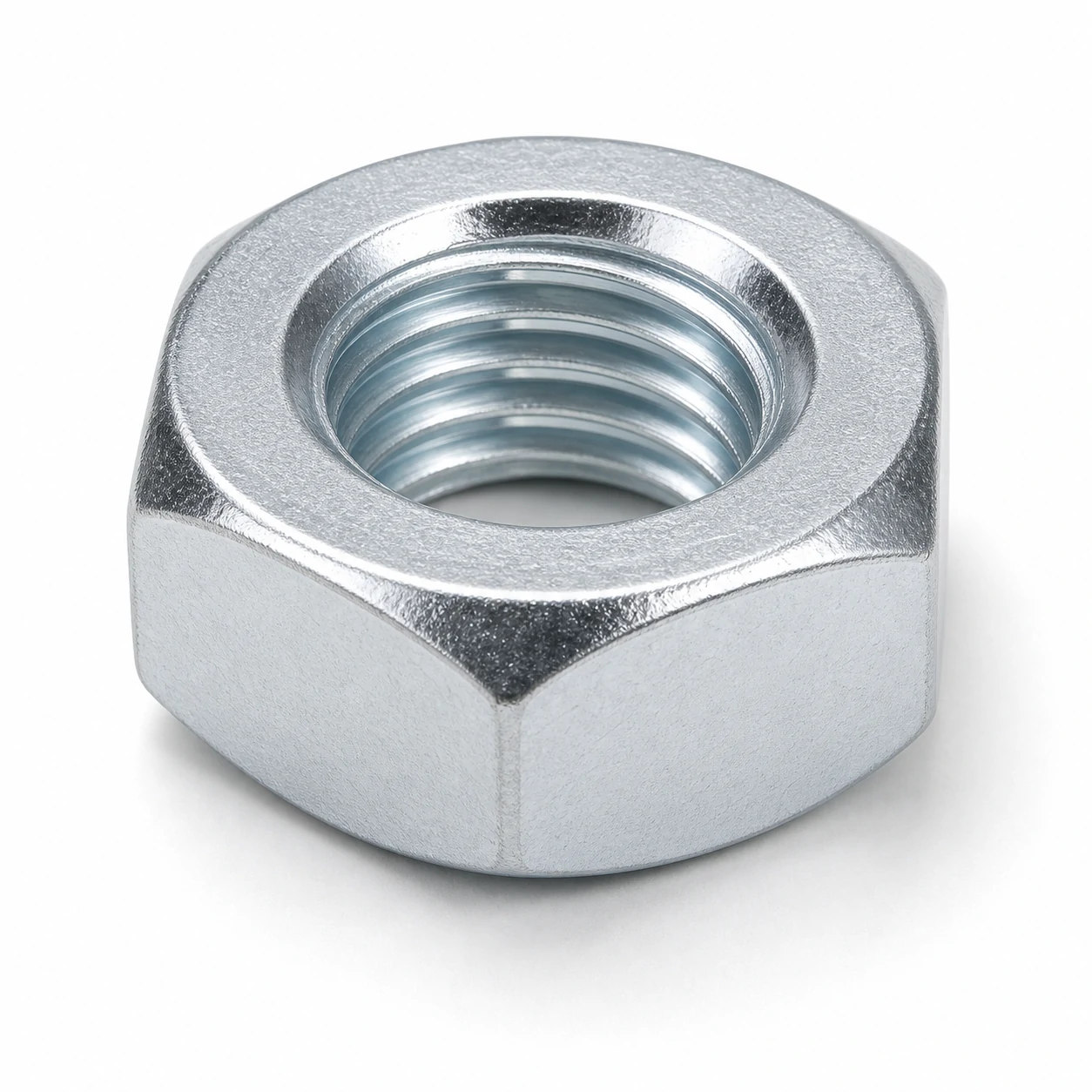
Dimensional data for M3 Hex Slotted Castle Nut (Type 2) to GB/T 6180 / ISO 7036, with the drive and the installation notes for this type. Values are taken from the governing standard rather than from a general machine-thread table, because this type is not selected on one.
M3 Dimensional Row (GB/T 6180 / ISO 7036)
| Size | Pitch (mm) | Width across flats s (mm) | Width across corners e (mm) | Total height m (mm) | Slot width (mm) | Reference standard |
|---|---|---|---|---|---|---|
| M3 | 0.5 | 5.5 | 6.01 | 4.0 | 1.2 | ISO 7036 / GB/T 6180 |
Spanner & Drive for M3 Hex Slotted Castle Nut (Type 2) — GB/T 6180 / ISO 7036 (Series 050)
Drive geometry for M3 Hex Slotted Castle Nut (Type 2) — GB/T 6180 / ISO 7036 (Series 050) is given by the row above; match the tool to the listed values.
Tightening Torque for M3
| Class 8.8 (dry, ~µ 0.125) | ≈ 1.3 Nm |
|---|---|
| Class 10.9 (dry, ~µ 0.125) | ≈ 1.8 Nm |
| Class 12.9 (dry, ~µ 0.125) | ≈ 2.1 Nm |
Indicative dry-joint values. Lubrication can lower the required torque by 15–25%. Always confirm against the joint design, especially when going up a strength class.
Proof Load & Strength for M3
| Tensile stress area As (ISO 898-1) | 5.03 mm² |
|---|---|
| Proof load, class 8.8 | 2.9 kN |
| Proof load, class 10.9 | 4.2 kN |
| Proof load, class 12.9 | 4.9 kN |
| Min. ultimate tensile, class 8.8 | 4 kN |
Proof load = stress area × proof stress per ISO 898-1. Design joints so the working preload stays below the proof load of the selected class.
Common Applications for M3 Hex Slotted Castle Nut (Type 2) — GB/T 6180 / ISO 7036 (Series 050)
M3 Hex Slotted Castle Nut (Type 2) — GB/T 6180 / ISO 7036 (Series 050) are commonly specified for paired with the same-size screws on PCB hardware, light enclosures and small-scale assemblies.
Installation Tips for M3 Hex Slotted Castle Nut (Type 2) — GB/T 6180 / ISO 7036 (Series 050)
- At M3 the joint is sensitive to over-torque — use a torque-limiting driver and check the head doesn't bury into a softer counterpart.
Mating Parts for M3
Pair M3 with the matching M3 bolt or screw, plus a M3 flat washer where required to distribute load on softer materials.