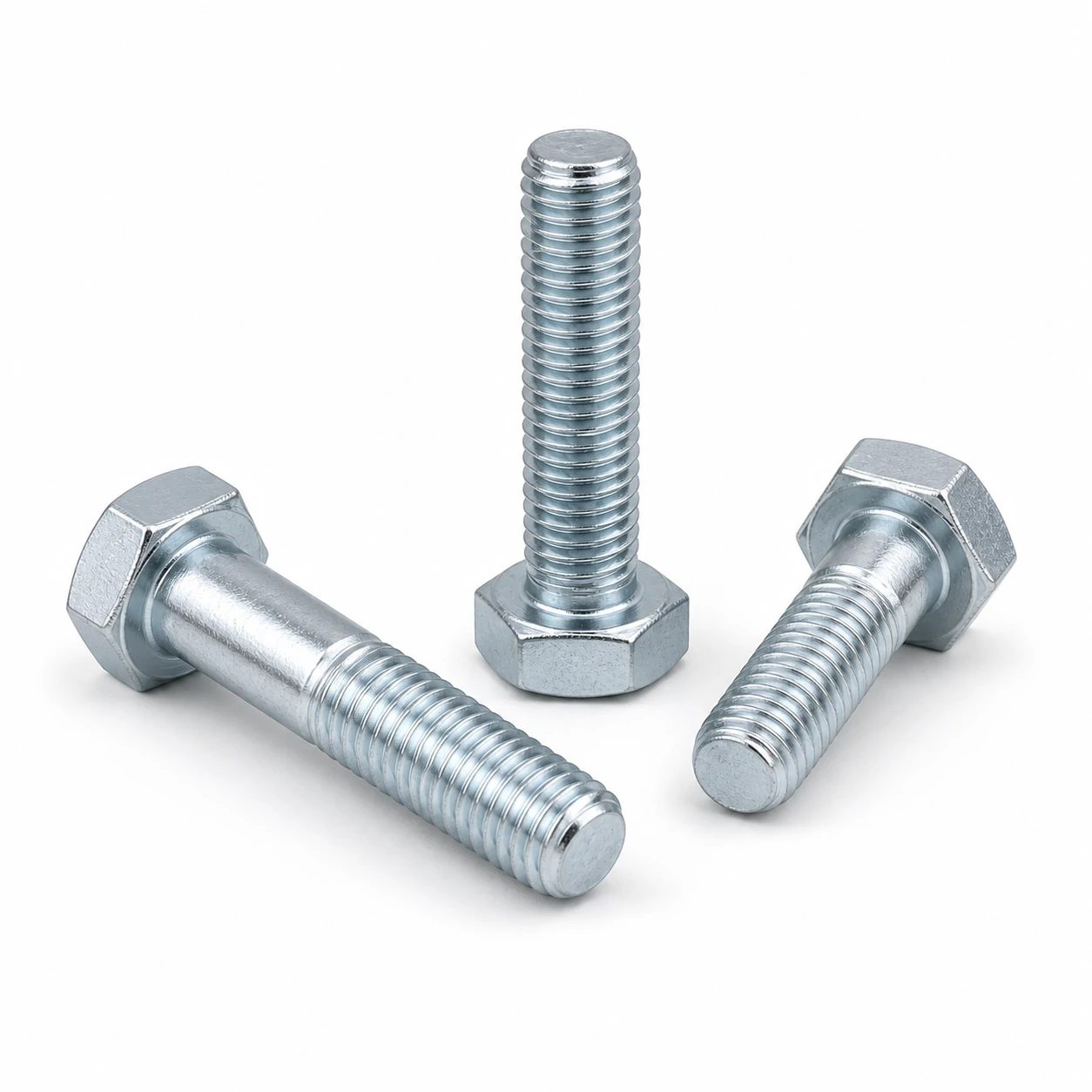
The M5 size of Hex Bolts, Grade C is dimensioned by ISO 4016. The tables below give the dimensional row from the standard, the drill and spanner sizes that go with it, and the assembly torque per property class. The technical drawing on this page redraws to the exact values selected.
M5 Dimensional Row (ISO 4016)
| Size | Pitch (mm) | Width across flats s (mm) | Width across corners e min (mm) | Head height k (mm) | Product grade | Reference standard |
|---|---|---|---|---|---|---|
| M5 | 0.8 | 8.0 | 8.63 | 3.35 | Grade C | ISO 4016 / DIN 601 |
Spanner & Drive for M5 Hex Bolts, Grade C
M5 Hex Bolts, Grade C have a width across flats of 8.0 mm — fit a 8.0 mm open-ended spanner or socket. Use a 6-point socket for tight clearances and to reduce rounding; for repeated assembly choose a torque wrench so the joint preload is repeatable.
Hole Sizes for M5
| Coarse-thread pitch (ISO 724) | 0.8 mm |
|---|---|
| Through-hole / clearance (ISO 273 medium) | 5.5 mm |
| Tapping drill, coarse thread | 4.2 mm |
Tightening Torque for M5
| Class 8.8 (dry, ~µ 0.125) | ≈ 5.8 Nm |
|---|---|
| Class 10.9 (dry, ~µ 0.125) | ≈ 8.1 Nm |
| Class 12.9 (dry, ~µ 0.125) | ≈ 9.7 Nm |
Indicative dry-joint values. Lubrication can lower the required torque by 15–25%. Always confirm against the joint design, especially when going up a strength class.
Proof Load & Strength for M5
| Tensile stress area As (ISO 898-1) | 14.2 mm² |
|---|---|
| Proof load, class 8.8 | 8.2 kN |
| Proof load, class 10.9 | 11.8 kN |
| Proof load, class 12.9 | 13.8 kN |
| Min. ultimate tensile, class 8.8 | 11.4 kN |
Proof load = stress area × proof stress per ISO 898-1. Design joints so the working preload stays below the proof load of the selected class.
Common Applications for M5 Hex Bolts, Grade C
M5 Hex Bolts, Grade C are commonly specified for precision instruments, small machinery and consumer-electronics enclosures.
Installation Tips for M5 Hex Bolts, Grade C
- Use a 6-point socket where access allows — 12-point sockets are more prone to rounding the corners on smaller sizes.
- On flanged or serrated variants, do NOT add a separate flat washer — the flange already spreads the load and the washer can defeat the locking serrations.
- At M5 the joint is sensitive to over-torque — use a torque-limiting driver and check the head doesn't bury into a softer counterpart.
When to Step Up or Down from M5
When the joint preload approaches the proof load of M5 class 8.8, step up to M6 class 8.8 (or move to M5 class 10.9). When the joint is over-specified, M4 often saves weight and cost without losing the safety margin.