
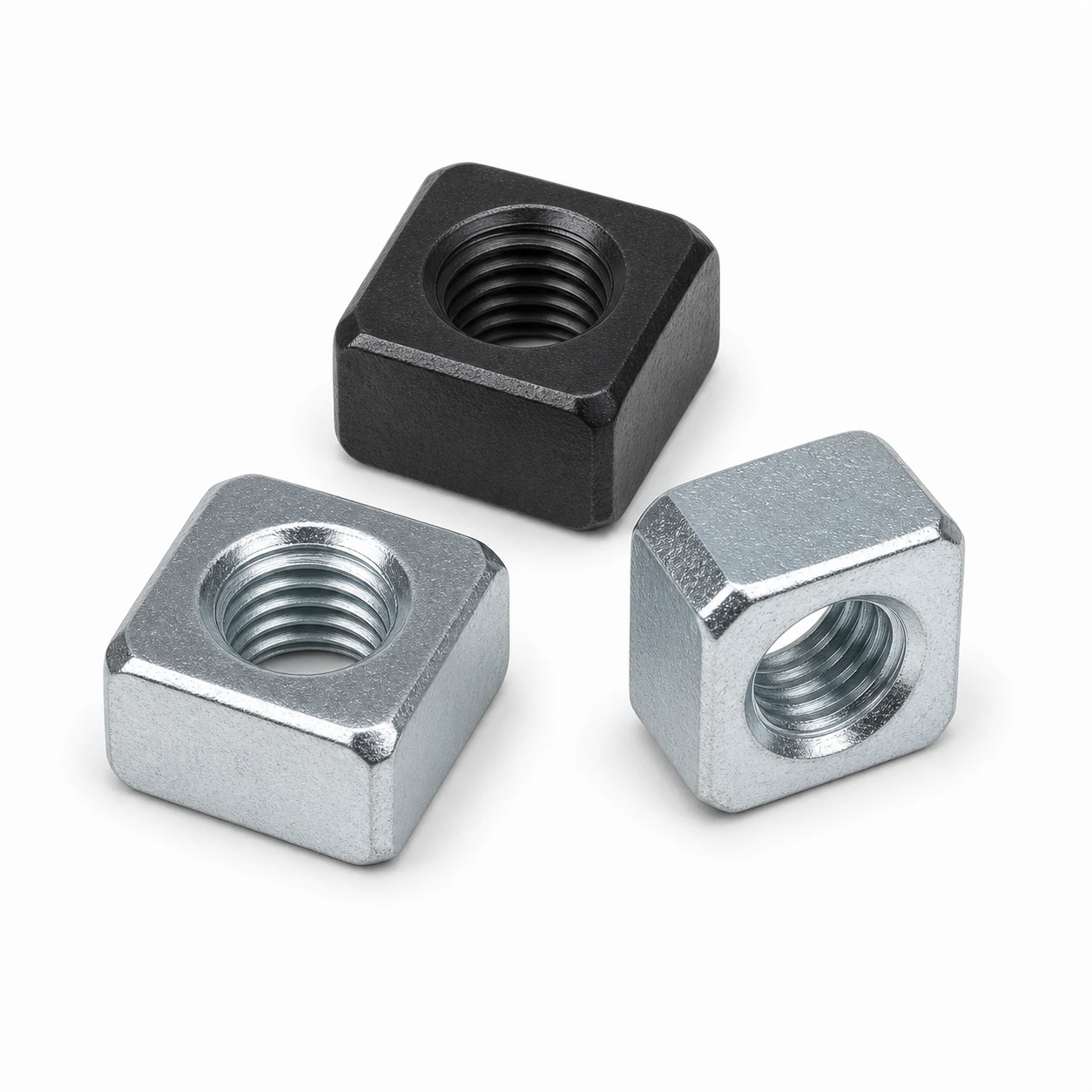
The table below lists the dimensions catalogued for square nuts under DIN 557. The scope of DIN 557 itself is not summarised here — where a figure matters, confirm it against the published document.
DIN 557 — Scope
The table below lists the dimensions catalogued for square nuts under DIN 557. The scope of DIN 557 itself is not summarised here — where a figure matters, confirm it against the published document.
Tolerance & Product Grades
Product grade is a concept from dimensional fastener standards and does not apply to DIN 557. Tolerances for this part are the limits shown against each dimension in the table.
Dimensions Specified by DIN 557
| Size | Pitch (mm) | Width across flats s (mm) | Width across corners e min (mm) | Nut height m (mm) | Reference standard | Notes |
|---|---|---|---|---|---|---|
| M5 | 0.8 | 8.0 | 11.1 | 4.0 | DIN 557 / DIN 562 | Square nut, general / channel use |
| M6 | 1.0 | 10.0 | 13.9 | 5.0 | DIN 557 / DIN 562 | Square nut, general / channel use |
| M8 | 1.25 | 13.0 | 18.0 | 6.5 | DIN 557 / DIN 562 | Square nut, general / channel use |
| M10 | 1.5 | 17.0 | 23.6 | 8.0 | DIN 557 / DIN 562 | Square nut, general / channel use |
| M12 | 1.75 | 19.0 | 26.5 | 10.0 | DIN 557 / DIN 562 | Square nut, general / channel use |
| M16 | 2.0 | 24.0 | 33.5 | 13.0 | DIN 557 / DIN 562 | Square nut, general / channel use |
| M20 | 2.5 | 30.0 | 42.0 | 16.0 | DIN 557 / DIN 562 | Square nut, general / channel use |
Equivalent Standards
Where direct equivalents exist (ISO ↔ DIN, ISO ↔ ASME), they are listed on the parent Square Nuts page.
Always confirm against the dimensions on this page, since some "equivalent" standards differ in tolerances and head geometry.
Companion Standards
A complete specification for square nuts normally cites several documents: one for the geometry, one for the material or mechanical properties, and one for the finish. DIN 557 is one of them, not all of them.
Custom manufacturing · Made to drawing
Need a nut to this standard in a non-standard size?
Parts built to DIN 557 are already in the catalog, so a special is usually a variation on existing tooling rather than a new design — which is what keeps the cost down. Made by cold heading or tapping.
Minimum order from 2,000 pieces; samples within 7 days of drawing approval.




