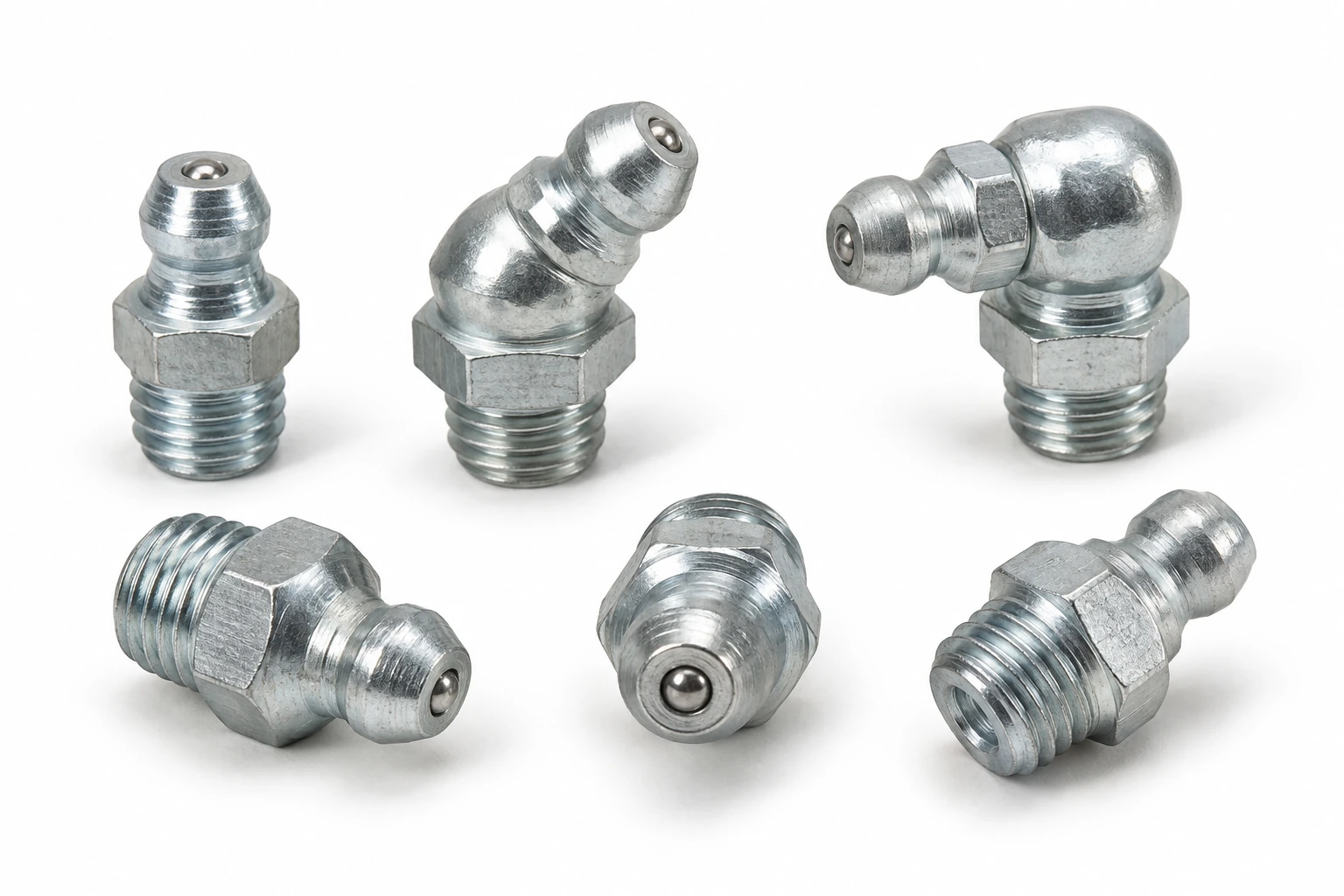
DIN 71412 is the standard cited for grease nipples (din 71412). This page sets out what the standard controls for this part, reproduces the dimensional table supplied against it, and notes the related designations referenced on drawings.
DIN 71412 — Scope
DIN 71412 specifies the dimensional requirements for grease nipples (din 71412).
Material, surface condition and any performance rating are set by separate documents specific to this part family — ISO 898-1 and ISO 898-2, which govern bolt and nut property classes, do not apply here.
Tolerance & Product Grades
Tolerances for grease nipples (din 71412) are given as limits on the individual dimensions in the table rather than as a fastener product grade.
Where a general-tolerance class is cited on the drawing instead, it applies to the dimensions not otherwise toleranced.
Dimensions Specified by DIN 71412
| Thread | Head angle | Form | Notes |
|---|---|---|---|
| M6 x 1.0 | straight (form A) | DIN 71412 A | commonest small nipple |
| M8 x 1.0 | straight (form A) | DIN 71412 A | general machinery |
| M8 x 1.25 | straight (form A) | DIN 71412 A | general machinery |
| M10 x 1.0 | straight (form A) | DIN 71412 A | general machinery |
| M10 x 1.0 | 45 degrees (form B) | DIN 71412 B | where a straight gun will not reach |
| M10 x 1.0 | 90 degrees (form C) | DIN 71412 C | tight or shrouded positions |
| R 1/8 in | straight (form A) | DIN 71412 A | tapered pipe thread |
| R 1/4 in | straight (form A) | DIN 71412 A | tapered pipe thread |
| 1/4-28 UNF | straight | inch series | imported and automotive equipment |
Companion Standards
DIN 71412 controls only the geometry of grease nipples (din 71412). Surface finish is governed by separate finish standards (for example ISO 4042 for electroplating), and corrosion testing by ISO 9227 (neutral salt spray). Mechanical performance is set by the standards specific to this part family, not by ISO 898-1 or ISO 898-2, which apply to bolts, screws and nuts.
When to Specify DIN 71412
DIN 71412 is still widely used in European mechanical engineering and as a cross-reference on legacy drawings; its ISO equivalent is preferred for new designs.