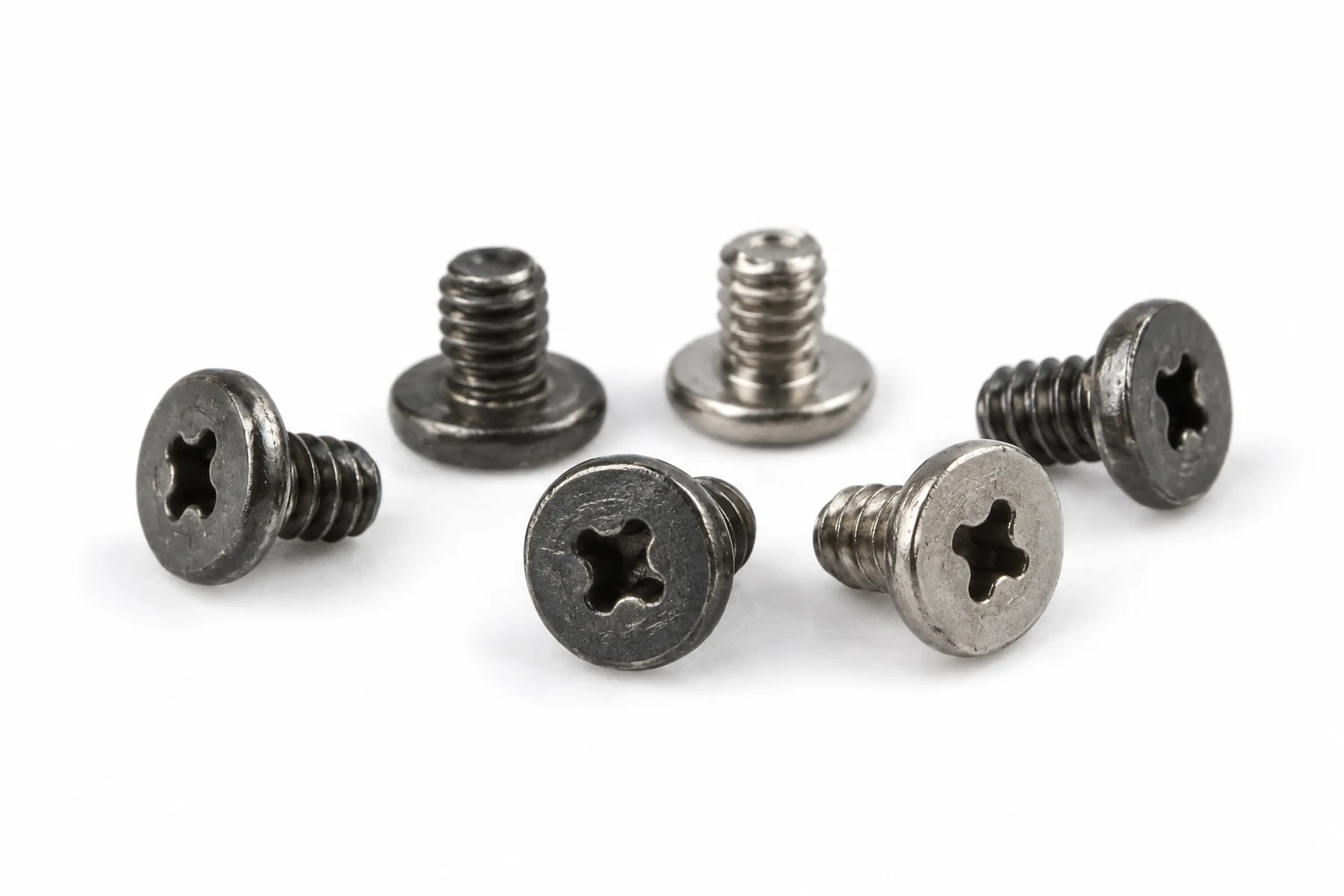
4IP Internal Service Screws for Mobile Devices are used primarily for replacing a model-specific internal or exterior service screw with the correct drive and under-head length. This page lists the industries and assemblies where they are specified, the selection criteria that matter for each application, installation practice, and the cases where a different fastener type is the correct choice. Parts are supplied to Trade series (4IP service screws).
Typical Applications for 4IP Internal Service Screws for Mobile Devices
The most common settings where these are specified:
- Smartphone service: 4IP screws are used at documented internal battery and camera-area positions.
- Device refurbishment: Position-specific head geometry is retained in replacement sets.
- Electronics repair: The Torx Plus recess gives the service tool a positive fit.
- Mobile equipment labs: Short internal screws fit around tightly packed components.
How to Specify 4IP Internal Service Screws for Mobile Devices for Your Application
- Size: Match the size to the mating part — see the dimension table below for each option.
- Drive & head: Pick the drive (socket, cross, slot) and head style for the tool access and seating surface; a recessed drive resists cam-out under power tools.
- Environment: For damp, coastal or chemical exposure prefer A4/316 stainless or a suitable coating; indoors, plated steel or A2 is usually sufficient.
- Standard: This product is supplied to Trade series (4IP service screws). Quoting the standard on your order guarantees interchangeable dimensions between suppliers.
Installation & Assembly Practice
- Match the driver exactly to the recess (PH ≠ PZ; hex key sizes per ISO 2936) and keep the tool axial — side load is the main cause of stripped drives.
- In tapped holes, engage a thread length of at least 1× the nominal diameter in steel, 2× in aluminum.
- Set power tools to a torque that seats the head without embedding it into the mating surface.
Common Selection Mistakes with 4IP Internal Service Screws for Mobile Devices
- Under-sizing the drive for the installation torque — a small recess at high torque strips before the screw is seated.
- Using a countersunk head in thin sheet where the countersink removes most of the load-bearing material.
- Specifying stainless in high-strength duty: A2-70 is roughly class 7 steel, not a 10.9 substitute.
Where 4IP Internal Service Screws for Mobile Devices Are Not the Right Choice
Not for high-preload structural joints (use a property-class bolt and nut), and not in thin sheet where a self-drilling or self-tapping type suits better.