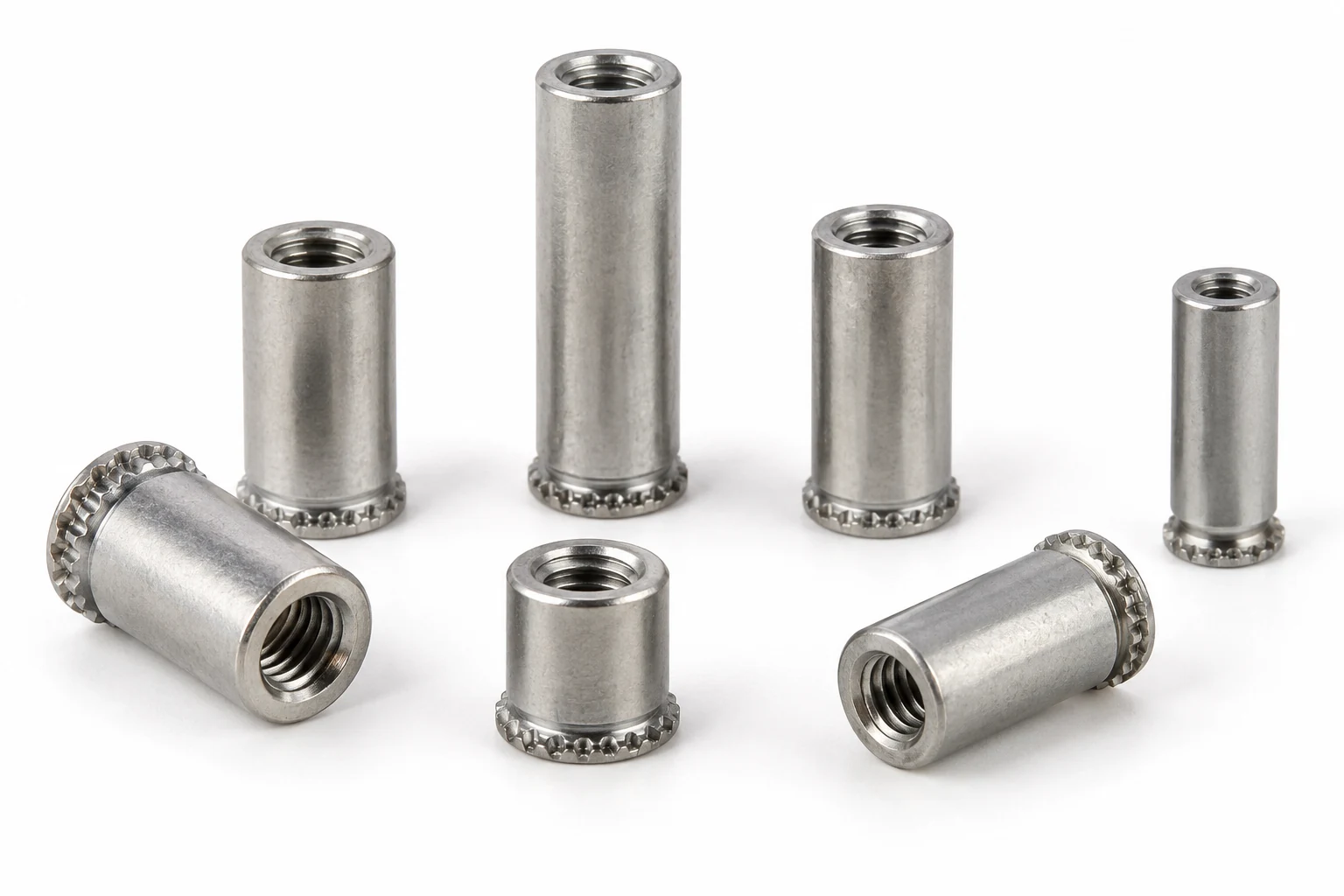
Application guide for Self-Clinching Standoffs for Sheet Metals to Trade series (self-clinching sheet-metal standoffs). The core duty of the type is putting a permanent, torque-resistant thread into sheet metal too thin to tap. The typical industries, the how-to-specify checklist, assembly practice and the exclusion cases are set out below. Stocked across roughly M2.5 to M3.5, they cover light-duty and instrument-scale work.
Typical Applications for Self-Clinching Standoffs for Sheet Metal
The most common settings where these are specified:
- Sheet-metal enclosures: Self-clinching standoffs add a thread to a panel without a loose rear nut.
- Control cabinets: Blind and through-threaded forms support brackets and covers.
- Electronics chassis: Length codes set board or cover spacing from the sheet.
- Fabricated equipment: Steel, stainless and aluminum choices follow the panel environment.
Related Self-Clinching & Press-Fit Hardware products

Round Head Stainless Steel Self Clinching Thread Studs and Pins for Sheet Metal and Hardware Tool Unc 4-40 6-32
Carbon Steel,Stainless Steel,Aluminum · A
US$0.06 – 0.12MOQ 1,000 pieces
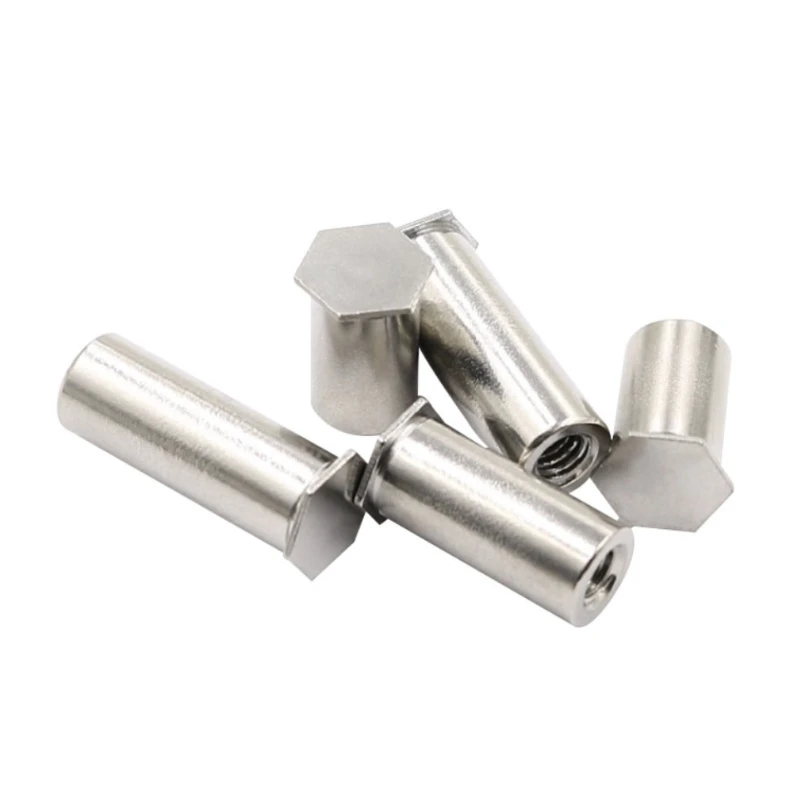
Blind Hole Press-Fit Standoff Hexagonal Standoff Provides Accurate Board-to-Board Spacing
Hexagon Head · DIN
US$0.012 – 2.40MOQ 100 pieces

Dawson U. S. Straight Rod Terminal Block with Nut Unc Wire 316 Stainless Steel Extra Long Swage Stud
Extra Long Swage Stud · 1/8", 3/16"
US$0.35 – 0.59MOQ 10 pieces
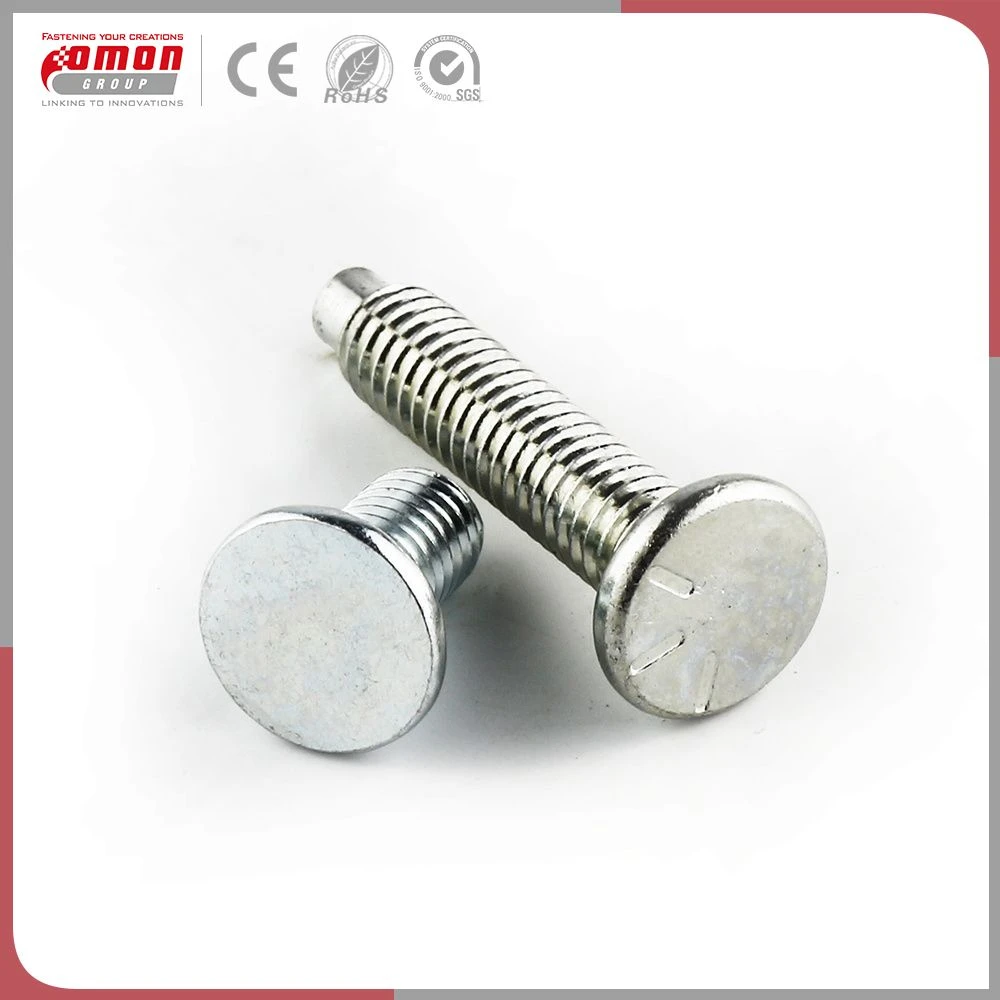
Eco-Friendly Building Self Clinching Studs Metal Fastener
Stud · Fasteners and Attachment Accessories 135
US$0.006 – 1.20MOQ 100 pieces

Pem Self Clinching Nuts Installation for Sheet Metal Ss Zi Cls for Stainless Steel M2 M2.5 M3 M4 M5 M6 M8 M10 M12 Metric
Round Head · DIN, GB
US$0.012 – 0.024MOQ 5,000 pieces
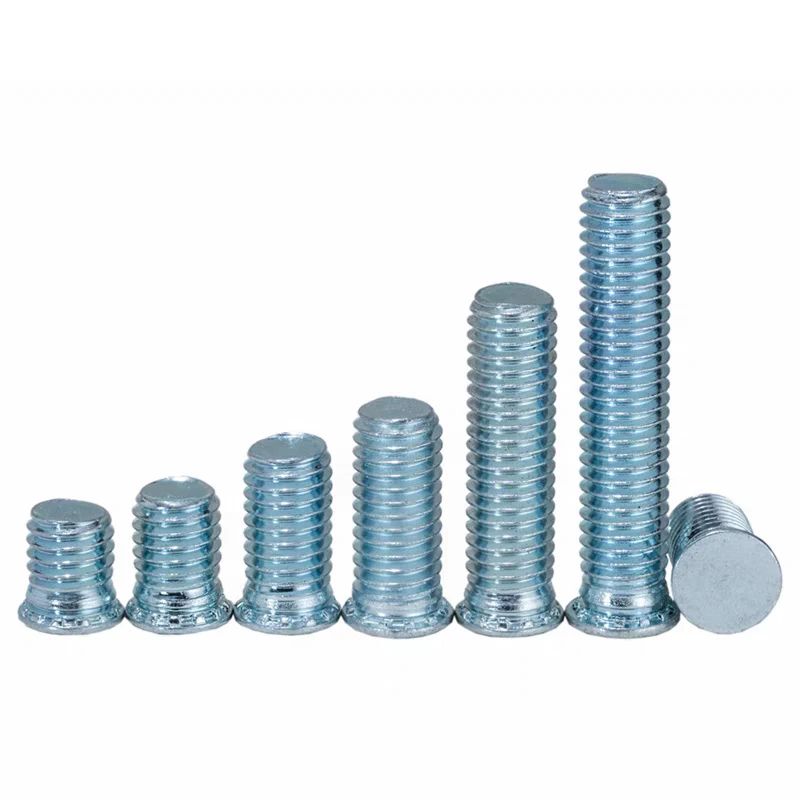
High Quality Carbon Steel or Stainless Steel Self Clinching Metric Thread Round Flush Head Stud Rivet Self-Locking Screw
Round Head · DIN, GB, ANSI, JIS
US$0.096 – 0.12MOQ 5,000 pieces
View all Self-Clinching, Press-Fit & Swage Fasteners → Full product catalog
How to Specify Self-Clinching Standoffs for Sheet Metal for Your Application
- Size: Match the nominal size to the mating thread or hole. This product spans M2.5–M3.5; check the full table below for the exact dimensions of each size.
- Locking & grade: Match the strength grade to the bolt, and choose a locking style (nyloc, all-metal, serrated flange) if the joint sees vibration.
- Environment: For damp, coastal or chemical exposure prefer A4/316 stainless or a suitable coating; indoors, plated steel or A2 is usually sufficient.
- Standard: This product is supplied to Trade series (self-clinching sheet-metal standoffs). Quoting the standard on your order guarantees interchangeable dimensions between suppliers.
Installation & Assembly Practice
- Run the nut down by hand before applying the wrench to catch cross-threading early.
- Tighten the nut rather than the bolt head where access allows — the torque-to-preload relation is more consistent.
- For locking styles, note that nyloc inserts are single-use in critical joints and lose grip above roughly 120 °C.
Common Selection Mistakes with Self-Clinching Standoffs for Sheet Metal
- Pairing a high-class bolt with a lower-class nut — the nut strips before the bolt reaches proof load; the nut class must meet or exceed the bolt class.
- Using a plain nut with a spring washer in severe vibration instead of a prevailing-torque locking nut.
- Re-using nyloc nuts in critical joints.
Where Self-Clinching Standoffs for Sheet Metal Are Not the Right Choice
Not on their own — they need a matching bolt or stud — and a plain nut is not a substitute for a locking type under heavy vibration.
Custom manufacturing · Made to drawing
Need a self-clinching standoffs for sheet metal outside the standard range?
Locking method is specifiable independently of the rest: nylon insert, all-metal deformed thread, serrated flange, or none. Made by cold heading or tapping.
Minimum order from 2,000 pieces; samples within 7 days of drawing approval.