
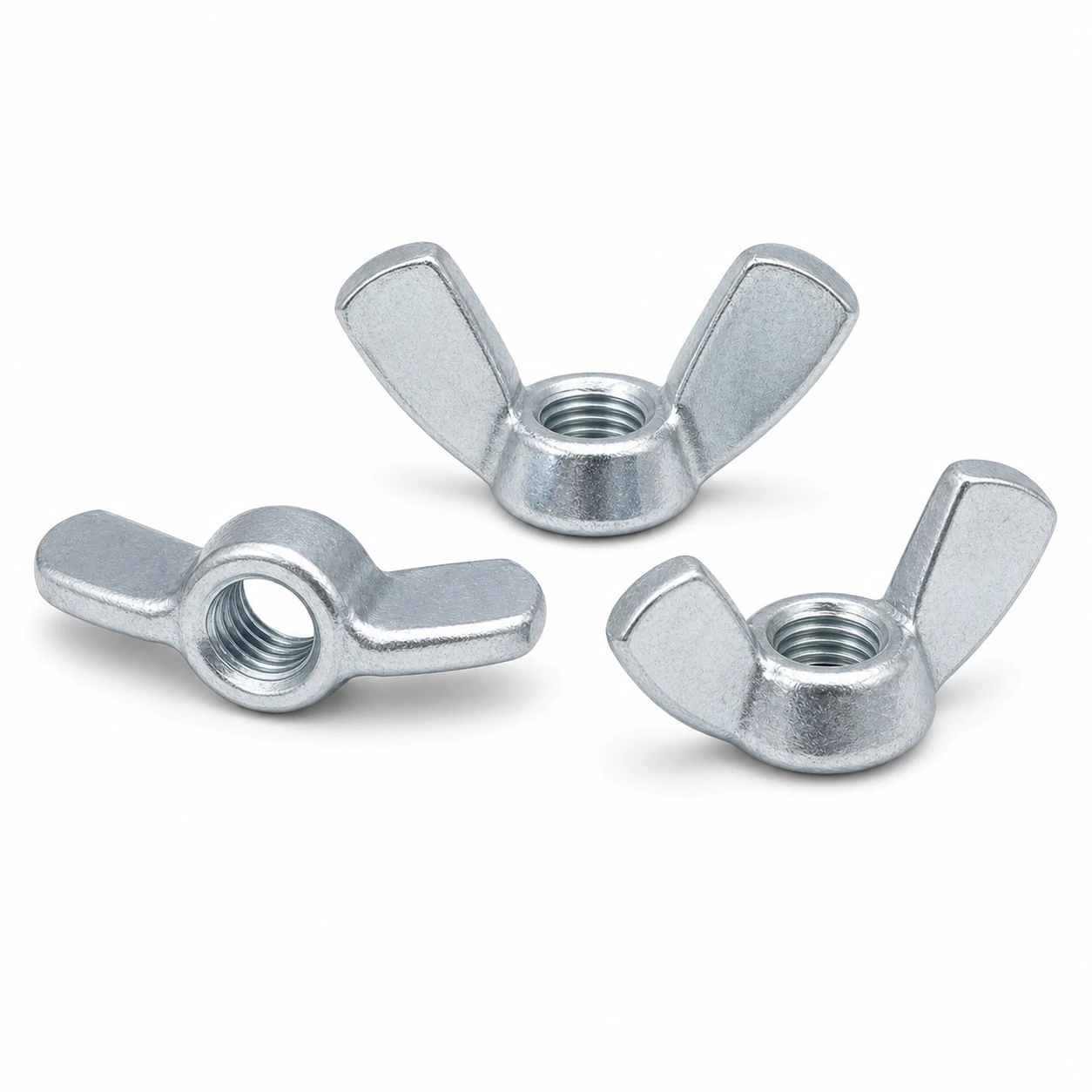
For wing nuts in Grade 12.9 Steel, the controlling selection factors are corrosion exposure, strength requirement and service temperature. The grade data for Grade 12.9 Steel (class 12.9) is summarized below together with every size supplied.
Why Choose Grade 12.9 Steel for Wing Nuts
The highest common strength class, for high-load machine assembly. For wing nuts, this matters when requires plating or black-oxide protection is the primary requirement.
Mechanical & Physical Properties
| Grade designation | class 12.9 |
|---|---|
| Magnetic response | Magnetic |
| Service temperature | up to approx. +300 °C |
| Corrosion characteristic | Requires plating or black-oxide protection |
Corrosion Behavior in Service
Carbon and alloy steel wing nuts require a coating for corrosion protection. Zinc plating (with or without passivation) is the most common; hot-dip galvanizing is used for outdoor structural service; black-oxide is mainly a tarnish-prevention finish for tool-room use.
Galvanic & Galling Considerations
For wing nuts in steel, the dominant compatibility issue is hydrogen embrittlement at high property classes (10.9 and above) when electroplated. Plating must be followed by an appropriate baking treatment, or a non-electroplated finish (mechanical zinc, zinc flake) should be substituted.
Sizes of Wing Nuts Available in Grade 12.9 Steel
| Size | Pitch (mm) | Wing span (mm) | Wing height (mm) | Body height (mm) | Reference standard | Notes |
|---|---|---|---|---|---|---|
| M4 | 0.7 | 28 | 17 | 9 | DIN 315 | Hand-tightened wing nut |
| M5 | 0.8 | 32 | 19 | 10 | DIN 315 | Hand-tightened wing nut |
| M6 | 1.0 | 37 | 22 | 12 | DIN 315 | Hand-tightened wing nut |
| M8 | 1.25 | 45 | 27 | 15 | DIN 315 | Hand-tightened wing nut |
| M10 | 1.5 | 55 | 33 | 18 | DIN 315 | Hand-tightened wing nut |
| M12 | 1.75 | 64 | 38 | 22 | DIN 315 | Hand-tightened wing nut |